The best robot arms make it easier to explore AI, robotics, automation, and programming without committing to industrial-scale equipment. This roundup focuses on accessible kits with useful combinations of mechanical range, software support, vision features, and expansion options.
Whether you are building a classroom demonstrator, training an imitation-learning model, or developing a ROS-based prototype, these picks cover a range of capabilities and budgets.
Best 10 Robot Arms Picks for 2026
Advanced AI Pick

- 6DOF full-metal arm with 500 mm reach and 500 g payload
- K230 vision, voice control, and multimodal AI support
- LeRobot-compatible and open source for advanced development
Best For: University AI labs and embodied-AI development
Research Platform Pick

- Assembled 6DOF arm with gripper and 2.5 kg rated payload
- Approximately 754 mm reach and stated ±0.1 mm repeatability
- Supports open-source control, ROS 2, simulation, and LeRobot
Best For: Robotics research and manipulation experiments
Teleoperation Pick
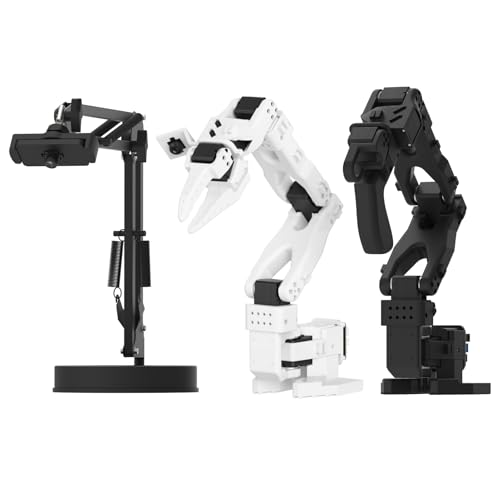
- Leader-follower teleoperation for collecting demonstrations
- Dual-camera setup supports manipulation and scene awareness
- LeRobot-compatible for imitation and reinforcement learning
Best For: Vision-action dataset creation and teleoperation
Compact STEM Pick
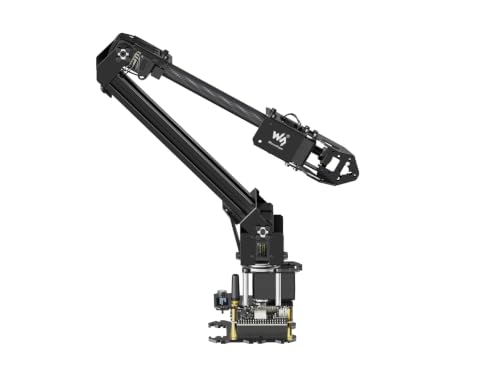
- Lightweight 4DOF arm with 0.5 kg payload at 0.5 m
- ESP32, wireless control, web app, and ROS2 compatibility
- Expansion plate supports custom end-of-arm tooling
Best For: STEM projects and lightweight mobile-platform builds
Best for VLA Development
HIWONDER SO-ARM101 Standard Kit

- LeRobot-compatible for AI training and deployment
- Dual cameras support vision-action data collection
- High-torque magnetic-feedback bus servos
Best For: Advanced VLA and imitation-learning projects
Best Open-Source Development Platform

- Includes a gripper and assembled arm kit
- Supports Python SDK, ROS1, and ROS2
- Open-source guides cover calibration and deployment
Best For: ROS-based AI robotics and STEM development
Best Starter AI Arm
HIWONDER SO-ARM101 Starter Kit

- Tutorial-focused package for new users
- LeRobot-compatible with leader-follower control
- Dual-camera setup supports AI vision tasks
Best For: Students beginning tabletop AI robotics
Advanced AI Learning Pick
SO-ARM101 Assembled Advanced Kit

- Assembled six-axis platform with 12 bus servos
- Dual-camera system for manipulation and awareness
- LeRobot-compatible with included debugging tools
Best For: Advanced AI research and imitation-learning projects
Full-Metal Embodied AI Platform

- Full-metal arm with 500 mm reach and 500 g payload
- K230 module offers 30+ vision features and voice interaction
- Supports LeRobot, Arduino, app, PC, and remote control
Best For: University labs and multimodal embodied-AI development
Accessible Open-Source Starter
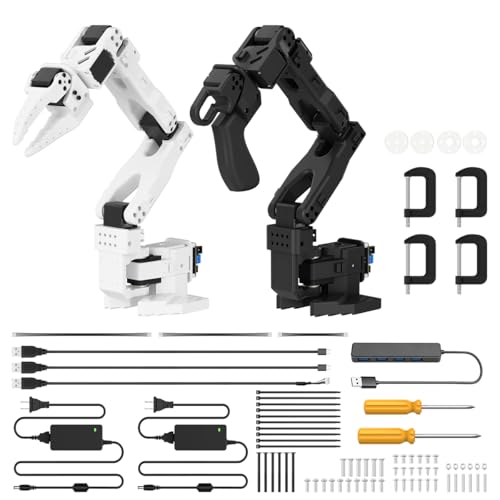
- Assembled six-axis arm for a simpler starting point
- Dual cameras and 12 magnetic-feedback bus servos
- LeRobot-compatible with BusLinker debugging support
Best For: Students and hobbyists beginning AI robotics
Advanced AI Pick – NexArm K230 6DOF Robot Arm
For buyers seeking robot arms for embodied-AI development, the NexArm Advanced Kit combines a full-metal 6DOF structure with onboard vision, voice interaction, and LeRobot compatibility. Its 500 mm reach, 500 g payload, and stated ±2 mm repeatability suit hands-on experiments, though this is an advanced platform rather than a beginner toy.
Best For: University AI labs, advanced robotics education, and developers training multimodal or imitation-learning systems.
Pros:
- Includes a 6 TOPS K230 vision module with more than 30 stated AI vision features.
- Supports LeRobot, ACT, VLA workflows, open-source code, Arduino, PC, app, and remote control.
- Full-metal construction, magnetic encoder servos, inverse kinematics, and curve smoothing support controlled motion.
Cons:
- The 500 g payload is modest compared with heavier research-oriented robot arms.
- Its adult, 15-and-up positioning and broad AI feature set may be excessive for simple STEM projects.
The NexArm stands out when vision, voice, and large-model experimentation matter as much as mechanical movement. Choose it if you want an expandable embodied-AI platform and are prepared for a more involved development experience.
Research Platform Pick – Seeed Studio reBot B601-RS
The Seeed Studio reBot B601-RS is one of the more research-focused robot arms in this roundup. It arrives assembled with a gripper, offers a manufacturer-rated 2.5 kg payload and approximately 754 mm reach, and provides a path into ROS 2, simulation, motor-control experiments, and LeRobot workflows.
Best For: Robotics researchers and developers who need an assembled arm for manipulation, simulation, and control-algorithm testing.
Pros:
- 2.5 kg rated payload and approximately 754 mm reach support more substantial manipulation work.
- Stated ±0.1 mm repeatability is useful for structured testing and repeatable motion planning.
- Open hardware and software, Python access, ROS 2, Pinocchio, MuJoCo, Isaac Sim, and LeRobot support.
Cons:
- Power supply is not included.
- LeRobot demonstration learning requires additional compatible hardware, including a leader arm, cameras, and computing equipment.
- The research-oriented software ecosystem requires setup and validation for each workflow.
With its higher payload and very tight stated repeatability, the reBot B601-RS is a strong choice for serious experimentation. Budget for the missing power supply and supporting hardware before treating it as a complete learning system.
Teleoperation Pick – Hiwonder SO-ARM101
The Hiwonder SO-ARM101 is designed for collecting the demonstrations that power learning-based robot arms. Its leader-follower teleoperation setup, dual-camera vision system, and LeRobot integration make it especially relevant for building vision-action datasets and exploring imitation or reinforcement learning.
Best For: Developers and educators creating teleoperation demonstrations, vision-action datasets, and LeRobot learning experiments.
Pros:
- Leader-follower operation can synchronously capture arm trajectories for training data.
- Combines a gripper-mounted camera with an external camera for manipulation and environmental awareness.
- Uses 12 high-voltage bus servos with magnetic feedback and includes visual PC debugging software.
Cons:
- Its learning-focused setup is more specialized than a basic desktop robot arm.
- The supplied notes do not specify payload, reach, or repeatability figures.
- Advanced teleoperation and dataset workflows may require additional setup and computing resources.
The SO-ARM101 makes the most sense when data collection is central to the project. Its camera and leader-follower configuration offer a practical route into imitation learning, while the open LeRobot ecosystem leaves room for further experimentation.
Compact STEM Pick – Waveshare RoArm-M2-S
The Waveshare RoArm-M2-S is a lightweight option for buyers comparing robot arms for STEM, prototyping, and mobile-platform projects. Its ESP32 controller, wireless control modes, visual web application, and open interfaces make it approachable for experimentation, while the 4DOF design keeps the system simpler than the AI-focused arms above.
Best For: STEM learning, secondary development, custom end-effectors, and mounting on mobile platforms.
Pros:
- Lightweight design weighs less than 850 g and supports a stated 0.5 kg payload at 0.5 m.
- 360-degree omnidirectional base creates a workspace with an approximately 1-meter diameter.
- ESP32 control, wireless and wired communication, ROS2 compatibility, tutorials, and open interfaces support customization.
Cons:
- The 4DOF layout offers less movement flexibility than the 6DOF arms in this roundup.
- The supplied notes do not list a repeatability specification.
- Its 0.5 kg at 0.5 m payload is intended for lighter tasks rather than heavy manipulation.
RoArm-M2-S is a sensible starting point for practical robotics learning and inventive desktop builds. Its expansion plate and wireless ESP32 control are particularly useful if you plan to add custom tooling or integrate the arm with another platform.
Best for VLA Development – HIWONDER SO-ARM101 Standard Kit
The HIWONDER SO-ARM101 Standard Kit is one of the more capable robot arms for developers working with LeRobot, imitation learning, and vision-action datasets. Its leader-follower teleoperation, dual-camera setup, and magnetic-feedback servos support hands-on experimentation with AI manipulation tasks.
Best For: Developers and advanced learners building VLA, imitation-learning, or reinforcement-learning projects.
Pros:
- Integrates with the LeRobot ecosystem, including community models, datasets, and simulations.
- Supports synchronous leader-follower teleoperation for collecting trajectory data.
- Includes gripper-mounted and external cameras for manipulation and environmental awareness.
- Uses 30KG, 12V bus servos with magnetic feedback for smoother, more stable motion.
Cons:
- Its focus on VLA and imitation learning may be more advanced than casual users need.
- Recommended for ages 16 and up, reflecting its technical learning focus.
Choose this version if camera-based data collection and a more complete development setup are priorities. The included visual software for servo scanning, monitoring, and trajectory control also makes debugging more manageable.
Best Open-Source Development Platform – reBot B601-DM Robotic Arm
The reBot B601-DM is a practical choice among robot arms for users who want an assembled platform with a gripper, Python SDK support, and ROS compatibility. Its open-source design and learning resources make it suitable for moving from basic grasping tasks into AI robotics research and development.
Best For: Robotics developers, STEM educators, and researchers using LeRobot, Python, ROS1, or ROS2.
Pros:
- Works with LeRobot and Hugging Face projects for imitation and reinforcement learning.
- Includes a gripper and an assembled arm kit for a faster start.
- Supports Python SDK, ROS1, ROS2, Linux, macOS, and Windows environments.
- Provides open-source assembly, calibration, testing, and deployment guidance.
Cons:
- 3D-printed parts are not included.
- The listed dimensions make it a relatively substantial tabletop setup.
This arm stands out for software flexibility and documentation rather than a dedicated camera system. Its leader-follower tracking, improved wiring, and Nvidia Jetson compatibility give developers several ways to build and test real-world robotics workflows.
Best Starter AI Arm – HIWONDER SO-ARM101 Starter Kit
The HIWONDER SO-ARM101 Starter Kit offers an accessible entry point into robot arms for learners exploring LeRobot, AI vision, and imitation learning. It retains the platform’s leader-follower workflow and dual-camera capabilities while adding tutorials intended to help new users begin with assembled hardware.
Best For: Beginners and students starting tabletop AI robotics or imitation-learning projects.
Pros:
- Integrates with LeRobot and supports algorithms such as ACT.
- Offers synchronous leader-follower operation for recording demonstrations.
- Includes gripper-mounted and external cameras for vision-based tasks.
- Comes with tutorials and assembled 3D-printed parts for a simpler start.
Cons:
- The Starter Kit may provide fewer included components than the Standard Kit.
- Its technical learning curve may still be significant for users new to robotics.
Consider this version when guided learning matters more than maximizing the included kit. It combines a 6DOF arm, high-voltage bus servos, AI vision recognition, and a tutorial-oriented package for building foundational skills.
Advanced AI Learning Pick – SO-ARM101 Assembled Advanced Kit
For shoppers comparing robot arms for hands-on AI research, the Hiwonder SO-ARM101 Advanced Kit offers an assembled six-axis platform with dual-camera vision, 12 high-torque bus servos, and LeRobot compatibility. Its included 3D-printed parts and debugging hardware make it a practical choice for exploring imitation learning without assembling the arm from individual parts.
Best For: Adult researchers, developers, and advanced hobbyists who want an assembled robot arm for programming, vision-based manipulation, and open-source AI experimentation.
Pros:
- Supports end-to-end imitation learning through the LeRobot open-source framework.
- Dual cameras provide gripper-level precision and broader environmental awareness.
- 12 magnetic-feedback bus servos are designed for smooth, stable motion.
- BusLinker V3.0 software supports servo scanning, monitoring, trajectory control, and calibration.
Cons:
- Its adult-oriented programming focus may be demanding for beginners.
- The plastic-and-metal construction is less industrial than a full-metal arm.
Choose this version if you value an assembled setup and a fuller package for AI learning. It is especially compelling when dual-camera perception and debugging access matter more than industrial payload specifications.
Full-Metal Embodied AI Platform – NexArm Standard Kit
Among robot arms aimed at serious development, the Hiwonder NexArm stands out with a full-metal body, a 500 mm reach, a 500 g payload, and stated ±2 mm repeatability. Its ESP32 and AT32 architecture, K230 vision module, and LeRobot integration support projects spanning inverse kinematics, imitation learning, multimodal AI, and voice interaction.
Best For: University labs, educators, and developers building embodied AI projects that need metal construction, vision features, multimodal control, and a documented programming platform.
Pros:
- Full-metal construction with magnetic encoder servos and inverse kinematics.
- Provides a 500 mm reach, 500 g payload, and stated ±2 mm repeatability.
- K230 vision module includes more than 30 AI vision features and supports voice interaction.
- Includes open-source code, schematics, tutorials, and PC, app, remote, and Arduino control.
Cons:
- The broad AI feature set may require substantial programming and setup knowledge.
- Its standard kit lists the NexArm robot arm but does not specify the additional expansion hardware.
NexArm is the strongest fit here for buyers prioritizing a more substantial mechanical platform and wider AI expansion options. Its stated reach and payload also make it easier to evaluate for practical grasping tasks than a kit without published figures.
Accessible Open-Source Starter – SO-ARM101 Starter Kit
If you are new to robot arms and want a guided entry into AI experimentation, the Hiwonder SO-ARM101 Starter Kit provides the same core six-axis concept, dual-camera vision, and 12 high-torque bus servos in a starter-oriented package. It arrives assembled with 3D-printed parts and works with the LeRobot open-source framework.
Best For: Adult beginners, students, and hobbyists learning programming, calibration, vision recognition, and imitation learning with an assembled platform.
Pros:
- Assembled design reduces the mechanical setup burden for new users.
- Dual cameras support both close-up gripper views and environmental awareness.
- Magnetic-feedback bus servos are designed to provide smooth, stable motion.
- BusLinker V3.0 enables servo scanning, status monitoring, trajectory control, and debugging.
Cons:
- The starter package is aimed at learning and may offer fewer advanced inclusions than the Advanced Kit.
- It is recommended for ages 16 and up, so it is not positioned as a young-child robotics toy.
This is the sensible SO-ARM101 choice when you want the assembled foundation and open-source learning path without specifically shopping for the Advanced Kit. It covers the essential hardware for programming and AI vision exploration while keeping the product focus straightforward.
How We Picked These Robot Arms
We focused on Robot Arms suited to education, prototyping, research, and serious maker projects. Key considerations included degrees of freedom, payload and reach potential, servo quality, frame construction, gripper design, controller compatibility, documentation, and support for common robotics software.
Because these kits serve different audiences, we also considered how much assembly and configuration they require. Some are better for quickly experimenting with AI and vision, while others are more appropriate for users who want an open platform for custom hardware and software.
Quick Comparison
| Best For | What to Prioritize | Typical Strength |
|---|---|---|
| AI and imitation learning | Camera support, SDKs, demonstrations, and model compatibility | Faster experimentation with embodied AI |
| ROS development | ROS1/ROS2 support, Python tools, and open documentation | Flexible research and integration |
| Classrooms and beginners | Clear instructions, assembled options, and reliable software | Lower setup friction |
| Advanced makers | Expansion ports, bus servos, and accessible hardware | Greater customization potential |
Key Buying Factors for Robot Arms
Degrees of Freedom and Reach
Four degrees of freedom can handle straightforward pick-and-place movements, but six-axis designs provide more natural orientation control and are better for demonstrations, manipulation, and complex trajectories. Check the working envelope as well as the advertised axis count.
Software and Compatibility
Software often matters more than the arm itself. Look for Python SDKs, example projects, APIs, and compatibility with platforms such as ROS or LeRobot. If you plan to train models, verify whether the kit supports data capture, teleoperation, camera input, and repeatable demonstrations.
Servos, Payload, and Construction
High-torque serial bus servos can provide better position feedback and coordinated control than basic hobby servos. A metal frame may improve durability, but it can also increase weight and cost. Confirm the real payload at the end of the gripper rather than relying only on motor specifications.
Assembly and Expansion
An assembled arm is convenient for rapid testing, while a kit can be more educational and easier to modify. Check whether the controller, power supply, gripper, camera, and mounting hardware are included. Expansion connectors are valuable if you expect to add sensors or alternate end effectors.
Who Should Buy Which Robot Arms?
Choose an AI-focused six-axis kit if your priority is imitation learning, computer vision, or embodied-AI experiments. Select an open-source arm with Python and ROS support if you expect to integrate custom software or research workflows. A four-axis ESP32-based kit is a sensible choice for compact desktop automation and electronics projects. Beginners should favor clear documentation and an assembled or well-supported package, while experienced developers can benefit from open hardware, flexible expansion, and accessible servo protocols.