The right eyepiece can make a telescope easier and more enjoyable to use, especially when you wear glasses or spend long sessions studying the sky. Long eye relief helps you see the full field without pressing your eyes against the lens.
This roundup compares 10 options across fixed focal lengths, wide-angle designs, zooms, and budget-friendly sets. Use the guide below to match magnification, field of view, and viewing comfort to your telescope and observing habits.
Best 10 Telescope Eyepieces with Long Eye Relief Picks for 2026
Comfortable Wide-Field Pick

- 13mm eye relief for comfortable sessions
- Immersive 70-degree apparent field
- Fully multi-coated five-element optics
Best For: Lunar, planetary, and general wide-field observing
High-Power Planetary Choice
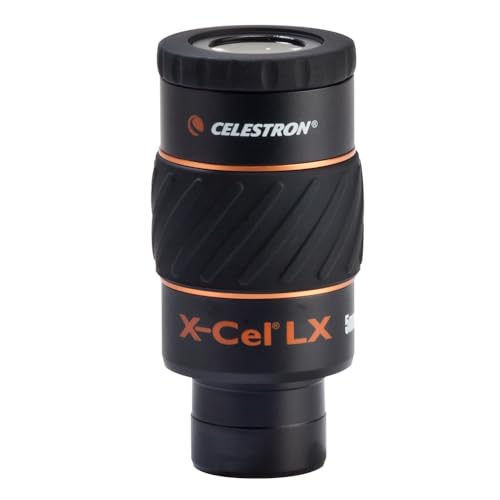
- Designed for high-power planetary views
- 60-degree field with six-element optics
- Twist-up eyeguard and filter-ready barrel
Best For: Planetary observing with compatible 1.25-inch telescopes
Immersive Long-Relief Option

- 15.6mm eye relief for comfortable viewing
- Immersive 82-degree apparent field
- Waterproof, argon-purged housing
Best For: Deep-sky clusters, nebulae, and comet observing
Versatile Multi-Focal-Length Set
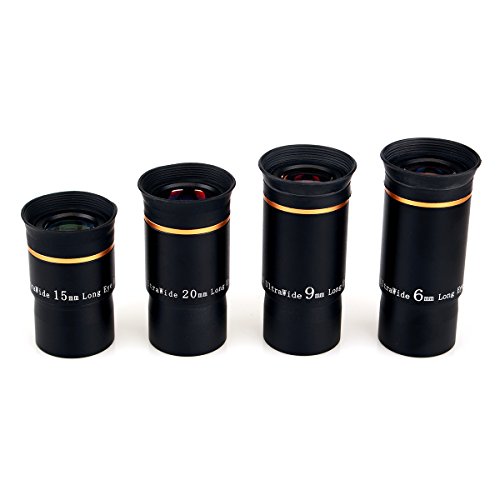
- Includes 6mm, 9mm, 15mm, and 20mm eyepieces
- 66-degree fields for broad lunar and deep-sky views
- Foldable eyecups can suit glasses wearers
Best For: Beginners building a versatile 1.25-inch eyepiece kit
Flexible Magnification Pick
Celestron 8-24mm Zoom Eyepiece

- Smoothly covers 8-24mm focal lengths
- Fully multi-coated optics with a 55° field of view
- Fits standard 1.25-inch eyepiece holders
Best For: Observers who want one versatile eyepiece instead of several fixed focal lengths
Glasses-Friendly Planetary Pick

- 17mm eye distance suits eyeglass wearers
- 6mm focal length for high magnification
- Wide 68° field with fully multi-coated optics
Best For: Comfortable lunar and planetary viewing at fixed high power
Maximum Eye Relief Pick

- Adjustable 16-33mm eye relief for glasses
- Smooth 7-21mm zoom replaces multiple eyepieces
- 1.25-inch fit with multi-coated seven-element optics
Best For: Eyeglass wearers seeking flexible, comfortable all-purpose viewing
Wide-Field Value Pick
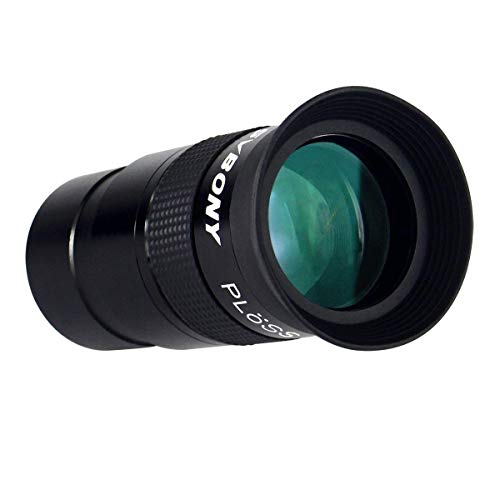
- 40mm focal length with a 40° apparent field
- Fold-down eye guard suits eyeglass wearers
- Fully multi-coated four-element optics
Best For: Wide-field lunar and deep-sky viewing
Most Versatile Pick

- 7.2–21.6mm adjustable zoom range
- 18–20mm eye relief with twist-up eyecup
- 42°–65° apparent field of view
Best For: Flexible viewing with fewer eyepiece changes
Wide-Angle Comfort Pick
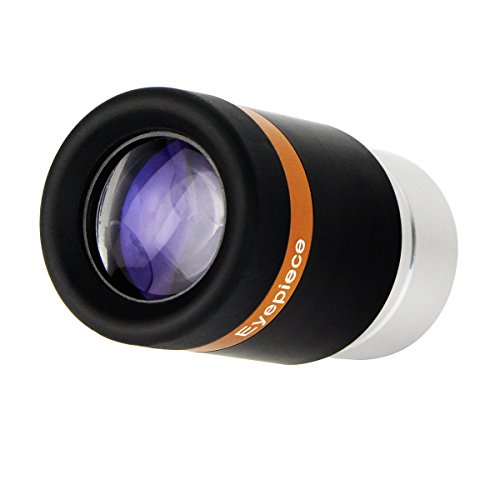
- 23mm focal length with a 62° apparent field
- Aspheric, fully coated optical design
- Large eyepiece diameter for comfortable viewing
Best For: Wide-angle celestial and scenery observation
Comfortable Wide-Field Pick – SVBONY SV154 15mm Eyepiece
For observers comparing telescope eyepieces with long eye relief, the SVBONY SV154 offers a practical balance of comfortable viewing and a broad 70-degree field. Its 15mm focal length suits general lunar, planetary, and wider-sky observing in telescopes with a 1.25-inch focuser.
Best For: Comfortable wide-field viewing of the Moon, planets, and general deep-sky targets.
Pros:
- 13mm eye relief with metallic twist-up eyecup helps make viewing more comfortable.
- 70-degree apparent field provides an immersive view.
- Fully multi-coated, five-element optics and blackened lens edges are designed to improve contrast.
- Safety undercut helps reduce the chance of slipping in the focuser or diagonal.
Cons:
- Its 13mm eye relief is comfortable but not especially generous compared with longer-relief designs.
- The 15mm focal length is a general-purpose option rather than a dedicated high-power planetary eyepiece.
The SV154 is a sensible choice when comfortable, moderately wide views matter more than maximum magnification. Its 1.25-inch format and included eye-comfort features make it an approachable everyday eyepiece.
High-Power Planetary Choice – Celestron X-Cel LX 5mm
The Celestron X-Cel LX 5mm is aimed at observers who want high-power planetary views without giving up practical eye comfort. Its 60-degree field, pop-up eyeguard, and grippy housing make it a useful option among telescope eyepieces with long eye relief for compatible 1.25-inch setups.
Best For: High-power planetary viewing and observers who appreciate an adjustable eyeguard.
Pros:
- Six-element fully multi-coated lens system supports the product’s planetary-viewing focus.
- 60-degree field offers a useful balance of magnification and viewing space.
- Twist-up rubber eyeguard can improve comfort and help increase contrast.
- Threaded 1.25-inch barrel accepts filters, while the rubber grip is easy to hold with gloves.
Cons:
- The 5mm focal length produces high power and may be demanding in less favorable seeing conditions.
- The supplied notes do not specify a numerical eye-relief measurement.
This eyepiece is best suited to a planetary-focused kit rather than as an all-purpose first eyepiece. The adjustable eyeguard and filter compatibility add useful flexibility for experienced observers.
Immersive Long-Relief Option – Explore Scientific 14mm 82°
The Explore Scientific 14mm 82° combines a generous 15.6mm eye relief with an expansive apparent field, making it one of the more compelling telescope eyepieces with long eye relief for deep-sky observing. Its sealed, argon-purged housing is also built for demanding outdoor use.
Best For: Deep-sky observers who want an immersive field for clusters, nebulae, and comet detail.
Pros:
- 15.6mm eye relief is generous for comfortable viewing and easier averted vision.
- 82-degree apparent field creates an immersive viewing experience.
- Argon-purged and waterproof construction adds environmental protection.
- EMD coatings, low-dispersion glass, blackened edges, and flat-black internal surfaces support contrast.
Cons:
- At 9 ounces, it is relatively substantial for a 1.25-inch eyepiece.
- The 82-degree design costs more space and weight than a simpler narrow-field option.
- The supplied warranty information specifies a limited USA one-year warranty when registered within 60 days.
Choose the 14mm 82° when field immersion and eye comfort are priorities. Its upper-medium power and focal-extender compatibility also give it room to grow in a broader observing setup.
Versatile Multi-Focal-Length Set – SVBONY Gold Line 6mm–20mm Set
For beginners or observers building a flexible kit of telescope eyepieces with long eye relief, this SVBONY Gold Line set covers 6mm, 9mm, 15mm, and 20mm focal lengths. The 66-degree fields, foldable eyecups, and 1.25-inch compatibility make it useful across lunar, planetary, and deep-sky sessions.
Best For: Beginners who want four magnification options in one 1.25-inch eyepiece set.
Pros:
- Four focal lengths cover high, medium, and wider viewing needs.
- 66-degree apparent field provides broader views than a basic narrow-field eyepiece.
- Foldable rubber eyecups can accommodate glasses wearers.
- Fully multi-coated and internally blackened optics are designed to improve transmission and reduce stray light.
Cons:
- The supplied notes describe the eye relief as good but do not provide a numerical measurement.
- The set’s 1.25-inch format is not intended for 2-inch focusers without suitable equipment.
- The 6mm eyepiece may require favorable observing conditions for comfortable high-power use.
This kit offers strong versatility for the price-conscious observer who needs several focal lengths at once. It is especially practical for learning which magnifications work best with a particular telescope.
Flexible Magnification Pick – Celestron 8-24mm Zoom Eyepiece
For observers comparing telescope eyepieces with long eye relief, the Celestron 8-24mm Zoom is a versatile option when convenience matters. Its smooth zoom range lets you adjust magnification without repeatedly changing eyepieces, while fully multi-coated optics are designed to support brightness, color, and contrast.
Best For: Stargazers who want one adjustable eyepiece for a broad range of magnifications and subjects.
Pros:
- Offers a continuous 8-24mm focal-length range with a 3:1 zoom ratio.
- Works with telescopes and spotting scopes using standard 1.25-inch eyepiece holders.
- Fully multi-coated optics and a 55-degree field of view.
- Includes a removable rubber eyecup, filter threads, T-threads, and a two-year U.S. warranty.
Cons:
- The supplied notes do not specify a long eye-relief measurement.
- A zoom eyepiece may not provide the same fixed focal length as a dedicated planetary eyepiece.
This is a practical space-saving choice for beginners or anyone building a compact eyepiece set. Choose it when smooth magnification changes and broad compatibility are more important than a documented long-eye-relief specification.
Glasses-Friendly Planetary Pick – SVBONY 6mm 68° Eyepiece
The SVBONY 6mm is a strong candidate among telescope eyepieces with long eye relief for observers who wear glasses. Its stated 17mm eye distance, 68-degree field of view, and 6mm focal length target comfortable high-magnification viewing of the Moon and planets.
Best For: Eyeglass wearers seeking a fixed high-power eyepiece for lunar and planetary observation.
Pros:
- Provides a stated 17mm eye distance for more comfortable viewing with glasses.
- 6mm focal length supports high magnification for lunar and planetary details.
- 68-degree wide-angle view helps with target acquisition and tracking.
- Fully multi-coated optics, a blackened interior, folding eyecup, and all-metal construction.
Cons:
- Fixed 6mm focal length offers less flexibility than a zoom eyepiece.
- High magnification can be more demanding of telescope conditions and alignment.
With its clearly stated eye distance and wide-angle design, this model is the most directly targeted option here for comfortable glasses-wearing use. It makes the most sense when planetary detail and a fixed high-power view are the priority.
Maximum Eye Relief Pick – Alstar 7-21mm Zoom Eyepiece
The Alstar 7-21mm Zoom stands out among telescope eyepieces with long eye relief because it specifies an adjustable 16-33mm range. That generous eye relief, combined with a smooth zoom and foldable eyecup, makes it a flexible choice for eyeglass wearers who want to move between planetary and deep-sky viewing without changing eyepieces.
Best For: Eyeglass wearers wanting adjustable magnification and extended comfort for varied observing.
Pros:
- Provides adjustable 16-33mm eye relief and a foldable rubber eyecup.
- Smoothly zooms from 7mm to 21mm to replace multiple fixed eyepieces.
- Uses a 7-element, 4-group multi-coated optical system with blackened lens edges.
- Offers a 30-47-degree apparent field of view and standard 1.25-inch compatibility.
Cons:
- Its apparent field of view varies from 30 to 47 degrees across the zoom range.
- The supplied notes identify multi-coated optics rather than fully multi-coated optics.
This is the clearest fit for buyers who prioritize documented long eye relief and zoom convenience together. Its 7-21mm range covers varied targets, while the adjustable eye-relief design is especially useful for extended sessions with glasses.
Wide-Field Value Pick – SVBONY 40mm Plossl
If you want telescope eyepieces with long eye relief for relaxed, wide-area viewing, this 40mm Plossl is a practical choice. Its 40° apparent field suits lunar observation, star clusters, nebulas, and other deep-sky targets, while the fold-down rubber eye guard is helpful for eyeglass wearers.
Best For: Broad-field lunar, cluster, and deep-sky viewing with a standard 1.25-inch telescope.
Pros:
- 40mm focal length and 40° apparent field support wide-field observation.
- Four-element, fully multi-coated optics with blackened interiors are designed for contrast and reduced stray light.
- Fold-down soft rubber eye guard accommodates eyeglass wearers and helps protect glasses.
- Metal construction, filter threading, and included storage case add practical convenience.
Cons:
- The fixed 40mm focal length does not provide zoom flexibility.
- Its 1.25-inch barrel limits compatibility to telescopes accepting that standard.
This is a straightforward low-power eyepiece for observers who prioritize comfortable, expansive views over magnification changes. The fold-down guard and filter compatibility make it especially easy to integrate into a visual observing setup.
Most Versatile Pick – SVBONY SV191 Zoom Eyepiece
For observers who want telescope eyepieces with long eye relief without repeatedly changing accessories, the SV191 combines a 7.2–21.6mm zoom range with 18–20mm eye relief. Its apparent field varies from 42° to 65°, giving you flexibility for different viewing targets.
Best For: Viewers who want adjustable magnification and comfortable use with or without glasses.
Pros:
- 7.2–21.6mm zoom range changes magnification without swapping eyepieces.
- 18–20mm eye relief and a twist-up rubber eyecup support extended viewing.
- Seven-element, four-group fully multi-coated optics are designed for sharp, high-contrast views.
- Accepts standard 1.25-inch filters and works with compatible telescopes and spotting scopes.
Cons:
- It is not parfocal, so refocusing is required after zooming.
- The zoom range has a variable apparent field of view rather than one fixed field.
The SV191 is the most adaptable option here, particularly for users who value convenience and long viewing comfort. Be prepared to refocus as you change focal length, but the broad range can simplify an observing session.
Wide-Angle Comfort Pick – SVBONY 23mm Aspheric Eyepiece
This 23mm aspheric eyepiece is worth considering if you want telescope eyepieces with long eye relief and an expansive view. Its 62° apparent field provides a broad perspective, while the large eyepiece diameter is designed to make viewing more comfortable during celestial and scenery observation.
Best For: Wide-angle views of bright celestial targets, scenery, and nebulas through a 1.25-inch telescope.
Pros:
- 23mm focal length and 62° apparent field offer a notably wide viewing perspective.
- Aspheric optical design and fully coated glass support light transmission and contrast.
- Large eyepiece diameter is intended to reduce viewing fatigue.
- Machined metal housing provides a solid, durable feel.
Cons:
- The fixed 23mm focal length does not offer zoom adjustment.
- Compatibility is intended for telescopes using a 1.25-inch, 31.75mm fitting.
This model emphasizes an immersive wide-angle experience rather than variable magnification. Its 62° field and large viewing area make it a sensible match for observers who prefer comfortable scanning of bright celestial objects and broad scenes.
How We Picked the Best Telescope Eyepieces with Long Eye Relief
We selected eyepieces that cover practical focal lengths and common 1.25-inch telescope formats, with attention to eye relief, apparent field of view, optical coatings, construction, and versatility. The list includes high-power planetary eyepieces, wider-field deep-sky options, zoom models, and multi-piece sets for beginners. Because published eye-relief specifications can vary by manufacturer, confirm the stated measurement and compatibility before buying.
Performance also depends on the telescope itself. A premium eyepiece cannot overcome poor collimation, unstable mounting, or excessive magnification for current seeing conditions.
Quick Comparison
| Type | Best Use | Main Advantage | Potential Trade-Off |
|---|---|---|---|
| Fixed short focal length | Moon and planets | Higher magnification | Needs steady skies and tracking |
| Wide-angle eyepiece | Deep-sky observing | More immersive view | Edge performance may vary |
| Zoom eyepiece | General-purpose viewing | Flexible magnification | Narrower field at higher power |
| Eyepiece set | New observers | Several focal lengths at once | Quality may be less consistent |
| Long focal length | Large nebulae and star fields | Bright, low-power views | May not suit light-polluted skies |
Key Buying Factors for Telescope Eyepieces with Long Eye Relief
Eye Relief and Glasses Use
Look for enough eye relief to see the entire field while wearing glasses; around 15mm or more is often more comfortable, though individual preferences differ. A twist-up or foldable eyecup can help position your eye consistently and block stray light.
Focal Length and Magnification
Calculate magnification by dividing your telescope’s focal length by the eyepiece focal length. Shorter eyepieces produce more power, while longer ones provide wider, brighter views. Avoid choosing maximum magnification solely by the telescope’s advertised limit.
Field of View and Optical Quality
A wider apparent field can make objects easier to follow and create a more immersive view, particularly with an undriven mount. Fully multi-coated optics can improve light transmission and contrast, but edge sharpness, distortion, and internal reflections still depend on the design.
Fit, Weight, and Compatibility
Most selections here use a 1.25-inch barrel, but verify your focuser size, available back focus, and diagonal clearance. Heavy wide-angle eyepieces may require rebalancing a small mount. A parfocal zoom can also reduce refocusing between magnifications.
Who Should Buy Which Telescope Eyepieces with Long Eye Relief?
Beginners building a first kit should consider a set or zoom for broad coverage with fewer purchases. Planetary observers should prioritize a comfortable short-focal-length eyepiece and use it only when atmospheric conditions support high power. Deep-sky viewers will generally benefit from a medium- or long-focal-length wide-angle model. Glasses wearers should prioritize verified eye-relief specifications over field width or low price.
For the best value, choose the focal lengths you will use most rather than collecting every available option. A balanced kit usually includes low, medium, and high magnification, with a comfortable long-eye-relief design for extended sessions.