Light readings are easier to capture and interpret when the meter uses a clear, generously sized display. The right model can help you check workspaces, position grow lights, evaluate photography setups, and troubleshoot uneven illumination.
This roundup compares 10 light meters with large displays, including compact handheld meters, rotating-sensor designs, split-sensor models, and options with backlighting or added temperature readings.
Best 10 Light Meters with Large Displays Picks for 2026
Best All-Around Choice

- 2.25-inch backlit LCD
- 180° rotating sensor
- Measures up to 200,000 lux
Best For: Plant, home, office, and automotive lighting checks
Best for High-Intensity Measurements

- Up to 400,000 lux
- Min/Max/Avg readings
- 9,999-count LCD with data hold
Best For: Bright LED and commercial lighting inspections
Best Split-Sensor Design
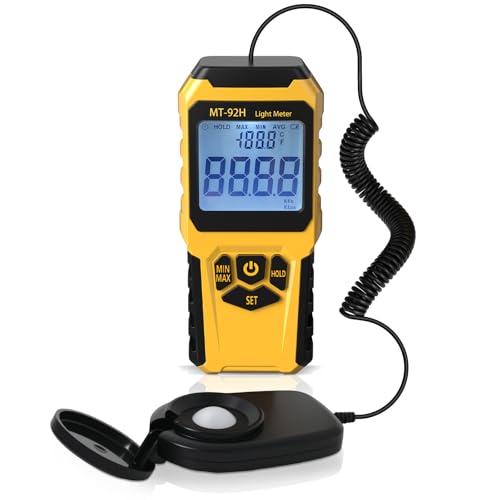
- Separate split-sensor probe
- 0–200,000 lux range
- Switchable high-visibility backlight
Best For: Flexible technical and professional measurements
Best Compact Option

- Large four-digit backlit LCD
- Up to 199,900 lux
- Compact with 0.5-second sampling
Best For: Portable home, office, agriculture, and photography checks
Best for Easy Setup
Extech LT40 White LED Light Meter
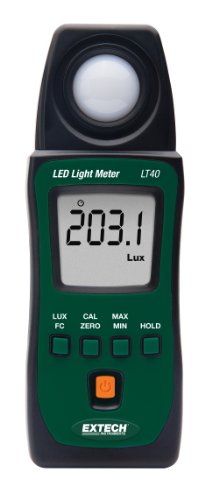
- Backlit 4000-count LCD
- Measures lux and foot-candles
- Data hold and auto power off
Best For: Portable light readings with a readable display
Wide-Range Pick
Digital Illuminance Meter with Color LCD
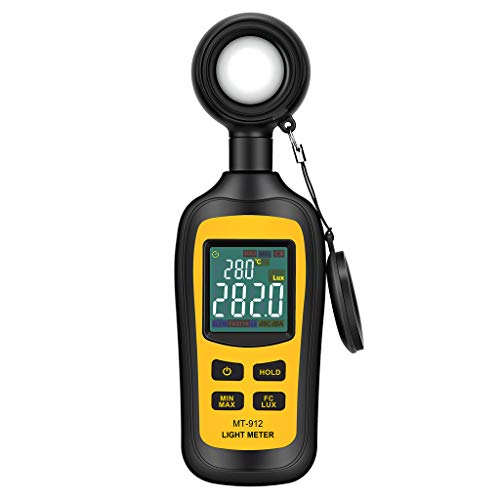
- 0–200,000 lux measurement range
- Four-digit color LCD
- Ambient temperature measurement
Best For: Indoor, workplace, and bright-light measurements
Peak-Reading Option
Dr.meter Digital Illuminance Light Meter

- 0–200,000 lux range
- Two readings per second
- Lux/FC conversion and peak recording
Best For: Plant lighting and brief high-intensity light checks
Best Overall Range
POROMETISTO 200,000-Lux Light Meter

- 0–200,000 lux and 0–20,000 FC range
- Backlit digital and analog display
- Data hold, MAX/MIN, and two-year warranty
Best For: Versatile indoor, outdoor, plant, and workplace measurements
Best Sensor Flexibility
DANOPLUS Rotating-Sensor Light Meter

- 360-degree rotating sensor
- Four automatic lux ranges up to 200,000
- Lux/foot-candle switching and MIN/MAX functions
Best For: Awkward-angle measurements in homes, offices, schools, and factories
Best for Plants and Photography
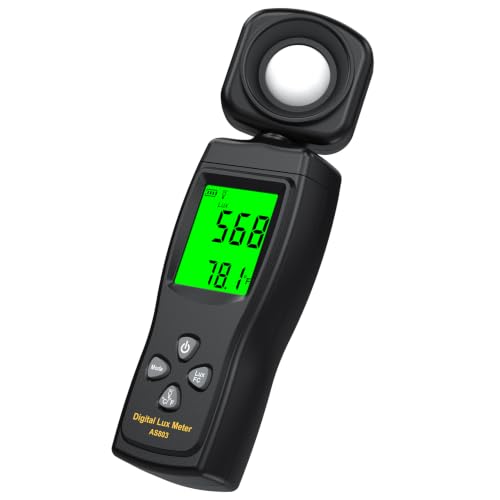
- Backlit LCD with 180-degree rotating sensor
- 0–200,000 lux range and 0.5-second sampling
- Adds Celsius/Fahrenheit temperature readings
Best For: Plant growth, photography, film, and indoor lighting checks
Best All-Around Choice – TopTes TS-710
For shoppers comparing light meters with large displays, the TopTes TS-710 combines a 2.25-inch backlit LCD with a rotating probe and a broad 0.1–200,000 lux measurement range. Its fast sampling and added temperature and humidity readings make it useful for routine checks around the home, office, workshop, or grow area.
Best For: Plant lighting, home and office LEDs, car headlights, and users who want light, temperature, and humidity readings in one meter.
Pros:
- Large backlit 2.25-inch LCD is easier to read in dim conditions
- 180-degree rotating sensor supports measurements from multiple angles
- Measures up to 200,000 lux and includes lux/foot-candle units
- Includes MAX/MIN, data hold, temperature, and humidity functions
Cons:
- Temperature readings may take time to adapt to a new environment
- Auto shut-off activates after 10 minutes of inactivity
The TS-710 is a versatile pick when display readability and flexible positioning matter. Its included case and three AAA batteries also make it ready for immediate use.
Best for High-Intensity Measurements – Triplett LT80
The Triplett LT80 is a practical option among light meters with large displays when you need to measure bright LED and other common light sources. It supports readings up to 400,000 lux, while its 9,999-count LCD and data-hold function help keep results visible during inspections.
Best For: High-intensity LED lighting, commercial lighting checks, and users who need min, max, and average readings.
Pros:
- Measures white LED sources up to 400,000 lux or 40,000 foot-candles
- Works with fluorescent, metal halide, high-pressure sodium, and incandescent sources
- Min/Max/Avg function summarizes key readings
- Data Hold freezes the displayed measurement
Cons:
- Its notes do not specify a backlit display
- It does not list temperature or humidity measurement
Choose the LT80 if maximum measurement capacity and statistical reading functions are more important than environmental extras. The auto-power-off feature can also be disabled when needed.
Best Split-Sensor Design – MT-92H Light Meter
The MT-92H stands out among light meters with large displays by pairing a separate split sensor with a switchable backlight. It measures up to 200,000 lux with 0.5-second refresh rates, making it convenient when the probe needs flexible placement or when lighting changes quickly.
Best For: Professional or technical measurements where a separate probe, quick updates, and readable results in dark or bright conditions are useful.
Pros:
- Split-sensor design allows flexible probe positioning
- Measures 0–200,000 lux with 0.1-lux resolution and ±3% accuracy
- Switchable backlight is designed for visibility in darkness or sunlight
- Also measures temperature in Celsius or Fahrenheit
Cons:
- The 188-gram weight is higher than some compact meters
- Its display backlight must be switched on when needed
The MT-92H is a strong fit for users who value probe flexibility and rapid measurement updates. Its compact profile and included three AAA batteries make it practical for field or workplace use.
Best Compact Option – UNI-T UT383
For a compact choice among light meters with large displays, the UNI-T UT383 offers a large four-digit LCD with backlight and a 0.5-second sampling time. It measures lux and foot-candles, while max/min, data hold, and overload indication support straightforward everyday checks.
Best For: Portable light checks in offices, homes, agriculture, laboratories, photography, and construction or street-lighting work.
Pros:
- Large four-digit LCD includes a backlight
- Measures up to 199,900 lux or 18,500 foot-candles
- Compact design with 0.5-second sampling
- Includes max/min, data hold, overload indication, and low-battery alerts
Cons:
- Its stated accuracy is ±(4%+8), lower than some listed alternatives
- It does not include temperature or humidity measurement
The UT383 is a sensible value-focused pick when portability and a readable backlit screen are priorities. Its broad application range makes it suitable for both household checks and light professional use.
Best for Easy Setup – Extech LT40 White LED Light Meter
For shoppers comparing light meters with large displays, the Extech LT40 offers a backlit 4000-count LCD in a compact, lightweight design. It measures lux and foot-candles and adds useful hold and auto-power-off functions.
Best For: Users who want a portable light meter with a readable backlit display and straightforward lux/foot-candle measurements.
Pros:
- Backlit 4000-count LCD display
- Measures both lux and foot-candles
- Data hold and auto power off
- Compact 4.9-ounce design with included AAA batteries
Cons:
- The supplied notes do not specify the measurement range or accuracy
- The notes identify additional electrical-testing features that may be unnecessary for basic light readings
The LT40 is a practical option when display readability and portability matter more than an extensively specified measurement range. Its backlight and data hold are especially convenient for quick checks in varied lighting conditions.
Wide-Range Pick – Digital Illuminance Meter with Color LCD
This handheld meter is a strong candidate for shoppers seeking light meters with large displays and broad coverage. It measures from 0 to 200,000 lux, includes a four-digit color LCD, and also measures ambient temperature.
Best For: Home, office, factory, and set-design users who need a broad lux range and an easy-to-read color display.
Pros:
- Measures illumination from 0 to 200,000 lux
- Four-digit color LCD screen
- Displays ambient temperature
- Includes minimum/maximum readings, data hold, and low-battery indication
Cons:
- Requires three AAA batteries
- Accuracy varies by range, from ±3% rdg ±8 digits below 10,000 lux to ±4% rdg ±10 digits above 10,000 lux
With its broad range and color screen, this model suits both routine indoor checks and brighter environments. The two-year warranty and compact 6.7-ounce build add practical value for regular use.
Peak-Reading Option – Dr.meter Digital Illuminance Light Meter
Among light meters with large displays, the Dr.meter model stands out for fast response and peak recording. It covers 0 to 200,000 lux, converts between lux and foot-candles, and is designed for indoor, outdoor, workplace, and plant-light checks.
Best For: Gardeners and practical users who want fast light readings, lux/foot-candle conversion, and peak-value capture.
Pros:
- 0–200,000 lux measurement range
- Fast readings at two measurements per second
- Switchable lux and foot-candle units
- Peak button records the highest light pulse value
Cons:
- Uses a 9V battery rather than AAA batteries
- The supplied notes do not specify display size, accuracy, or data-hold functionality
- At 12 ounces, it is heavier than some compact handheld options
The Dr.meter is a useful choice when response speed and peak capture are priorities. Its wide range and unit conversion also make it flexible for plant lighting, sunlight, and general environmental checks.
Best Overall Range – POROMETISTO 200,000-Lux Light Meter
For shoppers comparing light meters with large displays, the POROMETISTO stands out with a broad 0–200,000 lux range and a green backlight. Its combined digital and analog display, fast sampling, and practical recording functions make it suitable for checking everything from dim indoor areas to bright outdoor light.
Best For: Grow-light placement, office and warehouse checks, photography lighting, and outdoor lamp inspections.
Pros:
- Measures up to 200,000 lux and 20,000 foot-candles.
- Backlit digital and analog display supports quick reading in low light.
- Includes data hold, MAX/MIN recording, low-battery alert, and auto shutoff.
- Comes with batteries, sensor cap, lanyard, and a two-year warranty.
Cons:
- The stated ±(3% + 5 lux) accuracy is specified under standard incandescent lamps.
- Its sensor is not described as rotating, which may limit positioning flexibility.
This is a strong all-purpose choice if you want high measurement capacity, readable results, and useful logging features in a compact handheld meter.
Best Sensor Flexibility – DANOPLUS Rotating-Sensor Light Meter
The DANOPLUS is a practical option among light meters with large displays, especially when the sensor needs to be positioned independently. Its 360-degree rotating sensor, four measurement ranges, and four-digit LCD help simplify readings in homes, offices, schools, factories, and other work areas.
Best For: Measurements where flexible sensor positioning is more important than advanced environmental features.
Pros:
- Separate 360-degree rotating sensor helps aim the meter at the light source.
- Offers automatic range selection across 200 to 200,000 lux.
- Switches between lux and up to 20,000 foot-candles.
- Includes MIN/MAX, data hold, auto-power-off controls, and low-battery indication.
Cons:
- The four-digit LCD is described without a backlight.
- Its stated accuracy is ±4% ±10 digits, which is less precise than the POROMETISTO’s listed specification.
Choose this model when a rotating, detachable sensor can make awkward-angle measurements easier, such as checking overhead fixtures or enclosed spaces.
Best for Plants and Photography – Ohcans AS803 Light Meter
The Ohcans AS803 combines a 0–200,000 lux range with a backlit LCD and 180-degree rotating sensor, making it a useful choice among light meters with large displays. Its fast 0.5-second sampling, temperature readings, and hold/MAX/MIN modes add versatility for plant rooms, studios, offices, and other indoor environments.
Best For: Plant growth monitoring, photography and film lighting, and indoor environmental checks.
Pros:
- Measures up to 200,000 lux with a stated ±4% +10 accuracy.
- 180-degree rotating sensor and backlight support flexible, low-light measurements.
- Displays temperature in Celsius or Fahrenheit in addition to light readings.
- Samples every 0.5 seconds and includes hold, MAX/MIN, and low-power functions.
Cons:
- Requires three AAA batteries, one more than the other listed models.
- The sensor rotates through 180 degrees rather than a full 360 degrees.
- Temperature tracking adds utility but is not a substitute for a dedicated environmental monitor.
Its combination of a readable backlit display, flexible sensor, rapid sampling, and temperature mode makes the AS803 especially appealing for growers and photographers who need more than a basic lux reading.
How We Picked These Light Meters with Large Displays
We focused on practical features that affect everyday measuring: display readability, measurement range, refresh speed, sensor positioning, unit selection, portability, and ease of operation. The models here generally measure illuminance in lux, with several also supporting foot-candle readings. We also considered useful extras such as backlights, rotating or remote sensors, hold functions, temperature measurement, and automatic or manual range selection.
A large screen matters most when you are working at arm’s length, checking readings in a dim area, or viewing the meter from an awkward angle. However, display size should be evaluated alongside sensor flexibility and measurement resolution rather than treated as the only quality indicator.
Quick Comparison
For the broadest coverage, look for a meter reaching 200,000 lux. That range suits bright indoor lighting, daylight comparisons, and many photography or horticultural tasks. Models with rotating sensors are convenient when the display must remain facing you, while split-sensor designs can make it easier to measure inside cabinets, near fixtures, or around obstructions.
Backlit displays improve visibility in darker environments, but they can consume more battery power. A fast refresh rate is useful when moving through a room or adjusting lights in real time. If you mainly need occasional checks, a straightforward four-digit display and simple controls may offer the best value.
Key Buying Factors for Light Meters with Large Displays
Display and Readability
Check whether the screen is backlit, high-contrast, and large enough to read without bringing the meter close to your face. A clear unit indicator is also important when switching between lux and foot-candle measurements.
Range and Resolution
Choose a range that matches your work. Up to 200,000 lux provides useful headroom, while fine low-light resolution is more valuable for offices, studios, and plant shelves. A hold function can preserve a reading when the display is difficult to view live.
Sensor Design
A 180- or 360-degree rotating sensor helps aim the detector while keeping the screen visible. A split sensor places the display and detector separately, which can be preferable for tight spaces or measurements around large fixtures.
Extra Functions
Temperature readings, auto-ranging, data hold, selectable units, and fast refresh rates can improve convenience. Prioritize features that fit your workflow rather than paying for specifications you will not use.
Who Should Buy Which Light Meters with Large Displays?
Choose a rotating-sensor meter if you frequently measure ceiling lights, grow lamps, or fixtures from changing angles. Pick a split-sensor model for cabinets, shelves, equipment bays, and other confined areas. A backlit option is the better choice for dim rooms or inspections where ambient light is inconsistent.
For general home, office, classroom, and workshop checks, a basic handheld meter with a large LCD and broad lux range should be sufficient. Photographers and lighting technicians may prefer faster refresh rates, clear unit switching, and strong high-light measurement capacity. Plant growers should prioritize usable low-light resolution and a sensor that can be positioned level with the leaves or canopy.