Good classroom lighting supports comfortable reading, clear presentations, and productive learning. A light meter helps teachers, facilities teams, and school administrators measure whether desks, whiteboards, and activity areas receive suitable illumination.
We selected 10 handheld models with useful ranges, readable displays, and classroom-friendly features. The guide below explains what matters most when choosing one for routine school lighting checks.
Best 10 Light Meters for Classrooms Picks for 2026
Best Overall
Dr.meter Digital Illuminance Light Meter

- 0–200,000 lux measurement range
- Fast readings with FC/lux conversion
- Peak recording and low-battery alert
Best For: Routine classroom light checks and peak-value measurements
Best for Data Logging
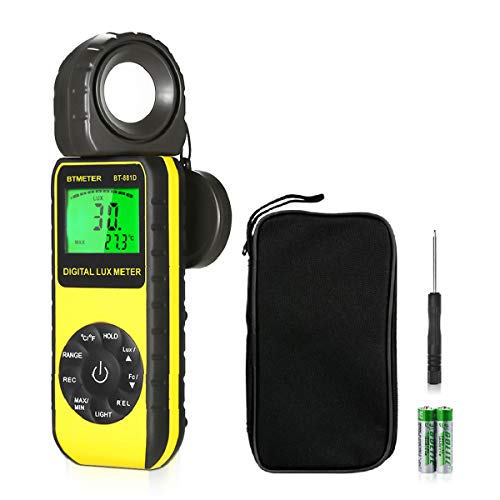
- Stores 33 sets of readings
- 270-degree rotating light sensor
- Measures up to 400,000 lux
Best For: Comparing lighting across rooms and measurement angles
Best for Readability
MT-92H Split-Sensor Light Meter
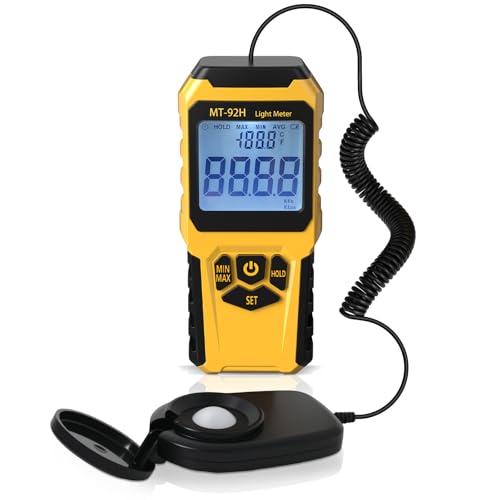
- Switchable backlit display
- Separate split-sensor design
- 0–200,000 lux range with ±3% accuracy
Best For: Classrooms needing flexible probe placement and easy viewing
Best Compact Option
BTMETER 881E Handheld Luxmeter
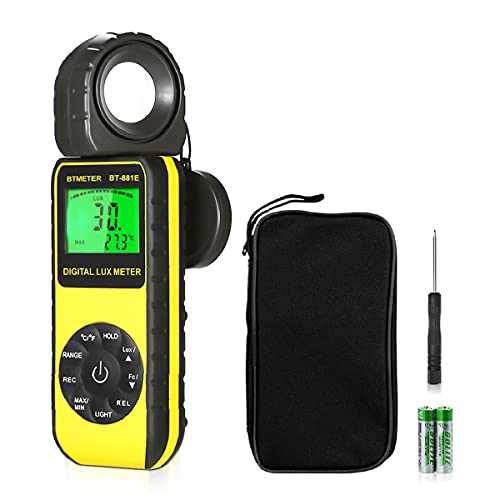
- Lightweight 5.5-ounce design
- 270-degree rotating sensor
- Stores 33 readings
Best For: Portable classroom-to-classroom lighting checks
Best Professional Pick
UNI-T UT383 Digital Light Meter

- Measures up to 199,900 Lux or 18,500 FC
- Backlit display with 0.5-second sampling
- Compact design with Max/Min and data hold
Best For: Portable classroom, lab, and facility checks
Best High-Range Option

- Reaches 200,000 Lux and 18,500 FC
- Automatic range conversion and large display
- Includes backlight, hold, Max/Min, and AAA batteries
Best For: Routine brightness surveys across school spaces
Best Resolution Value
Digital Luxmeter 200,000-Lux Meter

- Offers 0.1-Lux and 0.01-FC resolution
- Measures up to 200,000 Lux at ±4% accuracy
- Includes auto/manual range and hold functions
Best For: Detailed classroom and lab lighting checks
Reliable Classroom Basics
Compact 200,000-Lux Light Meter
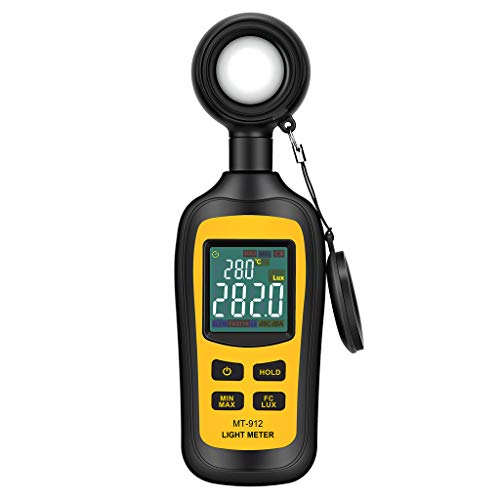
- Measures 0–200,000 lux and ambient temperature
- Offers MIN/MAX, data hold, and auto power-off
- Lightweight design with a two-year warranty
Best For: Routine classroom brightness checks and temperature monitoring
Range-Focused Classroom Pick

- Four ranges span 0–200,000 lux
- Includes maximum, minimum, and average readings
- Data hold supports recording classroom measurements
Best For: Comparing illumination across rooms and work areas
Flexible Positioning Choice

- 360-degree sensor adjusts toward the light source
- Four ranges measure up to 200,000 lux
- Includes MIN/MAX, data hold, and auto-ranging
Best For: Measuring lighting around fixtures, desks, and windows
Best Overall – Dr.meter Digital Illuminance Light Meter
For classrooms seeking practical light meters for classrooms, the Dr.meter Digital Illuminance Light Meter combines a broad 0–200,000 lux range with fast readings and simple FC/lux switching. Its compact, battery-powered design is suitable for checking lighting in learning spaces and other indoor areas.
Best For: Teachers and facilities staff who want straightforward classroom light checks with peak-value recording.
Pros:
- Measures from 0 to 200,000 lux and supports FC/lux conversion.
- Provides readings twice per second for quick measurements.
- Peak mode records the highest light pulse value.
- Includes a low-battery alert and 9V battery.
Cons:
- Uses a 9V battery rather than AAA cells.
- The supplied notes do not specify a backlit display or stored-reading memory.
Its wide range and uncomplicated controls make it a balanced choice for routine classroom lighting checks, especially when peak readings are useful.
Best for Data Logging – BTMETER BT-881D Light Meter
The BTMETER BT-881D is a strong option among light meters for classrooms when staff need to compare readings across rooms or locations. It offers a 0.01–400,000 lux range, a rotating sensor, and memory for 33 readings.
Best For: School staff comparing illumination at desks, work areas, windows, and different classroom angles.
Pros:
- Wide 0.01–400,000 lux and 0.01–40,000 FC measurement range.
- Samples two to three times per second with a stated 0.4-second response.
- 270-degree rotating sensor helps with angled measurements.
- Stores 33 readings and includes a relative measuring mode.
Cons:
- The supplied notes do not mention a backlit display.
- Accuracy varies by measurement range.
The rotating sensor and reading memory give this model a practical edge for systematic classroom surveys and side-by-side comparisons.
Best for Readability – MT-92H Split-Sensor Light Meter
The MT-92H focuses on easy viewing and flexible positioning, making it a useful choice for light meters for classrooms. Its split sensor, switchable backlight, and 0.5-second refresh rate support quick checks in bright, dim, or awkwardly positioned spaces.
Best For: Educators and maintenance teams who need a readable display and a separately positioned sensor.
Pros:
- Measures 0–200,000 lux with stated ±3% accuracy and 0.1-lux resolution.
- Refreshes readings every 0.5 seconds.
- Split-sensor design allows flexible probe positioning.
- Switchable backlight supports viewing in darkness or direct sunlight.
Cons:
- Uses three AAA batteries, which may require more replacements than a single-battery design.
- Its temperature measurement feature may be unnecessary for basic classroom lighting checks.
For classrooms where screen visibility and sensor placement matter, the MT-92H offers a particularly convenient combination of readability and measurement flexibility.
Best Compact Option – BTMETER 881E Handheld Luxmeter
The compact BTMETER 881E is a practical handheld choice for light meters for classrooms, combining a broad 0.01–300,000 lux range with quick sampling and a rotating sensor. Its smaller 5.5-ounce design is convenient for carrying between rooms.
Best For: Teachers, school technicians, and staff who want a portable meter for routine indoor measurements.
Pros:
- Measures 0.01–300,000 lux and 0.01–30,000 FC.
- Provides two to three samples per second with a stated 0.4-second response.
- 270-degree rotating sensor makes angled checks easier.
- Stores 33 readings and offers relative measurement mode.
Cons:
- The supplied notes do not specify a backlit display.
- Accuracy varies depending on the measurement range.
With its light weight, memory, and rotating sensor, the 881E is well suited to staff who regularly carry a meter from one classroom or office to another.
Best Professional Pick – UNI-T UT383 Digital Light Meter
For classrooms needing a compact, versatile tool, the UNI-T UT383 is one of the more capable light meters for classrooms. It measures illuminance in Lux or foot-candles, covers a broad range, and provides readings quickly on its backlit display.
Best For: Teachers, facility staff, and school labs that want a portable meter with professional-oriented measurement features.
Pros:
- Measures from 0 to 199,900 Lux and up to 18,500 FC.
- Offers Max/Min, data hold, overload indication, and a low-battery indicator.
- Uses a large four-digit LCD with backlight and a 0.5-second sampling time.
- Compact 5-ounce design is convenient to carry between rooms.
Cons:
- The stated accuracy is ±(4% + 8), so it is better suited to practical checks than highly exact calibration work.
- Operation depends on battery power.
The UT383 is a strong all-around choice when portability, quick readings, and a broad measurement range matter. Its included manual and available UNI-T user support add practical value for school use.
Best High-Range Option – S8608 200,000-Lux Light Meter
The S8608 is a practical choice for comparing brightness across classrooms and other school spaces. Among light meters for classrooms, it stands out for its 200,000-Lux maximum, automatic range conversion, and large-screen display.
Best For: Schools that need a straightforward meter for classrooms, halls, labs, and other indoor or outdoor areas.
Pros:
- Measures visible brightness up to 200,000 Lux or 18,500 FC.
- Supports Lux and FC unit switching with automatic range conversion.
- Includes Max/Min, data hold, backlight, auto power-off, and low-battery functions.
- Comes with three AAA batteries.
Cons:
- The supplied notes do not specify an accuracy rating.
- Its 4.6-ounce body is portable, but the notes do not describe a protective case.
With its wide range and school-focused use examples, the S8608 is well suited to routine brightness surveys. It is a sensible option when simple controls and included batteries are priorities.
Best Resolution Value – Digital Luxmeter 200,000-Lux Meter
This digital luxmeter offers a broad range and fine display resolution for checking lighting in classrooms. It is a useful candidate among light meters for classrooms when users want both Lux and foot-candle readings, plus manual control over the range.
Best For: Classroom, maintenance, and lab users who value 0.1-Lux resolution and flexible range settings.
Pros:
- Measures up to 200,000 Lux with stated accuracy of ±4%.
- Provides 0.1-Lux and 0.01-FC resolution.
- Supports Lux/FC units, auto or manual range, and a hold function.
- Samples readings twice per second and includes low-battery detection.
Cons:
- The required 9V battery is not included.
- Auto power-off occurs after approximately 15 minutes, which may interrupt longer checks.
- The supplied notes list a plastic construction without describing added protection.
This model is appealing for users who want more granular readings without giving up a 200,000-Lux range. Budget for a 9V battery before using it for classroom inspections.
Reliable Classroom Basics – Compact 200,000-Lux Light Meter
For classrooms that need a straightforward way to check brightness, this handheld meter measures from 0 to 200,000 lux and also records ambient temperature. Its compact design and practical readout make it a versatile option among light meters for classrooms.
Best For: Teachers, facility staff, and school offices that want a simple, broad-range meter with temperature readings.
Pros:
- Measures light from 0 to 200,000 lux.
- Provides ambient temperature measurements.
- Includes MIN/MAX readings, data hold, auto power-off, and low-battery indication.
- Lightweight 6.7-ounce design with a two-year warranty.
Cons:
- Requires three AAA batteries.
- Accuracy varies by measurement range.
This is a well-rounded choice for routine classroom checks, especially when portability and a temperature reading are useful alongside illuminance measurements.
Range-Focused Classroom Pick – BSIDE 200,000-Lux Tester
The BSIDE L1 gives school staff four selectable ranges for measuring classroom illumination, from 0–200 lux up to 200,000 lux. It also supports maximum, minimum, and average readings, making it useful for comparing light levels in different areas.
Best For: Classrooms, school maintenance teams, and teachers who want multiple reading modes for indoor lighting checks.
Pros:
- Four selectable ranges cover 0–200,000 lux.
- Provides maximum, minimum, and average readings.
- Includes data hold for recording measurements.
- Lists 0.1-lux resolution and ±4% accuracy.
Cons:
- Requires one 9V battery.
- The supplied notes do not specify a warranty or auto-power-off function.
With its range options and average-reading capability, the L1 is a practical fit for educators or facilities staff evaluating several classroom lighting conditions.
Flexible Positioning Choice – Rotating-Sensor Light Meter
The DANOPLUS DP-331 is designed for classroom measurements where sensor placement matters. Its separate 360-degree rotating sensor can be positioned toward the light source, while four ranges cover readings up to 200,000 lux.
Best For: Teachers and facilities staff measuring light around desks, fixtures, windows, or other awkward classroom locations.
Pros:
- 360-degree rotating sensor helps with positioning.
- Offers 200, 2,000, 20,000, and 200,000-lux ranges.
- Supports MIN/MAX readings, data hold, auto-range selection, and low-battery indication.
- Includes two AAA batteries and weighs 5.3 ounces.
Cons:
- Accuracy is listed as ±4% ±10 digits.
- The sensor’s separate design may require additional handling during measurements.
The rotating sensor is the standout feature for classroom use, offering more flexibility than a fixed sensor when checking illumination from different angles or locations.
How We Picked the Best Light Meters for Classrooms
We focused on practical tools for measuring illuminance in lux, with preference for models covering common indoor lighting levels and offering up to 200,000 lux for broader use. We also considered sensor flexibility, display readability, refresh speed, portability, and controls that make repeated measurements straightforward.
For classroom work, a meter does not need to be complicated. Consistent readings, a sensor that can be positioned accurately, and a screen that is easy to read in different conditions are usually more valuable than advanced features that are rarely used.
Quick Comparison
| Feature | Why It Matters |
|---|---|
| Measurement range | Allows checks from dim corners to bright windows and project areas. |
| Rotating or split sensor | Makes it easier to measure desks, walls, ceilings, and awkward angles. |
| Lux and foot-candle support | Useful when school guidelines or facility records use different units. |
| Large or backlit display | Improves readability during walkthroughs and low-light checks. |
| Fast refresh rate | Helps identify changes caused by blinds, daylight, or lighting controls. |
Key Buying Factors for Light Meters for Classrooms
Range and Accuracy
Choose a range that comfortably covers normal classroom illumination rather than operating at the edge of the meter’s limits. A broad range is helpful for comparing desks near windows with darker areas at the back of a room.
Sensor Positioning
A rotating or separated sensor can be more useful than a compact design because it lets you place the sensing head on the work surface while viewing the display from a comfortable angle. This is especially helpful when checking rows of desks consistently.
Display and Controls
Look for clear digits, simple unit switching, and accessible hold or maximum-reading functions. A backlight can help in dim rooms, although it may affect battery life. Automatic shutoff is useful for preserving power during storage.
Portability and Durability
School staff may carry the meter between several rooms, so a lightweight handheld body and protective case are worthwhile. Consider whether the controls and sensor feel sturdy enough for frequent use by multiple users.
Who Should Buy Which Light Meters for Classrooms?
For routine classroom audits: Choose a straightforward digital lux meter with a broad range, clear display, and dependable basic controls.
For facilities teams: A model with a rotating or split sensor, fast refresh, memory, or maximum-reading functions can make room-to-room surveys more efficient.
For teachers and school staff: Prioritize portability, readable digits, simple operation, and low maintenance over specialist features.
For wider environmental checks: Consider a unit that also reports temperature or supports foot-candle measurements if those readings are part of your building documentation.
Whichever model you choose, take readings at consistent desk height and in representative locations. Repeat measurements with blinds, lights, and screens in their normal positions so the results reflect how the classroom is actually used.