The best chemistry sets for classrooms make abstract concepts easier to understand through safe, structured, hands-on activities. The options in this roundup range from guided experiment kits to reusable lab equipment and molecular model sets.
Use the buying guide below to match your students’ age, curriculum, available supervision, and classroom budget with the right combination of materials.
Best 10 Chemistry Sets for Classrooms Picks for 2026
Best Beginner Experiment Kit

- 28 guided introductory experiments
- 48-page full-color science guide
- Includes core lab tools and chemicals
Best For: Ages 10–15 and beginner STEM activities
Best Classroom Labware Variety

- Includes 28 reusable lab pieces
- Multiple sizes for measuring and mixing
- Includes rack and dropper pipettes
Best For: Classroom lab stations and liquid-handling practice
Best Advanced Chemistry Curriculum

- More than 333 hands-on experiments
- 192-page manual with broad chemistry coverage
- Includes lab equipment, chemicals, and goggles
Best For: Supervised instruction for ages 12 and up
Best Measurement-Focused Set

- Five cylinders and five beakers
- Sizes range from 10 ml to 1,000 ml
- Reusable plastic with raised scales
Best For: Volume measurement and liquid-handling lessons
Best Complete Lab Station

- 57-piece station with lab vessels and tools
- Includes experiment cards and a full-color manual
- Non-hazardous chemicals; no borax
Best For: Elementary classroom demonstrations and guided STEM stations
Best Shared Tool Collection

- Includes multiple flasks, goggles, droppers, and test tubes
- Broad selection of basic plastic lab tools
- Designed for simple experiments with household materials
Best For: Small-group classroom activities and rotating lab stations
Best Molecular Modeling Set
444-Piece Organic Chemistry Kit

- Includes 136 atoms, 158 bonds, and fullerene parts
- Builds ball-and-stick and space-filling models
- Portable snap-lock design for classroom or lab use
Best For: Middle school through college molecular structure lessons
Complete Glassware Classroom Kit
37-Piece Glass Chemistry Lab Set

- 37 pieces across seven essential lab tool types
- Borosilicate glass with a three-tier plastic rack
- 10 ml–100 ml cylinders and 50 ml–1,000 ml beakers
Best For: Classroom labs, demonstrations, and science fairs needing assorted glassware
Advanced Molecular Modeling Collection

- Includes 444 atoms, bonds, and Fullerene parts
- Offers ball-and-stick and space-filling models
- Supports geometry, bond angles, and stereochemistry lessons
Best For: Middle school through graduate-level molecular structure instruction
Portable Molecular Structure Kit
136-Piece Student Molecular Model Set
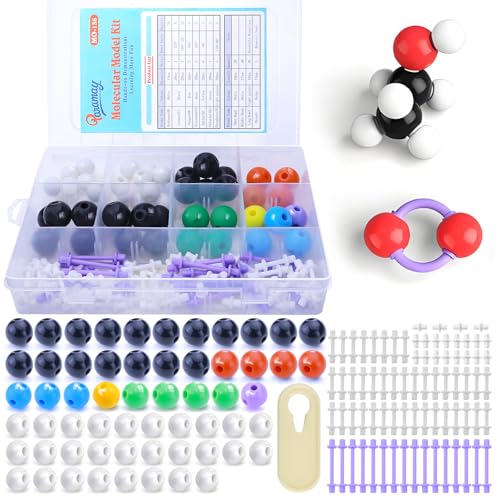
- Builds organic and inorganic chemical structures
- Includes C, H, O, N, and S atoms with single and double bonds
- Slim case and remover tool support classroom storage
Best For: Portable high school and college molecular modeling lessons
Best Beginner Experiment Kit – Chemistry C500
For buyers comparing chemistry sets for classrooms, the Thames & Kosmos Chemistry C500 offers a structured introduction through 28 guided experiments. Students can explore acids and bases, reactions among solids, liquids, and gases, foamy reactions, and invisible ink with the included equipment and chemicals.
Best For: Beginner chemistry instruction for students ages 10–15, especially guided STEM activities.
Pros:
- Includes 28 classic experiments covering several introductory chemistry topics.
- Full-color, 48-page manual provides setup instructions and explanations of results.
- Includes beakers, test tubes, chemicals, stoppers, and pipettes.
Cons:
- Designed for introductory rather than advanced chemistry study.
- Recommended for one player, so classroom use may require shared or rotating stations.
The C500 is a practical choice when clear instructions and approachable demonstrations matter more than a large experiment count. Its compact format can work well for small-group or teacher-led activities.
Best Classroom Labware Variety – 28-Piece Plastic Lab Set
For classrooms that need reusable equipment rather than a fixed lesson kit, this 28-piece plastic set provides graduated cylinders, beakers, Erlenmeyer flasks, test tubes, pipettes, and a rack. The range of container sizes supports measuring, mixing, transferring, and observing liquids during chemistry activities.
Best For: Classroom lab stations and repeated measurement or liquid-transfer exercises.
Pros:
- Includes multiple sizes of cylinders, beakers, flasks, test tubes, and pipettes.
- Plastic construction is lightweight, reusable, and break-resistant.
- Graduated containers support liquid measurement and observation.
- Test tube rack helps keep setups organized.
Cons:
- Does not include chemicals or a guided experiment manual.
- Plastic labware may be less suitable when instruction specifically requires glass equipment.
This set is best viewed as flexible classroom infrastructure. It gives teachers a broad selection of containers for demonstrations and student practice, but lesson materials and substances must be supplied separately.
Best Advanced Chemistry Curriculum – CHEM C3000
Among chemistry sets for classrooms, the Thames & Kosmos CHEM C3000 stands out for its depth: more than 333 experiments across 27 chapters, including inorganic, organic, and electrochemistry. Its 192-page manual and extensive equipment list make it suited to older students who are ready for sustained, hands-on study.
Best For: Advanced students ages 12 and up, high-school preparation, homeschool programs, and supervised classroom chemistry.
Pros:
- Offers more than 333 experiments across broad chemistry topics.
- 192-page manual explains procedures, chemical concepts, equations, and safety practices.
- Includes substantial lab equipment such as glass test tubes, beakers, an Erlenmeyer flask, burner, electrodes, and goggles.
- Includes chemicals for real reactions, with guidance on safety and waste disposal.
Cons:
- Adult supervision is required throughout.
- Its advanced scope may be excessive for younger beginners.
- Some experiments require common household additions.
The C3000 is the strongest option here for a comprehensive chemistry program rather than occasional demonstrations. Teachers should plan for close supervision, chemical safety procedures, and appropriate storage.
Best Measurement-Focused Set – Teenitor 10-Piece Labware Set
For chemistry sets for classrooms focused on measurement skills, the Teenitor set supplies five graduated cylinders and five beakers in sizes ranging from 10 ml to 1,000 ml. Its reusable plastic construction and raised scales make it useful for repeated measuring and liquid-handling activities.
Best For: Classroom lessons on volume measurement, comparison, and basic liquid-transfer practice.
Pros:
- Provides five graduated-cylinder sizes and five beaker sizes.
- Raised, double-sided scales are designed for repeated visibility.
- Plastic is described as reusable, acid resistant, and alkali resistant.
- Hexagonal cylinder bases improve stability during use.
Cons:
- Contains measurement vessels only, with no test tubes, chemicals, or experiment guide.
- It may not cover activities requiring specialized chemistry equipment.
This is a focused labware purchase rather than a complete experiment kit. It makes sense for teachers building measurement stations or supplementing an existing chemistry curriculum with durable plastic vessels.
Best Complete Lab Station – Ooze Labs Chemistry Station
For classrooms seeking chemistry sets for classrooms with a ready-to-use lab setup, the Ooze Labs Chemistry Station offers a colorful, hands-on format for ages 6 and up. Its 57 pieces support activities such as glowing slime, fizzing reactions, bubbles, and chromatography.
Best For: Elementary-age classroom demonstrations and guided STEM activity stations.
Pros:
- Includes a large chemistry station, beakers, test tubes, flasks, pipettes, and other lab tools.
- Experiment cards clip onto the station for convenient reference.
- Includes a 16-page, full-color manual with experiments and scientific explanations.
- Uses non-hazardous chemicals and does not contain borax.
Cons:
- The activities require classroom supervision and preparation.
- The large station may take more storage space than a basic tool set.
This is the most complete option for teachers who want an engaging visual lab centerpiece with materials and experiment guidance included.
Best Shared Tool Collection – 39-Piece Kids Science Lab Kit
This 39-piece set is a practical choice for chemistry sets for classrooms when students need multiple basic tools for hands-on exploration. It includes flasks, beakers, graduated cylinders, test tubes, racks, droppers, goggles, magnifying glasses, tweezers, spoons, and funnels.
Best For: Small-group activities where several students need access to duplicate lab tools.
Pros:
- Includes four flasks, four pairs of safety goggles, and four droppers for group use.
- Provides varied equipment, including beakers, cylinders, test tubes, racks, and funnels.
- Made from thick plastic described as suitable for drops, spills, and rough play.
- Supports simple experiments using common household materials.
Cons:
- The supplied notes do not include experiment chemicals or a dedicated experiment manual.
- Teachers may need to plan activities and provide household materials separately.
Choose this kit when quantity and tool variety matter more than an all-in-one experiment curriculum, especially for rotating classroom groups.
Best Molecular Modeling Set – 444-Piece Organic Chemistry Kit
For chemistry sets for classrooms focused on molecular structure, this 444-piece model kit turns abstract concepts into tangible 3D builds. It includes 136 atoms, 158 bonds, and 150 fullerene parts for constructing structures from simple compounds to complex polymers.
Best For: Grade 7 through graduate-level lessons in organic chemistry, biochemistry, and molecular biology.
Pros:
- Supports both ball-and-stick and space-filling molecular models.
- Includes C60 fullerene components along with atoms and bonds.
- Embedded components are designed for straightforward assembly.
- Snap-lock construction makes the set portable between classroom, home, and lab.
Cons:
- This is a modeling tool rather than a kit with chemical reagents or experiment activities.
- Its educational value depends on teacher-led instruction or accompanying lessons.
This set is a strong fit for visualizing molecular geometry and bonding, particularly when students are ready for more advanced chemistry concepts.
Complete Glassware Classroom Kit – 37-Piece Glass Chemistry Lab Set
For classrooms that need hands-on equipment, the Frienda 37-piece set is a broad choice among chemistry sets for classrooms. It combines borosilicate glass beakers, flasks, test tubes, graduated cylinders, droppers, and stirring rods with a three-tier plastic rack, covering common measuring, mixing, transferring, and holding tasks.
Best For: Middle school and high school labs, science fairs, demonstrations, and home chemistry projects needing assorted glassware.
Pros:
- Includes 37 pieces across seven essential tool types.
- Offers graduated cylinders from 10 ml to 100 ml and beakers from 50 ml to 1,000 ml.
- Uses clear borosilicate glass with a blue plastic test-tube rack.
Cons:
- The glass components may require careful handling and storage in classroom settings.
- Its broad assortment may include more equipment than a lesson requiring only basic models or measuring tools.
This is a practical all-in-one option for teachers who want varied glassware without assembling a kit piece by piece. Its range of sizes also makes it adaptable to different classroom activities and science-fair displays.
Advanced Molecular Modeling Collection – 444-Piece Molecular Model Kit
The LINKTOR model kit takes a visual, hands-on approach to chemistry sets for classrooms. With 444 pieces, it supports ball-and-stick and space-filling models, helping learners examine chemical structures, bond angles, molecular geometry, and stereochemistry in three dimensions.
Best For: Grade 7 through graduate-level instruction, teacher demonstrations, molecular geometry lessons, and advanced chemistry study.
Pros:
- Includes 136 atoms, 158 bonds, and 150 Fullerene C-60 parts.
- Supports both ball-and-stick and space-filling molecular models.
- Color-coded pieces and detachable connections support guided learning and reuse.
Cons:
- The 444-piece inventory may be more extensive than needed for introductory lessons.
- It focuses on molecular modeling rather than laboratory glassware or experimental procedures.
Choose this set when the goal is to make abstract molecular concepts visible and manipulable. Its unusually large inventory and Fullerene components give teachers room to demonstrate both foundational and more advanced structures.
Portable Molecular Structure Kit – 136-Piece Student Molecular Model Set
The 136-piece Matifaner kit is a compact option among chemistry sets for classrooms, especially where storage and transport matter. Color-coded atoms and assorted bonds let students build organic and inorganic structures, while the included remover tool and slim plastic case support repeated classroom use.
Best For: High school, college, and introductory classroom lessons that need a portable model set for organic and inorganic structures.
Pros:
- Includes 136 pieces for building simple through more complex structures.
- Contains C, H, O, N, and S atoms plus single and double bonds.
- Comes with a link-remover tool and slim storage box.
Cons:
- It has fewer pieces than the larger 444-piece LINKTOR set.
- The notes do not specify the full quantity of each atom or bond type.
This set is a sensible fit for teachers who want core molecular modeling capability in a smaller package. Its storage case and easy-connect pieces make it convenient for shared classrooms, textbook transport, and student practice.
How We Picked These Chemistry Sets for Classrooms
We selected a range of Chemistry Sets for Classrooms that support different teaching styles, ages, and lesson goals. The lineup includes guided experiment kits, plastic labware assortments, glass equipment sets, and molecular modeling systems. We considered the breadth of included materials, the potential for repeated use, clarity of instruction, suitability for demonstrations or student stations, and how well each type of kit supports foundational chemistry concepts.
Because classroom needs vary, no single set is ideal for every group. Teachers should confirm the recommended age range, experiment requirements, material quality, and safety instructions before purchasing or combining kits.
Quick Comparison
| Best for | Recommended kit type | Why it works |
|---|---|---|
| Structured introductory lessons | Guided experiment kit | Provides procedures, activities, and purpose-built components. |
| Everyday classroom stations | Plastic labware set | Lightweight, reusable, and generally easier to manage. |
| More realistic demonstrations | Glass lab kit | Offers familiar laboratory shapes and graduated vessels. |
| Atomic and molecular concepts | Molecular model kit | Makes bonding, structure, and three-dimensional shapes visible. |
| Early elementary exploration | Basic science activity set | Supports simple observation, measuring, mixing, and sequencing. |
Key Buying Factors for Chemistry Sets for Classrooms
Age, Curriculum, and Supervision
Choose activities that match students’ reading ability, motor skills, and chemistry background. Younger learners typically benefit from simple, highly supervised demonstrations, while older students may use molecular models or more detailed experiment guides. Review every activity for required chemicals, heat, glass, and protective equipment.
Component Quality and Quantity
Count the vessels, droppers, tubes, measuring tools, and connectors before buying. One kit may suit a teacher-led demonstration, whereas several identical kits may be needed for small groups. Plastic is often practical for high-use classrooms; glass can provide a more authentic lab experience but requires stricter handling and storage.
Instructional Value and Reusability
Guided experiments are useful when you need ready-to-teach lessons, but consumable materials may limit repeat use. Labware and molecular models generally support many units across several school years. Look for clearly labeled pieces, accessible instructions, and storage that keeps small components organized.
Safety and Classroom Logistics
Prioritize non-toxic, age-appropriate activities and establish procedures for goggles, cleanup, spills, and waste disposal. Avoid assuming that a child-focused label means no supervision is needed. Check the manufacturer’s safety guidance and your school’s science policies before use.
Who Should Buy Which Chemistry Sets for Classrooms?
Teachers introducing chemistry to younger students should favor simple experiment kits or basic plastic labware with straightforward demonstrations. Middle school classrooms may benefit from a guided kit paired with reusable measuring vessels. High school teachers covering bonding and molecular geometry should consider a 136- or 444-piece model kit, especially for lessons requiring multiple student groups. Classrooms seeking realistic equipment for demonstrations can choose a glass set, while budget-conscious programs or high-turnover stations may prefer durable plastic pieces. For the most flexible setup, combine a guided experiment kit with molecular models and a separate replenishable labware set.