Finding the right digital sound level meter depends on more than maximum decibel range. Display readability, weighting options, data logging, calibration support, and portability can make a major difference in real-world measurements.
We compare 10 practical options for checking noise in homes, classrooms, workshops, offices, and outdoor environments, from simple handheld readers to models with memory and export features.
Best 10 Digital Sound Level Meters Picks for 2026
Reliable Everyday Pick
Extech 407730 Digital Sound Level Meter

- 40–130dB range with 0.1dB resolution
- A/C weighting and fast analog bar graph
- Max/Min tracking, Max Hold, and windscreen
Best For: General noise checks and everyday sound measurements
Portable Value Choice

- 30–130dB range with ±1.5dB accuracy
- A/C weighting, FAST/SLOW response, and SONE mode
- MAX/MIN tracking, data hold, and windbreak
Best For: Portable home, office, classroom, and music noise checks
Certified Measurement Pick
SM-130DB Type 2 Sound Level Meter
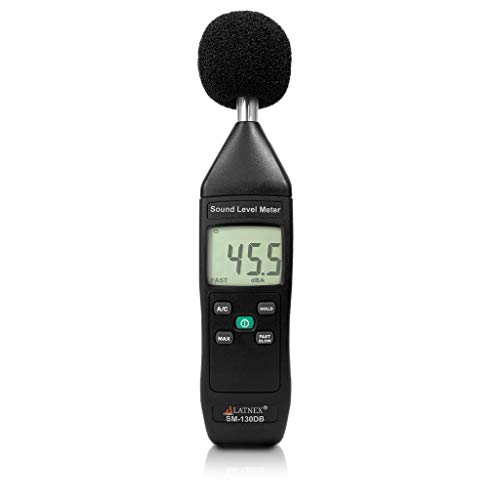
- EN 61672 Type 2 with calibration certificate
- 35–130dB range and 0.1dB resolution
- Includes 2-year warranty and technical support
Best For: Workplace, facility, environmental, and mechanical noise testing
Best for Data Logging
DANOPLUS DP-441 Data Logger Meter

- Records up to 43,000 readings with Excel export
- 30–130dB range with ±1.5dB accuracy
- Rechargeable battery, alarms, and A/C weighting
Best For: Long-term monitoring, reporting, and PC-based noise analysis
Best Overall
TopTes TS-501B Sound Level Meter

- 30–130 dB range with A/C weighting
- Large backlit 2.25-inch LCD
- MAX/MIN, data hold, batteries, and case included
Best For: General home, workshop, and workplace noise checks
Best Budget Pick
VL6708 LCD Digital Decibel Meter
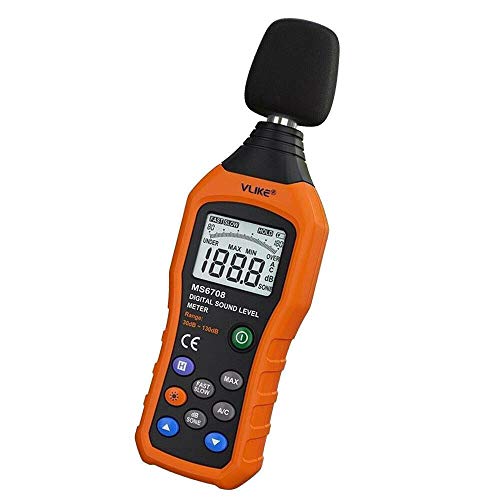
- 30–130 dB range with A/C mode
- Backlit display and automatic range selection
- Portable casing with power-saving features
Best For: Basic handheld environmental sound measurements
Best for Response Control
Tadeto SL720 Sound Level Meter
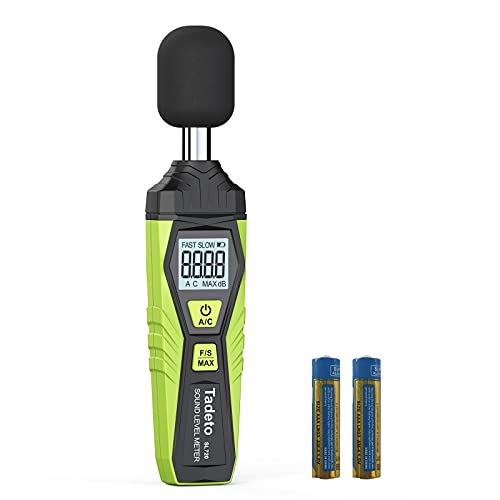
- Fast and slow response settings
- A/C weighting across a 30–130 dB range
- 0.1 dB resolution with backlit LCD
Best For: Changing household, industrial, and construction noise
Classroom & Home Pick
Versatile Digital Sound Level Meter

- 30–130 dB range with 0.1 dB resolution
- FAST/SLOW, MAX/MIN, and hold functions
- Backlit display and auto shutdown
Best For: Everyday noise checks in homes, schools, offices, and workshops
Large-Display Pick
Wall-Mountable Sound Level Meter

- Large red LCD display
- Wall-hanging design
- Digital decibel measurement
Best For: Stationary indoor monitoring where display visibility matters
Feature-Rich Pick

- 30–130 dB range with ±1.5 dB accuracy
- FAST and Type A weighting
- Hold, MAX/MIN, backlight, and auto-off
Best For: Portable monitoring with expanded readout and weighting features
Reliable Everyday Pick – Extech 407730 Digital Sound Level Meter
If you need a straightforward option among digital sound level meters, the Extech 407730 covers common noise-testing tasks with a 40–130dB range, 0.1dB resolution, and A/C weighting. Its fast analog bar graph and Max/Min tracking make changing sound levels easier to monitor.
Best For: General environmental, workplace, and equipment noise checks where simple controls and clear readings matter.
Pros:
- Measures 40–130dB with 2dB accuracy and 0.1dB resolution
- Provides A/C weighting and a fast-response analog bar graph
- Includes Max/Min recording, Max Hold, auto power-off, and a windscreen
Cons:
- Its 40dB lower limit is higher than some competing meters
- Runs on four AAA batteries rather than a rechargeable battery
The Extech 407730 is a practical choice when you want familiar sound-level functions without data logging or computer connectivity. Its included batteries and windscreen also make it ready for basic measurements.
Portable Value Choice – Goldeep SL750A Decibel Meter
The Goldeep SL750A is a compact option for digital sound level meters, measuring 30–130dB with ±1.5dB accuracy. It adds A/C weighting, FAST/SLOW response modes, and both dB and SONE displays for environmental noise and perceived loudness checks.
Best For: Home, office, classroom, construction-site, music, and general portable noise testing.
Pros:
- Wide 30–130dB measurement range with ±1.5dB accuracy
- Offers A/C weighting and FAST/SLOW response settings
- Tracks MAX/MIN values and includes data hold, a windbreak, and two AAA batteries
Cons:
- Does not list computer data export or long-term data logging
- Uses replaceable AAA batteries
With its lightweight design, anti-slip grip, clear LCD, and SONE mode, the Goldeep is well suited to routine checks around the home or workplace. Choose it when portability and flexible day-to-day testing are more important than advanced logging.
Certified Measurement Pick – SM-130DB Type 2 Sound Level Meter
For buyers comparing digital sound level meters for structured noise assessments, the SM-130DB offers a 35–130dB operating range, 0.1dB resolution, and ±1.8dB accuracy at 94dB and 1kHz. It is identified as an EN 61672 Type 2 meter and includes a calibration certificate.
Best For: Environmental and mechanical noise checks in workplaces, schools, warehouses, factories, offices, and other facilities.
Pros:
- EN 61672 Type 2 sound level meter with calibration certificate
- Measures 35–130dB with 0.1dB resolution
- Includes a 2-year warranty and technical support
Cons:
- Uses a 9V battery rather than a rechargeable power system
- Supplied notes do not list data logging or PC export features
The SM-130DB stands out for buyers who value a stated measurement standard, calibration documentation, and support coverage. It is a stronger fit for repeat facility or workplace assessments than for casual sound-level readings.
Best for Data Logging – DANOPLUS DP-441 Data Logger Meter
The DANOPLUS DP-441 is a feature-rich choice among digital sound level meters, combining real-time readings with storage for up to 43,000 data points. Its colored display, adjustable alarm, A/C weighting, and Windows PC export support are useful when noise needs to be reviewed over time.
Best For: Extended noise monitoring, threshold alerts, report preparation, and measurements that need PC analysis or Excel export.
Pros:
- Stores up to 43,000 readings and exports data to Excel through a PC
- Measures 30–130dB with ±1.5dB accuracy
- Includes A/C weighting, FAST/SLOW response, three-color alarms, and DC output
- Rechargeable 1,000mAh battery with approximately 1.5-hour charging
Cons:
- PC connectivity is specified for Windows 7, 10, and 11
- Its broader feature set may be more than needed for occasional checks
The DP-441 is the clearest choice here for documenting noise over time rather than taking isolated readings. Its logger, visual alarm system, and export functions make it particularly useful for recurring inspections and analysis.
Best Overall – TopTes TS-501B Sound Level Meter
Among digital sound level meters, the TopTes TS-501B stands out as a practical all-around option for home, workshop, and workplace checks. It covers 30–130 dB, supports A/C weighting, and displays readings on a large backlit screen.
Best For: General-purpose noise monitoring when you want a readable display, peak tracking, and included accessories.
Pros:
- Large 2.25-inch backlit LCD is easy to read in dim conditions.
- A/C weighting, 30–130 dB range, and stated ±1.5 dB accuracy.
- MAX/MIN readings and data hold help capture changing noise levels.
- Includes three AAA batteries, a user manual, and a carrying case.
Cons:
- Battery-powered design requires three AAA batteries.
- It is intended for portable readings rather than direct report generation.
Choose this model if ease of use and a complete starter package matter most. Its backlight, non-slip sides, automatic shutoff, and factory calibration make it a balanced choice for routine noise checks.
Best Budget Pick – VL6708 LCD Digital Decibel Meter
This compact option keeps digital sound level meters straightforward for real-time readings. The VL6708 measures from 30–130 dB, includes A/C modes and a backlight, and is designed for portable checks around homes, offices, schools, workshops, and roads.
Best For: Buyers seeking a simple handheld meter for general environmental and audio-related measurements.
Pros:
- 30–130 dB measuring range with A/C mode and automatic range selection.
- Backlight supports reading measurements in darker conditions.
- Power-saving circuit and backlight auto-off feature help conserve batteries.
- Drop-resistant casing is designed for portable everyday use.
Cons:
- Four AAA batteries are required and are not included.
- The device cannot keep or generate a report directly.
- Its supplied notes do not specify a measurement accuracy figure.
This meter makes sense when you need basic, on-the-spot sound monitoring without extra reporting functions. Factor the cost of four AAA batteries into your purchase.
Best for Response Control – Tadeto SL720 Sound Level Meter
The Tadeto SL720 is one of the more flexible digital sound level meters for changing noise conditions. It measures 30–130 dB, offers A/C weighting, and lets you switch between fast and slow response times for general environmental checks or more variable sound levels.
Best For: Users who want response-rate control for monitoring household, industrial, vehicle, and construction noise.
Pros:
- 30–130 dB range with stated ±2.0 dB accuracy and 0.1 dB resolution.
- A weighting suits ambient noise, while C weighting supports higher-intensity sound analysis.
- Fast and slow response settings accommodate different noise patterns.
- Backlit LCD, low-battery indicator, and included two AAA batteries improve convenience.
Cons:
- Its stated accuracy is lower than the TopTes model’s ±1.5 dB specification.
- The feature set may be more than needed for occasional basic readings.
Consider the SL720 when response speed is an important part of your measurements. The lightweight design and clear backlit display also make it practical for moving between locations.
Classroom & Home Pick – Versatile Digital Sound Level Meter
For everyday noise checks, this digital sound level meter covers a broad 30–130 dB range and offers practical controls for comparing changing sound levels. Its compact design, backlit display, and automatic range switching make it suitable for routine measurements around homes, classrooms, offices, roads, and workshops.
Best For: General-purpose noise checks in homes, schools, offices, workshops, and traffic areas.
Pros:
- Measures 30–130 dB with 0.1 dB display resolution and stated ±1.5 dB accuracy.
- Offers FAST and SLOW response modes, plus MAX/MIN readings and result hold.
- Includes a backlight, low-battery indicator, and automatic shutdown to help conserve power.
Cons:
- The listed measurement range begins at 30 dB, so quieter sounds may show UNDER.
- Automatic shutdown occurs after three minutes, which may interrupt longer unattended measurements.
This is a practical choice when you want a compact meter with more than basic live readings. The combination of response modes, peak/minimum tracking, and hold functionality makes it useful for comparing noise conditions without a complicated setup.
Large-Display Pick – Wall-Mountable Sound Level Meter
This digital sound level meter is designed around visibility, with a large red LCD display and a wall-hanging form. It is a straightforward option for locations where readings need to be easy to see from a distance, although the supplied details provide fewer feature specifications than the other meters in this roundup.
Best For: Fixed indoor locations that benefit from a large, easy-to-read decibel display.
Pros:
- Large red LCD display is intended to make readings easy to view.
- Wall-hanging design suits a stationary monitoring setup.
- Uses digital decibel measurement with automatic operation.
Cons:
- The supplied information does not specify accuracy, response modes, data hold, or backlight functions.
- At 0.6 kg, it is considerably heavier than the compact handheld options listed here.
Choose this model primarily for its display size and wall-mounted format rather than advanced measurement controls. It may fit a fixed monitoring point better than a portable, feature-rich field meter.
Feature-Rich Pick – RISEPRO HT-80A Decibel Meter
The RISEPRO HT-80A is a well-equipped digital sound level meter for checking, monitoring, and controlling noise in personal, household, business, study, and industrial settings. It combines a 30–130 dB range with MAX/MIN recording, data hold, a backlight, and selectable time weighting.
Best For: Portable noise monitoring when hold, peak/minimum readings, and backlit operation are useful.
Pros:
- Measures 30–130 dB with stated ±1.5 dB accuracy and a 31.5 Hz–4 kHz frequency range.
- Includes FAST 125 ms time weighting and Type A frequency weighting.
- Provides data hold, MAX/MIN readings, backlight, and automatic power-off functions.
- Comes with a black carrying pouch and premium color gift box.
Cons:
- The stated range begins at 30 dB, limiting readings below that level.
- The supplied details identify it as IPX5 waterproof, but do not describe conditions for prolonged water exposure.
Among these digital sound level meters, the HT-80A offers one of the more complete feature sets for portable use. Its weighting options and MAX/MIN functions are useful when sound levels fluctuate, while the pouch supports transport between testing locations.
How We Picked These Digital Sound Level Meters
We focused on meters that cover common measurement needs while offering useful differences in operation and features. Selection criteria included stated decibel range, A- and C-weighting support, display visibility, response or hold functions, portability, power options, and data-recording capabilities. We also considered whether each meter suits occasional household checks, repeated workplace measurements, or more structured monitoring.
These products are intended for practical sound-level measurements. They should not automatically be treated as substitutes for laboratory-grade instruments or certified occupational noise surveys where regulatory compliance is required.
Quick Comparison
| Best For | Features to Prioritize |
|---|---|
| Home and classroom checks | Simple controls, backlit display, data hold, and a broad 30–130 dB range |
| Workshops and equipment testing | A/C weighting, MAX/MIN readings, stable response, and a protective design |
| Noise documentation | Internal memory, data logging, rechargeable power, and computer export |
| Wall or fixed-position monitoring | Large display, alarm functions, and easy-to-read continuous readings |
Key Buying Factors for Digital Sound Level Meters
Measurement Range and Accuracy
A 30–130 dB range covers many everyday situations, including conversations, appliances, traffic, and workshop equipment. If you need to measure quieter rooms or very loud machinery, check the manufacturer’s stated lower and upper limits, accuracy, and resolution rather than relying on range alone.
Weighting and Response Settings
A-weighting approximates human hearing and is commonly used for general environmental and workplace checks. C-weighting captures more low-frequency content and can be useful around machinery, speakers, and bass-heavy sounds. Fast and slow response settings help capture short peaks or produce steadier readings.
Display, Controls, and Power
A backlit LCD is valuable in dim rooms and workshops. Data hold, MAX/MIN, auto power-off, and simple one-handed controls improve usability. For frequent use, consider rechargeable power or widely available batteries, along with battery-life information.
Logging and Export
Basic meters show a live reading, while data-loggers can preserve measurements for later review. If you need evidence of changing noise levels, verify memory capacity, sampling behavior, export method, and included cables or software before buying.
Who Should Buy Which Digital Sound Level Meters?
Choose a straightforward handheld meter if you only need quick readings around a home, classroom, office, or hobby space. A backlit display and data hold are more valuable in these situations than advanced logging.
For workshops, audio testing, and equipment checks, select a model with A/C weighting, MAX/MIN tracking, and a dependable measurement range. Buyers documenting noise over time should prioritize a dedicated data logger with substantial memory and convenient export. If readings must remain visible from across a room, a large-screen or wall-mountable design with an alarm may be the better fit.