Choosing the right tripod can make a bigger difference to image sharpness and video smoothness than almost any other accessory. If stability is your priority, the best stand will match your camera weight, shooting style, and travel needs.
Below, we focus on camera tripods for stability across lightweight, compact, and heavy-duty options so you can find a dependable setup without overspending.
Best 10 Camera Tripods for Stability Picks for 2026
All-Round Stability Pick
SmallRig 71" Aluminum Camera Ball Head Tripod & Monopod CT-10

- 33 lb vertical load rating for solid support
- Tripod-to-monopod conversion suits travel use
- 360° ball head and reversible center column add flexibility
Best For: Creators who want a stable travel tripod with extra shooting versatility
Travel-Friendly Stability Pick
K&F CONCEPT 75" Pentagonal Aluminum Tripod

- Pentagonal tube design emphasizes stability and portability
- 2.6 lb body folds to a compact 19.6 inches
- 75-inch max height with 3-way pan head and bubble level
Best For: Travelers and vloggers who want a lightweight, stable tripod
Heavy-Duty Height Pick
Victiv 85" Camera Tripod Monopod

- 28 mm aluminum legs and 38 mm ball head for added rigidity
- Supports up to 35 lb and reaches 85 inches
- Converts to monopod for flexible field use
Best For: Users needing a taller, heavy-duty tripod with strong stability
Budget Travel Pick
Amazon Basics 50-inch Lightweight Camera Tripod

- Weighs just 1.23 lb for easy portability
- 3-way head and bubble level aid basic setup
- Best suited to lighter camera gear up to 4.4 lb
Best For: Casual shooters who want an inexpensive lightweight tripod
Best for Easy Setup
Victiv T72 72" Tripod and Monopod Combo

- Lightweight 3.3 lb design with carrying bag
- Converts to a 55-inch monopod quickly
- 72-inch height with aluminum construction
Best For: Travelers and vloggers needing a flexible, portable support option
Compact Stability Pick
K&F Concept 64" Lightweight Travel Tripod

- 2.53 lb aluminum tripod folds to 15.5 inches
- 360-degree ball head for flexible panning
- Supports up to 17.6 lbs for stronger setups
Best For: Travel photographers and creators who want portability plus solid load support
All-Around Stable Stand
VICTIV 74" Camera Tripod with Phone Holder
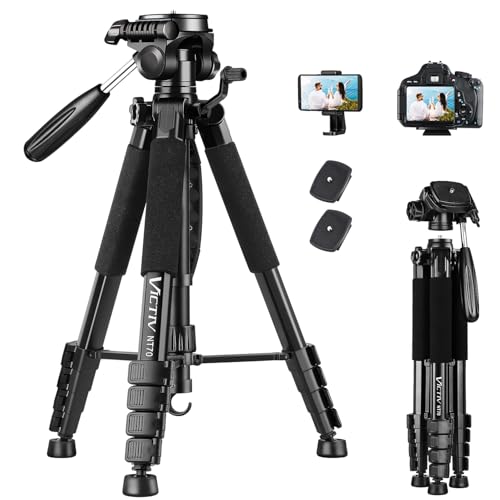
- 19-74 inch height range for flexible setup
- Non-slip pads and weight hook improve stability
- 3-way pan head handles multiple shooting angles
Best For: Video creators and photographers who want an adjustable tripod with stability extras
Heavy-Duty Video Stability Pick
NEEWER TP74 74" Fluid Head Tripod

- Double tandem aluminum alloy legs
- Fluid head with 360° rotation and tilt
- Max load 17.6 lb / 8 kg
Best For: DSLR and camcorder users needing a stable video tripod
Best Heavy-Duty Pick
XXZU 75" Camera Tripod with Remote

- Three-angle legs for uneven terrain
- Anti-slip feet with bottom hook stability
- Detachable center column for monopod use
Best For: Travelers and creators who shoot on uneven ground
Lightweight Tall Stability Pick
75" Heavy Duty Tripod for Devices

- Aircraft-grade aluminum legs with non-slip feet
- Hook for extra counterweight stability
- Folds to 20.8 inches and weighs 2.9 lb
Best For: Creators who need a tall tripod for travel and mixed devices
All-Round Stability Pick – SmallRig 71" Aluminum Camera Ball Head Tripod & Monopod CT-10
If you want camera tripods for stability without giving up flexibility, this SmallRig model is built for practical shooting on the go. Its magnesium aluminum alloy construction, 4-section legs, and wide stance help it stay planted, while the 360° ball head and reversible center column make it easy to frame low angles, macro shots, and standard compositions.
Best For: Creators who want a stable travel tripod that can also convert to a monopod.
Pros:
- Supports up to 33 lb vertically for a strong stability margin
- Converts into a monopod for hiking and travel use
- 360° ball head and inverted center column add shooting flexibility
- Adjusts from 16″ to 71″ and folds to a compact 16.9″
Cons:
- Telephoto lenses may need an additional mount ring for better balance
- Not water resistant
Overall, this is a well-rounded choice if you need a tripod that prioritizes steadiness but still adapts to different angles and field setups. It fits cameras, phones, and even projectors, making it useful for mixed content workflows.
Travel-Friendly Stability Pick – K&F CONCEPT 75" Pentagonal Aluminum Tripod
For buyers comparing camera tripods for stability on the road, this K&F Concept model stands out for its pentagonal tube design and compact folded size. It is lightweight enough for travel, yet still reaches 75 inches and includes a 3-way pan head with a bubble level for cleaner framing and more controlled movement.
Best For: Travelers, vloggers, and mobile creators who want a lightweight tripod with a stable feel.
Pros:
- Pentagonal tube design is engineered for stability and portability
- Lightweight 2.6 lb build with a compact 19.6″ folded size
- Extends from 18.9″ to 75″ for flexible shooting heights
- Includes Bluetooth remote and phone/tablet compatibility
Cons:
- 8.8 lb weight limit is lower than heavy-duty options
- Not water resistant
This is a smart choice if portability matters as much as steadiness. It is especially practical for travel, live streaming, and casual video work where easy setup and consistent framing are more important than heavy rig support.
Heavy-Duty Height Pick – Victiv 85" Camera Tripod Monopod
If your priority is camera tripods for stability on uneven ground or with heavier gear, this Victiv model leans hard into support. Its 28 mm aluminum leg tubes, 38 mm ball head, twist locks, and non-slip rubber feet are all designed to reduce shaking while giving you a tall working range up to 85 inches.
Best For: Users who want a taller, heavier-duty tripod for cameras, phones, and specialty optics.
Pros:
- Heavy-duty aluminum build with thicker 28 mm leg tubes
- Supports up to 35 lb while remaining relatively portable
- Tripod converts to a monopod with reversible center column and detachable leg
- 360° panoramic shooting and +90°/-70° tilt expand composition options
Cons:
- Heavier than lightweight travel tripods at 3.7 lb
- Folded size details are less straightforward than simpler compact models
This is the strongest stability-focused option in the group for taller shots and more demanding setups. It suits photographers who want more rigidity, more height, and the flexibility to switch between tripod and monopod use.
Budget Travel Pick – Amazon Basics 50-inch Lightweight Camera Tripod
For simple camera tripods for stability on a budget, this Amazon Basics stand covers the essentials without adding much weight or bulk. The aluminum build, lever-lock legs, bubble level, and 3-way head make it easy to set up for basic photos and video, especially when portability matters more than advanced load capacity.
Best For: Casual shooters who want an affordable, lightweight tripod for travel and everyday use.
Pros:
- Very light at 1.23 lb for easy carrying
- 3-section lever-lock legs simplify quick height changes
- Built-in bubble level helps with basic alignment
- Comes with a quick-release plate and storage bag
Cons:
- 4.4 lb weight limit is not suited for heavy DSLR setups
- Not recommended for long lenses or large telescopes
This is a straightforward option when you need a lightweight tripod for occasional shooting rather than demanding gear support. It offers convenient basics for travel photography, but serious stability needs will call for a more robust model.
Best for Easy Setup – Victiv T72 72" Tripod and Monopod Combo
If you want camera tripods for stability without hauling around a heavy rig, this 72-inch model is built for practical travel use. Its thicker aluminum leg tubes, flip locks, and 3.3 lb carrying weight make it a straightforward option for steady shooting in the field, yard, or on the go.
Best For: Travelers, vloggers, and hobbyists who want a lightweight tripod that can also convert to a monopod.
Pros:
- Thicker aluminum construction is designed to help keep the camera steady.
- Converts from tripod to 55-inch monopod in about 5 seconds.
- Lightweight at 3.3 lbs with a strapped carrying bag for easier transport.
- 72-inch max height and 3-way swivel head add flexibility for different angles.
Cons:
- Weight limit is listed at 3.3 pounds, so it is better suited to lighter setups.
- Not water resistant.
Overall, this is a versatile pick if you need a compact travel tripod that still aims for solid stability. The added monopod function makes it more flexible than a basic stand, especially for casual creators and outdoor use.
Compact Stability Pick – K&F Concept 64" Lightweight Travel Tripod
This K&F Concept model is a strong fit if you want camera tripods for stability in a compact travel size. The aluminum build, 4-section legs, and 360-degree ball head are aimed at keeping setup simple while still giving you enough control for landscapes, live streaming, and low-angle shots.
Best For: Travelers, content creators, and photographers who want a lightweight tripod with a high load capacity.
Pros:
- Very portable at 2.53 lbs and folds down to 15.5 inches.
- 360-degree ball head supports flexible panning and angle control.
- Quick flip leg locks make setup fast and convenient.
- Rated to hold up to 17.6 lbs, which is strong for a travel tripod.
Cons:
- Maximum height is 64.1 inches, which may be limiting for some users.
- Not water resistant.
For a lightweight travel tripod, this one balances portability and support well. It is especially appealing if you want a stable platform that is easy to carry and quick to adjust for different shooting styles.
All-Around Stable Stand – VICTIV 74" Camera Tripod with Phone Holder
For buyers comparing camera tripods for stability, this VICTIV stand focuses on everyday versatility and a steadier shooting experience. The 3-way pan head, non-slip pads, and weight hook are practical features for indoor or outdoor use when you want more control over the camera position.
Best For: Video creators, photographers, and phone users who want a tall, versatile tripod with extra stability features.
Pros:
- Adjusts from 19 to 74 inches for a wide range of shooting heights.
- 3-way pan head supports 360-degree horizontal, 180-degree up/down, and 90-degree vertical movement.
- Non-slip pads and a weight hook add stability during use.
- Works with cameras, phones, projectors, binoculars, and more.
Cons:
- At 3.14 lbs, it is not the lightest option for frequent travel.
- Weight limit is 9.5 pounds, so it is best kept to moderate gear.
This is a balanced choice if you want a tall, practical tripod with stability-focused details built in. It suits casual creators well and offers enough flexibility for photography, video, and streaming tasks.
Heavy-Duty Video Stability Pick – NEEWER TP74 74" Fluid Head Tripod
If you want camera tripods for stability, the NEEWER TP74 is built for heavier setups that need steady support for video and photo work. Its double tandem aluminum alloy legs, mid-level spreader, and nonslip rubber feet are all aimed at keeping your rig planted, while the fluid pan head helps movements stay smooth.
Best For: DSLR and camcorder users who want a stable, height-adjustable tripod for weddings, sports, landscapes, and product video.
Pros:
- Double tandem aluminum alloy legs and a mid-level spreader add stability.
- Fluid drag pan head offers 360° rotation and -75°/+90° tilt.
- Supports up to 17.6 lb / 8 kg for heavier camera and video gear.
- Quick-release setup supports switching between tripod and gimbal shooting.
Cons:
- At 10.9 lb, it is heavier than travel-focused tripods.
- Folded size is 36 inches, so it takes more space in transit.
The TP74 makes sense when stability matters more than portability, especially for creators who want a more secure platform for video production. The height range and bowl-base fluid head add flexibility, but this is clearly a tripod designed for steadiness and control.
Best Heavy-Duty Pick – XXZU 75" Camera Tripod with Remote
This XXZU tripod is a practical choice if you want camera tripods for stability without giving up portability. It uses aluminum alloy construction, thickened tubes, anti-slip rubber feet, and a bottom hook for added counterweight, while the three-angle leg adjustment helps it stay steady on uneven ground.
Best For: Travelers, hikers, and content creators who need a lightweight tripod that can handle uneven terrain and flexible shooting angles.
Pros:
- Three-angle leg adjustment helps it stand steadily on uneven surfaces.
- Anti-slip rubber feet and a bottom hook improve overall stability.
- Detachable center column converts to a monopod or selfie stick.
- Includes a remote control with up to 10m range for easier shooting.
Cons:
- Max load is 8 kg vertical, but drops to 3 kg at 45° tilt.
- The lightweight build is good for travel, but less substantial than heavier-duty tripods.
For outdoor shooting, the XXZU focuses on practical stability rather than bulk. It is a flexible, travel-first tripod that still gives you useful support for vlogging, selfies, and general camera use.
Lightweight Tall Stability Pick – 75" Heavy Duty Tripod for Devices
For shoppers comparing camera tripods for stability, this ZIKZOK model stands out for combining a tall 75-inch reach with a lightweight frame. Aircraft-grade aluminum legs, non-slip rubber feet, and a center column hook for sandbags are all included to help keep shots steady on slopes, beaches, or other less predictable surfaces.
Best For: Creators who want a tall, lightweight tripod for cameras, phones, tablets, and mixed device use.
Pros:
- Aircraft-grade aluminum legs and non-slip feet support stable shooting.
- Center column hook lets you add counterweight with a backpack or sandbag.
- Folds down to 20.8 inches and weighs about 2.9 lb for easier travel.
- Includes a fluid-style 3-way pan-tilt head, remote, carry bag, and device clamp.
Cons:
- 3-month warranty is shorter than many competing tripods.
- Ball heads are not used here, so head style may not suit every user.
This is a strong option if you want a do-it-all tripod that stays manageable to carry. Its stability features are straightforward and practical, making it a good fit for travel, vlogging, and multi-device setups.
How We Picked the Best Camera Tripods for Stability
For this roundup, we prioritized Camera Tripods for Stability based on build quality, maximum height, leg design, load support, head type, and ease of setup. We also looked for practical extras like quick-release plates, monopod conversion, phone mounts, and included remotes where they add real value.
Because stability is not just about weight, we also considered how well each tripod balances portability with rigidity. A tall tripod that flexes under a camera is less useful than a slightly shorter one that stays planted.
Quick Comparison: What Matters Most
If you shoot mostly still photos, a lighter aluminum travel tripod may be enough. For video, a fluid head and smoother panning matter more. If you use a DSLR, mirrorless body, or a longer lens, prioritize thicker legs, stronger locks, and a higher load rating.
For creators who switch between phone and camera use, a convertible design can be convenient, but make sure the phone accessory does not come at the expense of core tripod stability.
Key Buying Factors for Camera Tripods for Stability
Material and Leg Construction
Aluminum is common because it offers a solid mix of strength and portability. Look for wider leg tubes and secure locking mechanisms if wobble is a concern. Carbon fiber is lighter, but it is not necessary for every buyer.
Height and Center of Gravity
Taller tripods are useful, but extended center columns can reduce steadiness. If you often shoot at eye level, choose a model that reaches your preferred height without relying too heavily on the center column.
Load Capacity and Gear Type
Match the tripod’s rated load to your real setup, including lens, cage, microphone, and other accessories. For video rigs or heavier camera bodies, choose a margin above your actual weight for better stability.
Head Style and Use Case
Ball heads are versatile and fast, while fluid heads are better for controlled motion. For Camera Tripods for Stability, the head should lock firmly and resist drift once positioned.
Who Should Buy Which Camera Tripods for Stability?
Travel shooters should lean toward lighter, compact options that pack easily. Hybrid creators and casual users may prefer a tripod-monopod combination for flexibility. If you shoot events, interviews, or video work, a heavier-duty model with stronger support is usually the safer choice.
If stability is your top concern, choose the least complicated tripod that still meets your height, load, and portability needs. In most cases, a well-built midrange tripod will outperform a feature-heavy model that feels flimsy in use.