Manual focusing is easier when you can see your subject clearly, judge composition accurately, and block distracting glare. The right viewfinder can turn a small camera screen or bright optical scene into a more controlled shooting experience.
This roundup compares 10 camera viewfinders for manual focusing, including external optical finders, waist-level designs, director’s viewfinders, and LCD magnifiers. Use the guide below to match the viewing style, camera fit, and focusing support to your photography.
Best 10 Camera Viewfinders for Manual Focusing Picks for 2026
Bright Frameline Pick

- 28mm, 35mm, and 50mm framelines
- Clear optical glass construction
- Compact 21g aluminum body
Best For: Screen-free framing with common prime focal lengths
LCD Magnification Pick

- 3x focusable LCD magnification
- Light-blocking design for bright conditions
- Eyeglass-friendly left or right eyecup
Best For: Compatible 16:9 LCD screens and shaded manual viewing
Simple 35mm Framing Pick
TTARTISAN 35mm External Viewfinder
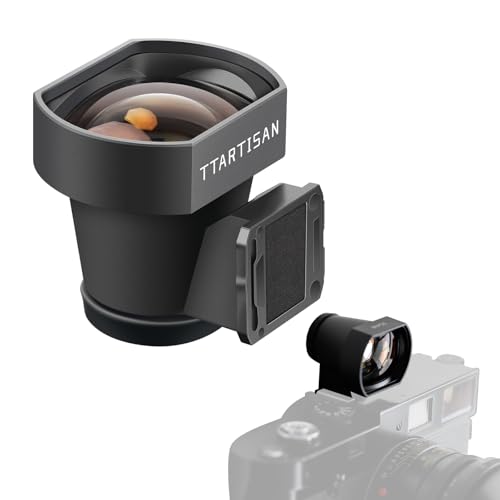
- Bright 35mm-equivalent frame lines
- Standard hot-shoe connection
- Lightweight metal construction
Best For: Straightforward 35mm-equivalent optical composition
High-Magnification Scene Viewer
VD 11X Micro Director's Viewfinder

- Multi-coated optical glass
- Multiple cinema and video aspect ratios
- Telescoping body with 37mm thread
Best For: Magnified scene checking and format-based composition
Best Waist-Level Option
CHI Sight 28mm Optical Viewfinder

- Mirrored waist-level optical image
- 35mm and 50mm frame lines
- Battery-free design with lens hood
Best For: Street, travel, and outdoor waist-level shooting
Best Magnifying Eyepiece
1.51x DSLR Viewfinder Magnifier

- 1.5x view magnification
- 15mm viewing distance
- Six mounting bases included
Best For: DSLR users seeking a larger focusing view
Best Compact 35mm Finder

- Dedicated 35mm framelines
- Multi-coated four-element optics
- Lightweight 25g aluminum body
Best For: Portable 35mm rangefinder-style composition
Daylight Detailer

- 3X optical-glass magnification
- Adjustable diopter and rubber eye surround
- Fits 3.0- and 3.2-inch LCD cameras
Best For: Macro observation and daylight manual focusing
Low-Angle Classic
ULANZI VF01 Waist-Level Viewfinder

- 28mm optical view with 35/50 framelines
- Universal cold shoe mounting
- Magnetic hood blocks stray light
Best For: Low-angle and candid optical framing
Comfort Focus

- 3X magnification for daylight detail viewing
- Adjustable diopter and rubber eye setting
- Includes lanyard and dust cloth
Best For: Outdoor manual focusing on 3.0- or 3.2-inch LCD cameras
Bright Frameline Pick – LightMate OV-X2
The LightMate OV-X2 is a strong choice among camera viewfinders for manual focusing when you want a bright, screen-free framing aid. Its built-in 28mm, 35mm, and 50mm full-frame lines support quick composition, while the optical glass and adjustable cold-shoe positions make it practical for compatible rangefinder and mirrorless setups.
Best For: Photographers using 28mm, 35mm, or 50mm lenses who want compact optical framing with a vintage-style metal build.
Pros:
- Bright, thick 28mm, 35mm, and 50mm framelines
- Six high-transmittance optical glass lenses for a clear view
- Lightweight 21g aluminum-alloy construction
- Adjustable cold-shoe positions and a standard mount
Cons:
- Provides framing assistance rather than electronic focus confirmation
- Standard cold-shoe compatibility excludes some special mounts
- Its approximately 0.5x magnification may not suit users seeking a highly enlarged view
Choose the OV-X2 if your priority is fast optical composition across three common focal lengths. The compact design and optional VfPort interface add flexibility, but verify your camera’s shoe compatibility before buying.
LCD Magnification Pick – Kamerar CVF-2
The Kamerar CVF-2 takes a different approach to camera viewfinders for manual focusing by enlarging your camera’s LCD rather than adding optical framelines. Its 3x focusable magnification, light-blocking design, and adjustable eyecup can make screen viewing more practical in bright conditions.
Best For: Photographers and video users with compatible 3.0-inch or 3.2-inch 16:9 LCD screens who need a shaded, enlarged viewing point.
Pros:
- Provides 3x magnification across the camera LCD
- Blocks excess ambient light for higher-contrast viewing
- Focusable eyecup works with either eye and accommodates eyeglasses
- Adjustable rubber bands install without leaving marks
Cons:
- Compatibility is limited to suitable 3.0-inch and 3.2-inch 16:9 screens
- Requires the camera LCD rather than offering an independent optical view
- At 4 ounces, it is heavier than the compact optical options in this group
The CVF-2 is best when screen glare and small display details are the main obstacles. Confirm your LCD size and aspect ratio first, since its mounting design is tailored to those specifications.
Simple 35mm Framing Pick – TTARTISAN 35mm External Viewfinder
The TTARTISAN 35mm Optical Viewfinder is a straightforward option among camera viewfinders for manual focusing. It adds bright 35mm-equivalent frame lines through a standard hot-shoe connection, helping you compose without depending on the camera’s LCD.
Best For: Mirrorless and rangefinder users shooting with a 35mm-equivalent lens who want a lightweight external framing aid.
Pros:
- Bright, clear frame lines for 35mm-equivalent lenses
- Standard hot-shoe mounting supports many compatible cameras
- Lightweight metal construction is easy to carry
- Designed to improve composition without relying on an LCD
Cons:
- Offers a single 35mm framing view rather than multiple focal-length lines
- Does not provide electronic focus confirmation
- Camera compatibility depends on having a suitable hot shoe
This viewfinder makes sense for photographers who regularly use a 35mm-equivalent focal length and prefer uncomplicated optical composition. It is less versatile than multi-frameline models, but its compact metal construction keeps the setup simple.
High-Magnification Scene Viewer – VD 11X Micro Director's Viewfinder
The VD 11X Micro Director’s HD Viewfinder is a specialized choice among camera viewfinders for manual focusing, combining multi-coated optical glass with a telescoping design and multiple aspect-ratio markings. Its light-blocking eyecup and magnification-focused viewing can help when composing or inspecting a scene in bright conditions.
Best For: Film, video, and low-vision users who need magnified scene viewing across several standard formats and aspect ratios.
Pros:
- Multi-coated optical elements support a high-definition view
- Supports aspect ratios including 4:3, 16:9, 1.85, 2.2, and 2.4
- Telescopic design and locking eyecup allow adjustable use
- 37mm filter thread accepts compatible wide-angle converters
Cons:
- Its format-focused design is more specialized than a simple camera hot-shoe viewfinder
- Requires checking compatibility with the intended camera or screen setup
- Not water resistant
The VD 11X is most appealing when aspect-ratio control and magnified scene inspection matter more than a compact frameline accessory. Its 37mm thread adds expansion potential, but the specialized design warrants checking your workflow before purchase.
Best Waist-Level Option – CHI Sight 28mm Optical Viewfinder
For photographers seeking camera viewfinders for manual focusing with a traditional shooting experience, the CHI Sight provides a battery-free, horizontally mirrored waist-level view. Its bright optical display and built-in frame lines are designed for quick composition with compatible focal lengths.
Best For: Street, travel, and outdoor photographers who prefer waist-level composition and 35mm or 50mm framing.
Pros:
- Horizontally mirrored image delivers an authentic waist-level shooting experience.
- Bright viewing screen includes 35mm and 50mm frame lines.
- Detachable lens hood helps reduce flare in direct sunlight.
- Battery-free optical design avoids screen delay and electronic interference.
Cons:
- The waist-level image is horizontally mirrored, which may require an adjustment period.
- Framing options are centered on the listed 35mm and 50mm configurations.
- It uses a cold-shoe mount rather than an integrated camera viewfinder.
With its adjustable cold-shoe mount, aluminum construction, Fresnel lens, and bright optical presentation, the CHI Sight is a distinctive choice for photographers who value tactile, screen-free composition.
Best Magnifying Eyepiece – 1.51x DSLR Viewfinder Magnifier
This eyepiece magnifier is a practical option among camera viewfinders for manual focusing when you want a larger view through a DSLR viewfinder. Its approximately 1.5x magnification and 15mm viewing distance are intended to make focusing and composition easier, including for some users who normally need glasses.
Best For: DSLR users who want a magnified eyepiece and need flexible mounting options across compatible camera bodies.
Pros:
- 1.5x magnification supports more precise viewing and focusing.
- 15mm eye relief provides a more comfortable viewing position.
- Six mounting bases support compatibility with various DSLR cameras.
- Glass lens construction is designed to preserve brightness and limit vignetting.
Cons:
- Compatibility depends on whether one of the six supplied bases fits the camera.
- The product is designed for fixed-focus DSLR eyepiece use rather than a separate external view.
- Magnification may take time to get used to when composing.
This model makes the most sense for DSLR owners who want a straightforward eyepiece upgrade, especially if a larger view can help with manual focus or viewing without glasses.
Best Compact 35mm Finder – TTArtisan 35mm Viewfinder
The TTArtisan 35mm Viewfinder is a compact external optical finder for photographers comparing camera viewfinders for manual focusing and precise composition. Its 35mm framelines, four-element optics, and multi-coating are intended to provide a clear rangefinder-style view through a standard cold shoe.
Best For: Photographers who primarily use a 35mm focal length and want a lightweight, classic external framing tool.
Pros:
- Dedicated 35mm framelines provide a clearly defined composition.
- Four-element, multi-coated optics support high light transmission.
- At 25g, it is compact and convenient to carry.
- Soft rubber eyecup improves viewing comfort.
Cons:
- The supplied framelines are specifically for 35mm framing.
- It is an optical framing accessory, not an electronic focusing aid.
- Cold-shoe mounting requires a camera with a compatible standard shoe.
With its lightweight anodized aluminum body, comfortable eyecup, and dedicated 35mm perspective, the TTArtisan is a focused choice for photographers who want simple, portable rangefinder-style composition.
Daylight Detailer – 3X LCD Viewfinder Magnifier
For photographers comparing camera viewfinders for manual focusing, this magnifier offers a larger view of compatible LCD screens. Its 3X optical-glass magnification, adjustable diopter, and eye-friendly rubber surround are aimed at improving detail visibility in bright daylight.
Best For: Macro observation and manual focusing on cameras with 3.0- or 3.2-inch screens.
Pros:
- 3X magnification provides a clear, enlarged shooting view.
- Optical glass is designed to preserve the original image without deformation.
- Adjustable diopter and rubber eye setting support more comfortable viewing.
- 1/4-inch and 3/8-inch screw holes allow tripod or shoulder-bracket mounting.
Cons:
- Compatibility is centered on 3.0- and 3.2-inch LCD screens.
- It adds about 12.6 ounces to the camera setup.
This is a practical choice when screen-based focusing is difficult in daylight and you want significant enlargement without sacrificing the displayed image.
Low-Angle Classic – ULANZI VF01 Waist-Level Viewfinder
Among camera viewfinders for manual focusing, the ULANZI VF01 takes a different approach: it provides an optical waist-level view for low-angle composition. Its three-element, three-group lens, switchable framelines, and magnetic hood make it suited to photographers who want a focused, screen-free framing experience.
Best For: Low-angle, candid, and retro-style shooting with compatible cameras using a cold shoe.
Pros:
- 28mm full-frame view with switchable 35mm and 50mm framelines.
- High-transmission optical design is intended to reduce distortion and artifacts.
- Universal cold shoe mount works with most popular cameras.
- Magnetic flip-open hood helps block stray light.
Cons:
- It is an optical framing accessory rather than a magnifying LCD viewfinder.
- Framelines are limited to 35mm and 50mm options.
- Actual framing depends on the camera and lens setup.
Choose this model for its distinctive low-angle workflow and optical preview, especially if switchable framelines matter more to you than LCD magnification.
Comfort Focus – HURRISE 3X HD Viewfinder
For camera viewfinders for manual focusing, the HURRISE model combines 3X enlargement with an adjustable diopter and rubber eye setting. It is designed for SLR and mirrorless cameras with 3.0- or 3.2-inch LCD screens, particularly when seeing fine details in bright daylight is a priority.
Best For: Outdoor detail viewing and more comfortable manual focusing for users who benefit from an enlarged screen image.
Pros:
- 3X magnification creates a clearer zoomed-in view in bright daylight.
- Optical glass is designed to show the original image without deformation.
- Adjustable diopter and rubber eye setting support prolonged viewing.
- Includes an anti-lost lanyard and dust cloth.
Cons:
- Compatibility is limited to most 3.0- and 3.2-inch LCD cameras.
- At approximately 13.5 ounces, it is not the lightest accessory.
- It requires mounting through its screw holes rather than attaching as a simple cold-shoe viewfinder.
This model makes sense when magnification, viewing comfort, and outdoor detail inspection are more important than keeping the camera setup especially compact.
How We Picked These Camera Viewfinders for Manual Focusing
We grouped the selection by how each finder helps with manual operation: optical framing, LCD enlargement, waist-level viewing, or broader scene visualization. We also considered advertised magnification, frameline coverage, mounting method, screen-size compatibility, portability, and whether the design suits rangefinder, DSLR, mirrorless, compact, or video workflows.
Compatibility matters more than feature count. A bright optical finder cannot display electronic focus aids, while an LCD magnifier may improve screen visibility but require a suitable 3.0- or 3.2-inch monitor and a secure mounting solution. Product specifications should be checked against your exact camera before purchase.
Quick Comparison
- Optical external finders: LightMate, TTArtisan, and similar models offer fast, battery-free framing through a cold shoe.
- Waist-level finders: CHI Sight and ULANZI models support discreet, low-angle, or alternate viewing positions.
- LCD magnifiers: Kamerar, HURRISE, and generic 3X designs enlarge the camera screen for easier manual focus and video monitoring.
- Director’s viewfinders: The VD model is intended for scene planning, lens-angle visualization, and production-style framing.
- Eyepiece magnifiers: The 1.51X DSLR accessory is designed to enlarge an existing eyepiece rather than replace it.
Key Buying Factors for Camera Viewfinders for Manual Focusing
Optical or LCD Viewing
Choose an optical finder for quick composition, low power consumption, and a direct view of the scene. Choose an LCD magnifier when you need a larger view of live view, focus peaking, exposure information, or recorded video. Optical finders generally do not show camera-generated focus aids.
Framelines and Focal Length
Fixed framelines are useful only when they match your lens and sensor format. A 28mm, 35mm, or 50mm marking can help with predictable composition, but verify whether the finder is intended for your camera’s crop factor and field of view.
Mounting and Fit
Cold-shoe models are simple to attach, but confirm that your camera has a usable accessory shoe and that the finder’s position does not interfere with a flash, microphone, or cage. LCD magnifiers need the correct screen dimensions and a stable attachment method. Eyepiece magnifiers require a compatible eyecup or mount.
Magnification, Glare, and Eye Comfort
Higher magnification can make fine details easier to inspect, but it may reduce the visible portion of the screen or make framing slower. Look for a hood, sunshade, clear optics, and an adjustable or comfortable eyepiece if you shoot outdoors for long periods.
Who Should Buy Which Camera Viewfinders for Manual Focusing?
Rangefinder and compact-camera users should prioritize a bright optical finder with framelines that match their primary focal lengths. DSLR and mirrorless photographers using live view will usually benefit more from a 3X LCD magnifier or a compatible eyepiece enlarger. Street and low-angle shooters may prefer a waist-level finder for discreet composition. Filmmakers and production users should consider a director’s viewfinder when planning lens coverage and camera placement. If flexibility is the priority, choose a model with multiple framelines or broad camera compatibility, but verify every dimension and mounting specification before ordering.