The best light meters make it easier to measure brightness accurately instead of relying on guesswork, camera previews, or subjective visual comparisons. The right model depends on whether you need photographic exposure readings, workplace illumination testing, or a broad lux range for general use.
This roundup compares 10 light meters across analog and digital designs, incident and reflected measurement, flash and cine features, sensor layouts, display options, and practical measurement ranges.
Best 10 Light Meters Picks for 2026
Best All-Around Camera Meter

- One-tenth-stop ambient and flash accuracy
- Photo, Cine, and HD Cine modes
- Compact design with LCD auto backlight
Best For: Photographers and videographers needing flexible ambient and flash metering
Best for Basic Lux Readings
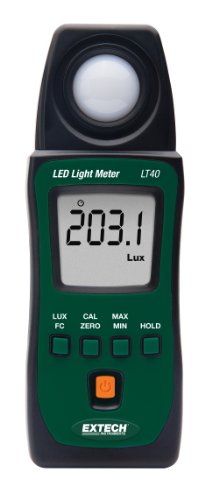
- Measures lux and foot-candles
- Backlit 4000-count LCD
- Data hold and auto power-off
Best For: Basic white LED illumination checks
Best Simple Illuminance Tester

- Dedicated illuminance meter tester
- Fluke-branded instrument
- Runs on one 9V battery
Best For: General light-level testing with a dedicated illuminance meter
Best Battery-Free Analog Meter
Sekonic L-398A Studio Deluxe III

- Battery-free amorphous photocell
- Incident and reflected ambient readings
- Full analog aperture/shutter dial
Best For: Users who prefer traditional, battery-free exposure metering
Best Overall
Dr.meter 200,000-Lux Digital Light Meter

- 0–200,000 lux measurement range
- Fast readings twice per second
- Lux/foot-candle conversion and peak mode
Best For: Plant-light checks and broad indoor or outdoor measurements
Best for Professional-Style Checks
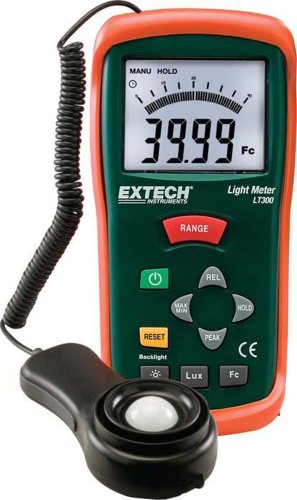
- Measures up to 40,000 lux
- Remote, color-corrected sensor
- Min/max, hold, peak, and relative modes
Best For: Workplace, studio, laboratory, and facility inspections
Best Value with Temperature
200,000-Lux Meter with Color LCD
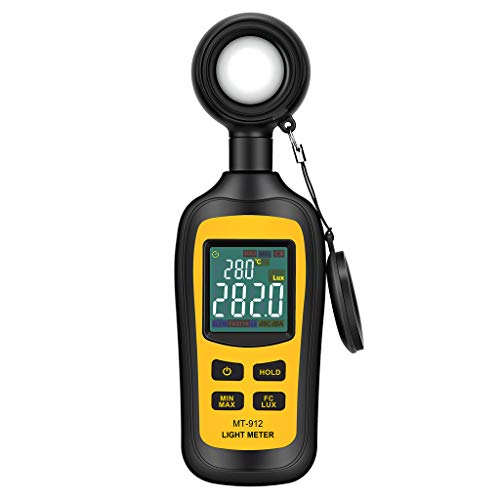
- Measures light up to 200,000 lux
- Adds ambient-temperature measurement
- Color LCD, min/max, hold, and two-year warranty
Best For: Home, office, factory, and set-design measurements
Professional Cine Meter
Sekonic LiteMaster Pro L-478D-U
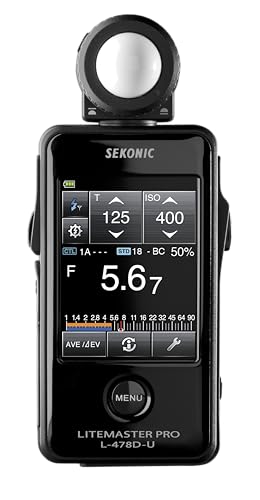
- Incident, flash, and optional reflected-spot metering
- Touchscreen controls with cine exposure settings
- Illuminance and luminance measurement modes
Best For: Professional photography, flash, and motion production
Fast Split-Sensor Meter
MT-92H Lux and Foot-Candle Meter
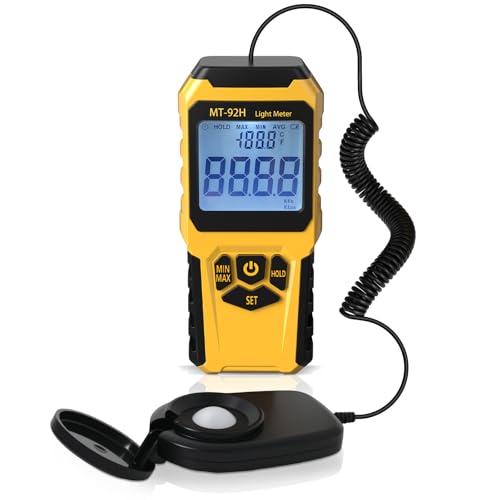
- 0–200,000-lux range with 0.5-second refresh
- Separate probe supports flexible positioning
- Switches between lux/Fc and °C/°F
Best For: Fast general-purpose illuminance checks
Wide-Range Illuminance Tester

- Measures visible brightness up to 200,000 lux
- Automatic range conversion with lux/FC switching
- Includes hold, min/max, backlight, and auto-off
Best For: General indoor, outdoor, plant, and brightness checks
Best All-Around Camera Meter – Sekonic L-308X-U Flashmate
The Sekonic L-308X-U is a versatile choice among light meters for photographers and videographers who need both ambient and flash readings. Its compact design, one-tenth-stop accuracy, and dedicated Photo, Cine, and HD Cine modes make it adaptable for stills, DSLR video, and cinema workflows.
Best For: Still photographers, DSLR and mirrorless videographers, and users who need compact ambient and electronic-flash metering.
Pros:
- Provides exposure readings accurate to one-tenth of a stop.
- Supports ambient and corded or cordless flash measurements.
- Includes Photo, Cine, and HD Cine modes with frame-rate and shutter-angle options.
- Offers a pocket-sized design with an LCD auto backlight.
Cons:
- Requires two AAA batteries.
- Its feature set may be more than needed for basic ambient-light measurement.
With a broad ambient EV range and shutter speeds extending to 1/8000 second in photo use, the L-308X-U is a strong multipurpose pick when your light-meter needs span photography and video.
Best for Basic Lux Readings – Extech LT40 LED Light Meter
The Extech LT40 is a straightforward option among light meters for checking white LED illumination in lux or foot-candles. Its backlit 4000-count display, data hold, and auto power-off support practical measurements in everyday inspection and maintenance tasks.
Best For: Users who need a compact white LED light meter with simple display and hold functions.
Pros:
- Measures illumination in lux and foot-candles.
- Uses a backlit 4000-count LCD display.
- Includes data hold for retaining a reading.
- Auto power-off helps conserve its included AAA batteries.
Cons:
- The supplied notes do not specify its measurement range or accuracy.
- Its listed features are focused on basic illumination testing rather than camera exposure control.
The LT40 is best considered a simple illumination tester rather than a photography exposure meter, making its clear display and data-hold function the main buying advantages.
Best Simple Illuminance Tester – Fluke 941 Light Meter
The Fluke 941 is a dedicated illuminance tester for buyers seeking a simple Fluke-branded option among light meters. The supplied information identifies it specifically as a light meter and illuminance meter tester, with a 9V battery required for operation.
Best For: Users who want a dedicated Fluke illuminance meter for general light-level testing.
Pros:
- Designed specifically for illuminance measurement.
- Comes from the Fluke brand.
- Uses a replaceable 9V battery.
Cons:
- The supplied notes do not list measurement range, display features, or accuracy.
- Its larger listed dimensions may be less convenient for pocket carry.
The Fluke 941 may suit buyers who prioritize a dedicated illuminance-testing tool and brand familiarity, but confirm the detailed specifications before choosing it for specialized work.
Best Battery-Free Analog Meter – Sekonic L-398A Studio Deluxe III
The Sekonic L-398A Studio Deluxe III offers a traditional approach to light meters with a battery-free amorphous photocell and an analog dial. It handles incident and reflected ambient readings, while its swivel head and included accessories help adapt it to studio and on-location photography or cinematography.
Best For: Photographers and cinematographers who prefer analog controls, full dial readouts, and battery-free ambient metering.
Pros:
- Battery-free photocell operation uses available ambient light.
- Supports incident and reflected ambient measurement.
- Full dial readout shows aperture and shutter-speed combinations without electronic menus.
- Includes a swivel head and multiple accessories, including lumisphere, lumidisc, and lumigrid.
Cons:
- Analog operation may be less immediate for users accustomed to digital displays.
- The supplied details list a lithium-ion battery requirement despite describing battery-free operation, so buyers should verify the power specification.
The L-398A is an appealing choice for hands-on exposure work and dependable field use, particularly when avoiding routine battery replacement matters more than digital convenience.
Best Overall – Dr.meter 200,000-Lux Digital Light Meter
If you need broad measurement coverage, this Dr.meter light meter combines a 0–200,000 lux range with quick readings and selectable lux or foot-candle units. Its peak function is useful when you need to capture brief, intense light pulses.
Best For: Plant-light checks, sunlight measurements, and general indoor or outdoor use.
Pros:
- Measures light intensity up to 200,000 lux.
- Provides fast readings twice per second.
- Switches between lux and foot-candle measurements.
- Includes peak-data recording and a low-battery alert.
Cons:
- Requires a 9V battery.
- Does not list temperature measurement among its features.
Choose this model when maximum range and flexible units matter most. It is a versatile option for home, office, factory, and plant-light measurements, while the peak mode adds value for brief high-intensity sources.
Best for Professional-Style Checks – Extech LT300 Light Meter
The Extech LT300 is a practical light meter for users who value controlled, repeatable readings. Its remote sensor, backlit display, and measurement functions make it well suited to workplace, studio, laboratory, and facility inspections.
Best For: Lighting inspections, workplace checks, photography, and facility-management tasks.
Pros:
- Measures lux and foot-candles up to 40,000 lux.
- Uses a cosine- and color-corrected sensor for varied lighting conditions.
- Offers min/max, data hold, zero adjustment, peak, and relative modes.
- Features a large backlit LCD and protective sensor cover.
Cons:
- Its 40,000-lux range is lower than the 200,000-lux models in this roundup.
- The supplied notes do not specify a temperature-measurement function.
The LT300 is the stronger choice when measurement controls and sensor flexibility are more important than maximum range. Its compact, lightweight design also supports on-the-go inspections.
Best Value with Temperature – 200,000-Lux Meter with Color LCD
This handheld light meter stands out by pairing a 0–200,000-lux range with ambient-temperature measurement. The color LCD and straightforward functions make it a useful light meter for homes, offices, factories, and set-design work.
Best For: Buyers who want high light-measurement range plus ambient-temperature readings.
Pros:
- Measures luminosity from 0 to 200,000 lux.
- Also measures ambient temperature.
- Includes a four-digit color LCD, min/max readings, and data hold.
- Offers auto power-off, low-battery indication, and a two-year warranty.
Cons:
- Requires three AAA batteries.
- Accuracy varies by range, with less precision above 10,000 lux.
Consider this model if temperature data is useful alongside light readings. Its compact build and broad range cover many everyday applications, while the included warranty adds reassurance for longer-term use.
Professional Cine Meter – Sekonic LiteMaster Pro L-478D-U
Among advanced light meters, the Sekonic LiteMaster Pro L-478D-U stands out for combining incident, flash, and optional reflected-spot metering with a touchscreen workflow. Its cine controls and technical measurement modes make it suited to creators who need more than basic exposure readings.
Best For: Professional photographers, filmmakers, and hybrid creators working with ambient light, flash, and motion-production settings.
Pros:
- Measures incident ambient and flash light, including flash-to-ambient analysis.
- Touchscreen color display supports quick exposure adjustments and clear data visibility.
- Cine mode includes frame-rate and shutter-angle controls.
- Illuminance and luminance modes add technical measurement flexibility.
Cons:
- Its advanced feature set may be more than casual users need.
- The optional reflected spot attachment is not included as a standard feature in the supplied details.
- Requires two AAA batteries.
This is the most versatile choice of the three for studio, location, flash, and cine work. Choose it when workflow control and multiple measurement modes matter more than simplicity.
Fast Split-Sensor Meter – MT-92H Lux and Foot-Candle Meter
The MT-92H is a practical choice among light meters for users who need broad illuminance coverage and quick updates. It measures from 0 to 200,000 lux, refreshes in 0.5 seconds, and uses a separate probe for flexible positioning.
Best For: Lighting checks, facilities work, plant or indoor measurements, and other applications requiring lux or foot-candle readings.
Pros:
- Measures up to 200,000 lux with stated ±3% accuracy and 0.1-lux resolution.
- 0.5-second refresh rate helps track changing light conditions.
- Split sensor and separate probe support flexible measurement placement.
- Switchable lux/foot-candle units and a backlit display improve usability.
Cons:
- This is an illuminance meter rather than a dedicated camera exposure meter.
- Temperature measurement is limited to the stated 14°F–140°F range.
- Requires three AAA batteries.
Its strong range, fast refresh, and probe design make the MT-92H a useful general-purpose illuminance tool. It is a better fit for measurement and monitoring than for advanced photography or cine exposure control.
Wide-Range Illuminance Tester – S8608 Digital Lux Meter
The S8608 is a straightforward digital option for measuring visible brightness. For shoppers comparing light meters, its 200,000-lux range, automatic range conversion, and lux/foot-candle switching provide useful flexibility for indoor, outdoor, plant, and basic photography checks.
Best For: Homes, schools, hospitals, factories, airports, grow-plant checks, and general indoor or outdoor brightness measurements.
Pros:
- Wide measurement range up to 200,000 lux.
- Automatic range conversion simplifies operation.
- Supports lux and foot-candle units.
- Includes maximum/minimum readings, data hold, backlight, auto power-off, and low-battery indication.
Cons:
- The supplied details do not specify accuracy or refresh rate.
- It is focused on visible-brightness measurement rather than flash or cine exposure analysis.
- The supplied notes do not include battery requirements.
The S8608 is a sensible pick when you want broad-range brightness readings and practical convenience features without the specialized controls of a professional camera meter. Its automatic ranging also suits routine spot checks.
How We Picked These Light Meters
We focused on the features that most affect real-world usability: measurement range, accuracy-oriented design, sensor placement, display readability, response speed, operating modes, portability, and intended application. The selection includes dedicated photographic meters, general-purpose illuminance testers, remote-sensor models, and high-range handheld options.
We also considered whether a meter supports incident or reflected readings, lux or foot-candle units, flash measurement, cine controls, relative or peak modes, and battery-free operation. Because no single meter is ideal for every task, the list covers several price and capability levels.
Quick Comparison
| Best For | Recommended Type | Useful Features |
|---|---|---|
| Photography and flash | Dedicated photographic meter | Incident, reflected, flash, and exposure readings |
| Film and video production | Photo/cine meter | Frame rate, shutter angle, and cine modes |
| Offices and facilities | General illuminance meter | Lux and foot-candle readings, clear LCD, broad range |
| Hard-to-reach light sources | Remote-sensor meter | Separate probe and flexible positioning |
| Simple analog operation | Battery-free analog meter | Fast manual readings and no battery dependence |
Key Buying Factors for Light Meters
Measurement Type
Incident meters measure light falling on the subject, while reflected meters measure light bouncing toward the meter. Incident readings are often useful for consistent exposure, whereas reflected readings can help evaluate specific surfaces or scenes. General illuminance meters typically report lux or foot-candles rather than camera exposure settings.
Range and Units
Choose a range that matches your environment. Indoor workspaces may need only modest readings, while studio lights, daylight, and industrial inspections can benefit from meters reaching tens or hundreds of thousands of lux. Foot-candle support is helpful when workplace or facility specifications use imperial units.
Photography and Cine Controls
Photographers should look for aperture, shutter-speed, ISO, incident, reflected, and flash functions. Videographers may benefit from frame-rate and shutter-angle settings. These controls can be more valuable than an especially high lux range if the meter is primarily for camera exposure.
Sensor and Display Design
A remote sensor helps when the display must remain visible while the probe is positioned near a fixture. A split or swiveling sensor can improve readings in awkward spaces. Backlighting, large digits, auto-ranging, and fast refresh rates also matter in dim locations or during repeated measurements.
Who Should Buy Which Light Meters?
Choose a dedicated Sekonic-style photographic meter if exposure consistency, flash work, or film and video controls are your priority. An analog model suits users who prefer simple operation and do not want to manage batteries. For offices, workshops, classrooms, and facility checks, a digital lux meter with lux and foot-candle modes is generally the more practical choice.
If you need to measure bright fixtures, daylight, or varied environments, prioritize a model rated to 200,000 lux. Select a remote-sensor design for reach and positioning flexibility, and choose a compact basic meter when portability and occasional brightness checks matter more than advanced exposure functions.