Small objects demand more than basic shape capture. The right scanner must preserve fine edges, surface detail, and accurate proportions while remaining easy to position, track, and process.
We compared 10 notable scanners across precision, scanning modes, color capture, portability, software workflow, and value to help you choose a model that fits your projects.
Best 10 3d Scanner for Small Objects Picks for 2026
Best Precision Pick

- Up to 0.02mm claimed accuracy
- Scans objects from 10–300mm
- Includes tripod and turntable
Best For: Detailed indoor scans of small objects
Best Full-Color Option

- Up to 0.02mm single-frame precision
- Captures full color and texture
- USB-C and Wi-Fi 6 connectivity
Best For: Detailed color scans and flexible workflows
Best Wireless Versatility

- Scans 5mm to 2000mm objects
- Wi-Fi 6 and 260g portable design
- AI-assisted filling and body completion
Best For: Portable scanning across varied object sizes
Best Beginner-Friendly Detail
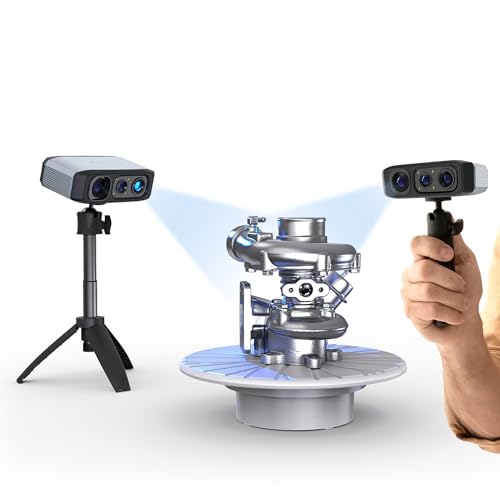
- Up to 0.03mm claimed accuracy
- Anti-shake and AI tracking features
- 24-bit color camera and JMStudio tools
Best For: Detailed color scanning with easier handheld operation
Best All-in-One Pick

- Standalone scanning and editing without a computer
- Near-mode precision for small, detailed objects
- 48MP color capture with STL, PLY, and OBJ export
Best For: Portable scanning of small parts, detailed models, and larger objects
Best Lightweight Value

- Scans objects as small as 20 × 20 × 20 mm
- 235 g handheld design with a complete starter kit
- 0.05 mm resolution and full-color texture capture
Best For: DIY scanning of small parts and color-textured models
Best for Precision Parts

- Up to 0.02 mm accuracy with blue laser scanning
- Handles dark and shiny surfaces without scanning spray
- Automated turntable and four scanning modes
Best For: Precision scanning, inspection, and reverse engineering of components
Best Overall

- 0.1mm precision with anti-shake tracking
- Scans dark and metallic objects without markers
- Lightweight 105g design with full-color capture
Best For: Portable desktop scanning for beginners and makers
Best Value

- 0.1mm high-accuracy mode for detailed scans
- 30 FPS point-cloud capture with ASIC processing
- Supports Android mobile scanning and full-color output
Best For: Flexible PC or Android scanning on a practical budget
Best Wireless Option

- Wireless Wi-Fi 6 scanning for compatible phones
- 0.1mm accuracy with 30 FPS capture
- Exports OBJ, STL, and PLY files
Best For: Mobile creators and makers needing flexible wireless workflows
Best Precision Pick – 3DMakerpro Seal Lite
For shoppers seeking a 3d scanner for small objects, the 3DMakerpro Seal Lite focuses on compact subjects measuring 10–300mm. Its blue LED light source is designed to capture fine dents and edge textures, while the included tripod and turntable can make stationary scanning easier.
Best For: Small indoor objects, detailed 3D printing scans, and users who want a compact scanner with up to 0.02mm accuracy.
Pros:
- Blue LED scanning targets fine surface details with claimed accuracy up to 0.02mm.
- Supports scan-back and anti-shake features for steadier handheld results.
- Includes a tripod and turntable, with JMStudio exports to OBJ, STL, PLY, and ASC.
Cons:
- Captures mono texture only rather than full-color texture.
- Designed primarily for indoor use and requires a relatively powerful computer.
- Handheld operation has a learning curve.
The Seal Lite is a focused choice when small-object detail matters more than color capture or broad scanning range. Its accessories and free software support add practical value, but beginners should plan time for setup and practice.
Best Full-Color Option – Revopoint MINI 2
The Revopoint MINI 2 is a versatile 3d scanner for small objects, combining blue-light precision with RGB color capture. It supports objects from 10 × 10 × 10mm up to 0.5 × 0.5 × 0.5m, making it suitable for tiny detailed parts as well as somewhat larger subjects.
Best For: Users who want detailed, full-color scans, mobile connectivity, and export options for 3D printing or modeling.
Pros:
- Offers single-frame precision up to 0.02mm and capture speeds up to 16fps.
- RGB camera and flash LEDs help capture color and texture details.
- Supports USB Type-C and Wi-Fi 6, with exports including STL, OBJ, PLY, 3MF, GLTF, and FBX.
Cons:
- Results can vary with object material and color; scanning spray may improve performance.
- Revo Design is paid separately and works only on Windows x86_64 systems.
- It is not intended for objects outside its stated scanning-volume range.
MINI 2 stands out for combining high detail with color and flexible connections. Its software ecosystem is capable, though buyers should distinguish the included scanning software from the separately sold CAD-focused Revo Design.
Best Wireless Versatility – Creality Pika
The Creality Pika is a 3d scanner for small objects that also handles a much wider size range, from 5mm components to objects up to 2000mm. Its dual-light system pairs blue lasers for detail with infrared structured light for faster scanning, while built-in wireless connectivity supports phone or PC workflows.
Best For: Buyers who want one portable scanner for tiny parts, larger objects, outdoor use, and cable-free operation.
Pros:
- Scans objects from 5mm to 2000mm using blue laser and infrared light sources.
- Wireless Wi-Fi 6 connectivity and a compact 260g design support portable scanning.
- AI hole-filling, body completion, and one-click exports can streamline model preparation.
Cons:
- Its claimed blue-laser accuracy is 0.03mm, rather than 0.02mm.
- Scanning performance still depends on the object and scanning conditions.
- Despite its broad range, very different object sizes may require changing scanning modes and technique.
Pika is the most flexible option here for users who do not want a scanner limited to miniature subjects. Its wireless design, outdoor capability, and AI-assisted processing make it appealing for mobile scan-to-print work.
Best Beginner-Friendly Detail – 3DMakerpro Moose Lite
The 3DMakerpro Moose Lite is a handheld 3d scanner for small objects that emphasizes detailed capture and easier operation. Blue light, optical anti-shake modules, AI tracking, and integrated JMStudio processing are intended to help users create refined models without relying as heavily on steady hands.
Best For: Beginners and makers who want detailed, true-color scans with guided tracking and built-in editing tools.
Pros:
- Blue-light scanning claims accuracy up to 0.03mm with 0.07mm resolution.
- Optical anti-shake, AI tracking, and re-scanning support more forgiving operation.
- Its 24-bit color camera captures color, while JMStudio handles scanning, editing, optimization, and exports.
Cons:
- The optional Smart Grip for smartphone scanning is sold separately.
- Compatibility is listed for Windows 10/11 64-bit and macOS 12/13.
- It is a handheld scanner, so users still need to learn an appropriate scanning technique.
Moose Lite offers a balanced feature set for makers who value detail but want assistance with tracking and stabilization. It is especially attractive for color-capable projects, although smartphone use adds an optional accessory cost.
Best All-in-One Pick – Revopoint MIRACO Pro
If you want a capable 3d scanner for small objects without being tied to a computer, the Revopoint MIRACO Pro is a versatile option. Its Near-mode is designed for fine details and small objects, while its built-in processing, color camera, and broad file-format support make it suitable for both scanning and 3D printing workflows.
Best For: Makers and professionals who want portable, standalone scanning for small parts, detailed models, and larger objects.
Pros:
- Near-mode supports fine details and small-object scanning, with single-frame precision up to 0.02 mm.
- Works without a computer and includes onboard scanning, editing, and storage.
- Captures photorealistic color with a 48-megapixel RGB camera and Flash LED system.
- Exports STL, PLY, and OBJ files and supports Wi-Fi 6 or USB-C transfers.
Cons:
- At 750 g, it is heavier than compact plug-and-play handheld alternatives.
- Revo Design scan-to-CAD software is sold separately and supports Windows only.
- Battery life is rated for up to two hours of scanning.
The MIRACO Pro stands out for its independence from a computer and its ability to move from tiny detailed parts to large objects. It is a strong choice when portability, color capture, and an integrated workflow matter more than the lightest possible scanner.
Best Lightweight Value – Creality Otter Lite Basic
The Creality Otter Lite Basic is a practical 3d scanner for small objects when portability and straightforward setup are priorities. Its close-range mode can capture objects as small as 20 mm on each side, while the included turntable, markers, and calibration board help beginners get started quickly.
Best For: DIY users who need a lightweight scanner for small parts, color-textured models, and entry-level reverse engineering.
Pros:
- Close-range scanning supports objects as small as 20 × 20 × 20 mm.
- Offers 0.05 mm resolution and captures color textures at up to 30 fps.
- Lightweight 235 g design with a carrying case and useful accessories included.
- Exports OBJ, STL, and PLY files for 3D printing, animation, VR, and reverse engineering.
Cons:
- Requires a Windows or macOS computer with Creality Scan software.
- USB connectivity is wired rather than wireless.
- Its stated 0.05 mm resolution is less precise than the higher-end scanners in this roundup.
For small-object scanning on a DIY budget, the Otter Lite Basic combines a compact handheld body with a complete starter kit. Its dual scanning ranges also give it more flexibility than a scanner limited to close-up work.
Best for Precision Parts – Revopoint MetroX
The Revopoint MetroX is a specialized choice for buyers seeking a high-accuracy 3d scanner for small objects, especially mechanical parts, molds, and other demanding surfaces. Its blue laser system, multiple tracking modes, and automated turntable scanning are geared toward measurement, inspection, and reverse-engineering workflows.
Best For: Professionals scanning precision components, dark or shiny surfaces, and complex geometries for inspection or CAD-oriented work.
Pros:
- Blue laser scanning reaches up to 0.02 mm accuracy and 0.01 mm precision.
- Handles challenging surfaces with 14 crossed blue laser lines and up to 60 fps capture.
- Four scanning modes include automated dual-axis turntable scanning.
- Supports feature, marker, and global-marker tracking for different object types.
Cons:
- Requires a USB 3.0 connection and a compatible x86_64 computer setup.
- The Class 2M laser projector requires users to avoid looking directly at the light source at close range.
- Its advanced measurement focus may be more capability than casual hobby scanning requires.
MetroX is the strongest fit here when accuracy and surface handling take priority over simplicity. The included calibration board, professional software, and automated turntable make it particularly appealing for repeatable inspection and reverse-engineering tasks.
Best Overall – Creality CR-Ferret SE
If you want a capable 3d scanner for small objects that is easy to carry and simple to operate, the Creality CR-Ferret SE is a strong all-around option. Its 0.1mm precision, anti-shake technology, and full-color capture are useful for detailed 3D printing and modeling work.
Best For: Beginners, makers, and designers who want portable scanning with color capture and reliable tracking.
Pros:
- Up to 0.1mm precision with anti-shake technology for steadier scans.
- Can scan dark, black, and metallic objects without spray or markers.
- 24-bit full-color capture and a compact 105g design.
- One-click operation is approachable for new users.
Cons:
- Designed for Mac and Windows rather than mobile-phone scanning.
- The supplied details do not specify a scanning speed.
The CR-Ferret SE stands out when ease of use, portability, and material flexibility matter more than mobile operation. It is a practical desktop-focused choice for small-object modeling and 3D printing projects.
Best Value – Creality CR-Scan Ferret
The Creality CR-Scan Ferret is a versatile choice if you need a 3d scanner for small objects with both detailed and wide-range modes. Its 0.1mm accuracy mode, 30 FPS point-cloud capture, and Android support make it suitable for home workshops and mobile scanning setups.
Best For: Users who want flexible scanning modes, full-color models, and the option to scan with a compatible Android device.
Pros:
- High-accuracy mode reaches up to 0.1mm precision and 0.16mm resolution.
- Up to 30 FPS point-cloud capture supports smoother handheld scanning.
- Full-color RGB capture preserves the object’s appearance.
- Can be powered through a 5V power bank or compatible Android device.
Cons:
- Android mobile scanning requires Android 10+, at least 8GB RAM, and Wi-Fi 6.
- iOS is listed in the requirements, but the compatibility note says mobile scanning is Android-only for this model.
- Computer use requires relatively modern hardware and at least 8GB RAM.
With dual scanning modes and fast image processing, the Ferret offers useful flexibility for detailed small objects and larger subjects alike. Check your device requirements carefully before buying, especially if you plan to scan without a computer.
Best Wireless Option – Creality CR-Scan Ferret Pro
The Creality CR-Scan Ferret Pro is a strong pick for shoppers seeking a wireless 3d scanner for small objects. It combines 0.1mm accuracy, 30 FPS scanning, anti-shake tracking, and Wi-Fi 6 transmission for a more mobile workflow across compatible phones and computers.
Best For: Creators who want wireless scanning with iPhone, Android, or PC compatibility and flexible file export.
Pros:
- Up to 0.1mm accuracy, 0.16mm resolution, and 30 FPS scanning.
- Wi-Fi 6 provides faster wireless data transfer than Wi-Fi 5.
- Supports OBJ, STL, and PLY exports for printing and design workflows.
- Anti-shake tracking helps maintain smoother scans during hand movement.
Cons:
- Best results may require avoiding highly reflective, transparent, or extremely dark surfaces.
- Wireless phone scanning requires compatible Android devices or an iPhone 11 and newer.
- The listed item weight is 2.81 pounds, making it less travel-friendly than the smaller Ferret SE.
The Ferret Pro is the most convenient choice here for users who value wireless mobility and broad export support. Its phone compatibility and anti-shake tracking make it appealing for field or workshop scanning, provided your devices meet the requirements.
How We Picked the Best 3d Scanner for Small Objects
We focused on scanners suited to miniatures, components, figurines, product prototypes, mechanical parts, and other compact subjects. The selection considers stated accuracy, tracking technology, light source, scan speed, resolution, color capability, connectivity, software features, and practical workflow. Models with desktop-friendly operation, handheld flexibility, or specialized detail-capture modes were included so different types of makers can find a suitable option.
Published accuracy figures are useful for comparison, but they do not guarantee identical results in every project. Lighting, surface finish, operator movement, calibration, alignment, and post-processing all affect the final mesh.
Quick Comparison
| What to Compare | Why It Matters |
|---|---|
| Accuracy and resolution | Determines how faithfully small edges, holes, lettering, and contours are reproduced. |
| Scanning technology | Blue light, blue laser, infrared, and structured-light systems have different strengths with detail, tracking, and surface tolerance. |
| Color capture | Useful for textured models, visual references, and digital replicas, but unnecessary for purely dimensional printing. |
| Connectivity and software | Affects setup, live preview, file export, alignment, cleanup, and compatibility with your computer or mobile device. |
| Portability | Handheld and wireless designs are easier to use around large subjects, while desktop setups can offer steadier small-object capture. |
Key Buying Factors for a 3d Scanner for Small Objects
Accuracy, Detail, and Working Distance
Choose the highest practical accuracy that matches your work. Fine mechanical parts and collectible details benefit from tighter stated precision, while larger decorative objects may prioritize coverage and speed. Check the scanner’s recommended object size and working distance, not just its headline accuracy.
Tracking and Surface Handling
Small objects can be difficult to track when they have plain surfaces, repetitive geometry, dark finishes, or reflective materials. Marker support, turntable compatibility, anti-shake tracking, and multiple scanning modes can make more difference than a specification alone. Matte spray or temporary markers may still be needed for challenging subjects.
Color, Texture, and Processing
If you need a visually accurate digital model, choose full-color or texture-capable scanning. For 3D printing and reverse engineering, dimensional accuracy and clean geometry usually matter more than color. Also confirm whether the included software supports hole filling, alignment, mesh editing, and the file formats used by your slicer or CAD program.
Ease of Use and Connectivity
Wireless scanning improves mobility, while a wired connection can simplify stable data transfer and extended sessions. Consider the required computer, phone, operating system, processing power, and calibration routine before buying.
Who Should Buy Which 3d Scanner for Small Objects?
Choose a compact, detail-oriented scanner if you mainly capture miniatures, small parts, jewelry-scale forms, or objects for 3D printing. A color-capable model is better for figurines, art references, and textured replicas. Buyers working on reverse engineering should prioritize reliable geometry, multiple tracking modes, and software with strong alignment and export tools.
For frequent field use, select a portable or wireless scanner with fast tracking and an uncomplicated workflow. For repeatable studio work, a desktop-oriented setup or turntable-compatible model may deliver steadier results. If you are new to scanning, favor clear software, guided calibration, and broad compatibility over the lowest advertised accuracy number.