Choosing the best 3D scanner for reverse engineering means balancing accuracy, scanning speed, tracking reliability, software capability, and the size of the parts you need to capture.
This roundup compares 10 current scanners suited to inspecting components, recreating replacement parts, documenting assemblies, and preparing meshes for CAD workflows.
Best 10 3d Scanner for Reverse Engineering Picks for 2026
Best Precision Choice

- Up to 0.01 mm single-frame precision
- Multiple modes for challenging surfaces
- Automatic turntable and mobile monitoring
Best For: Industrial measurement and precision reverse engineering
Best Handheld Versatility

- Blue light and NIR scanning in one device
- 0.02 mm stated accuracy
- Lightweight design with common file outputs
Best For: Mixed-size parts and portable reverse-engineering work
Best Field-Ready Speed

- Scanning speeds up to 90 FPS
- No-spray scanning for dark and shiny parts
- Wi-Fi 6 and approximately 2.5-hour battery grip
Best For: Fast mobile inspection and outdoor reverse engineering
Best Wireless Workflow

- Wireless scanning with up to three hours of battery life
- 90 FPS capture with dual scanning technology
- No-spray scanning and STL, OBJ, and PLY exports
Best For: Portable redesign, 3D printing, and wireless scanning
Best for Easy Setup

- Up to 0.01 mm precision
- Five specialized scanning modes
- Wi-Fi 6 and professional software support
Best For: High-accuracy reverse engineering and metrology
Portable Metrology Pick

- Standalone scanning and processing
- Near and Far modes for varied object sizes
- Optional photogrammetric measurement kit
Best For: Portable reverse engineering of small parts and large machinery
Compact Versatility Pick

- 260g wireless handheld design
- Blue laser and NIR scanning modes
- Up to 0.03 mm accuracy
Best For: Portable scanning of parts, prototypes, and varied objects
Premium Precision Pick
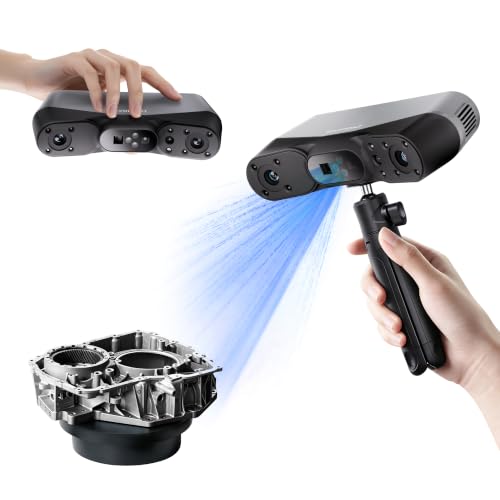
- Up to 0.03 mm single-frame accuracy
- Five modes for varied surfaces and sizes
- Outdoor-ready with Wi-Fi 6 and battery grip
Best For: Versatile reverse engineering across small parts, large components, and difficult surfaces
Portable Multiplatform Pick
Creality Pika Portable 3D Scanner

- Up to 0.03 mm blue-laser precision
- Up to 110 fps over USB 3.0
- Works with Windows, Mac, Android, and iOS
Best For: Portable part scanning, repairs, design work, and mixed body-capture projects
Metrology Workflow Pick
Revopoint MetroX Blue Laser Scanner

- Up to 0.02 mm accuracy and 0.01 mm precision
- Automated dual-axis turntable scanning
- Designed for inspection and scan-to-CAD workflows
Best For: Desktop reverse engineering, quality control, and detailed mechanical-part scanning
Best Precision Choice – MetroX Pro Blue-Laser Scanner
For demanding reverse-engineering work, the Revopoint MetroX Pro combines blue-laser scanning with multiple capture modes for detailed parts, dark surfaces, shiny components, and complex geometry. Its stated single-frame precision reaches 0.01 mm, making it a strong option when dimensional detail matters.
Best For: Industrial measurement, precision modeling, reverse engineering, inspection, and prototyping.
Pros:
- Up to 0.01 mm single-frame precision and 0.02 mm single-frame accuracy.
- Multiple laser and structured-light modes support flat, shiny, dark, and detailed surfaces.
- Automatic turntable scanning and real-time mobile viewing can streamline workflows.
- Exports scan data for reverse engineering, inspection, and 3D modeling workflows.
Cons:
- At 14.82 pounds in the package, it may be less convenient for highly mobile scanning.
- Revo Design and Revo Measure are paid software sold separately and support Windows only.
The MetroX Pro is the most measurement-focused choice in this group. It makes the most sense for users who prioritize precision, flexible tracking, and repeatable scanning over a lightweight handheld setup.
Best Handheld Versatility – Creality Raptor 3D Scanner
The Creality CR-Scan Raptor is a practical 3D scanner for reverse engineering when one device needs to handle small parts through large objects. Its blue-light and NIR systems cover different capture situations, while a 0.02 mm accuracy specification supports detailed scanning.
Best For: Handheld scanning of varied object sizes, CAD work, 3D printing, and design projects.
Pros:
- Combines blue light and infrared scanning for objects from 5 mm to 2,000 mm.
- Blue-light mode offers stated accuracy of up to 0.02 mm.
- RGB and infrared lighting support texture capture and marker recognition.
- Lightweight 372 g scanner with OBJ, STL, and PLY output support.
Cons:
- Recommended Windows systems require 32 GB RAM and an Nvidia GPU with 8 GB VRAM.
- Blue light may cause minor eye discomfort with direct exposure.
The Raptor stands out for coverage and portability rather than a single specialized scanning mode. It is a flexible pick for makers and professionals who move between small components, medium parts, and larger objects.
Best Field-Ready Speed – MetroY Ultra 3D Scanner
The Revopoint MetroY Ultra is built for fast, mobile scanning of industrial parts. With scanning speeds up to 90 FPS, blue-laser modes for dark or shiny surfaces, Wi-Fi 6, and a battery grip, it is a capable 3d scanner for reverse engineering in workshops or field environments.
Best For: Fast industrial scanning, outdoor inspections, tight-tolerance measurement, and mobile reverse engineering.
Pros:
- Up to 0.01 mm single-frame precision with stated volumetric accuracy of 0.015 + 0.04 mm × L (m).
- Up to 90 FPS scanning with five modes, including a single-line mode for deep holes.
- Scans dark, high-gloss, and metallic parts without spray and works in sunlight up to 100,000 lux.
- Wi-Fi 6, a 5,500 mAh battery grip, and broad export formats support mobile workflows.
Cons:
- Listed system requirements are demanding, including 32 GB RAM and an RTX 3060-class GPU for Windows.
- The battery grip provides about 2.5 hours of power.
Choose the MetroY Ultra if acquisition speed and field flexibility are central to your workflow. Its combination of fast capture, challenging-surface performance, and wireless operation is especially useful for inspection teams and on-site measurements.
Best Wireless Workflow – EINSTAR 2 3D Scanner
The SHINING 3D EINSTAR 2 is a convenient 3d scanner for reverse engineering when wireless operation and smooth real-time capture are priorities. Its dual scanning technology, 0.05 mm resolution, and 90 FPS performance cover parts ranging from small components to larger objects.
Best For: Wireless scanning, 3D printing, redesigning existing parts, and color-capture projects.
Pros:
- Combines 17 blue laser lines with IR VCSEL scanning.
- True wireless operation with built-in Wi-Fi and up to three hours of battery life.
- Scans black, reflective, and metallic surfaces without spray and supports outdoor use up to 110,000 lux.
- Exports STL, OBJ, and PLY files and includes RGB color capture.
Cons:
- Its 0.05 mm resolution is less fine than the higher-precision options in this roundup.
- Its battery requires charging for extended scanning sessions.
The EINSTAR 2 is a strong convenience-oriented option for users who value freedom from cables and a straightforward path to printable or editable models. It is particularly appealing for portable design and reverse-engineering projects.
Best for Easy Setup – Revopoint MetroY Pro
For demanding reverse-engineering work, the Revopoint MetroY Pro combines blue-laser scanning with up to 0.01 mm precision and up to 0.02 mm accuracy. Its multiple scanning modes, fast capture rates, and professional software compatibility make it a strong choice for detailed part documentation and metrology workflows.
Best For: Engineers, designers, and makers who need highly accurate scans of detailed or challenging surfaces.
Pros:
- Up to 0.01 mm precision and up to 0.02 mm accuracy.
- Five scanning modes cover detailed, deep-hole, full-field, and turntable scanning.
- Can scan shiny and dark surfaces without scanning spray in laser modes.
- Wi-Fi 6, marker-free scanning, and integration with professional software.
Cons:
- Revo Design and Revo Measure are sold separately.
- Windows use requires a relatively powerful computer, including 32GB RAM and an RTX 3060-class GPU.
- Some advanced workflows may require markers or the included turntable.
The MetroY Pro is the most measurement-focused option here, with temperature monitoring and specialized modes that support reliable, repeatable capture. It is best suited to users willing to meet its demanding system requirements for maximum accuracy.
Portable Metrology Pick – Revopoint MIRACO Plus
The Revopoint MIRACO Plus is an all-in-one option for reverse engineering when portability matters. Its integrated processing, near-and-far scanning modes, and optional photogrammetric kit support everything from small components to large machinery without requiring a computer during capture.
Best For: Professionals who need portable scanning for objects ranging from small parts to large equipment.
Pros:
- Integrated 8-core processor, 32GB RAM, and 256GB storage for standalone scanning.
- Near and Far modes handle small details and large surfaces.
- Photogrammetric kit supports length accuracy of 0.02 mm + 0.05 mm x L(m).
- Exports to common formats including STL, OBJ, PLY, 3MF, GLTF, and FBX.
Cons:
- The Photogrammetric Metrology Kit is an additional component for the specialized workflow.
- Revo Design is sold separately.
- Continuous scanning battery life is listed at up to two hours.
MIRACO Plus stands out when the workflow must move between the workshop and the field. Its self-contained design reduces reliance on a laptop, while the photogrammetry accessories extend its usefulness for larger reverse-engineering projects.
Compact Versatility Pick – Creality Pika
The Creality Pika is a lightweight 3d scanner for reverse engineering that balances fine detail capture with wireless portability. Its blue-laser mode reaches up to 0.03 mm accuracy, while NIR structured light supports larger objects and full-body scanning through a compact, battery-powered design.
Best For: Makers and small workshops that want a portable scanner for mechanical parts, prototypes, collectibles, and larger subjects.
Pros:
- Lightweight 260g design with Wi-Fi 6 and a built-in 3-inch touchscreen.
- Blue laser and NIR structured-light modes cover small details through large objects.
- Up to 0.03 mm accuracy and up to 110 frames per second.
- Scans dark and metallic surfaces without spray and exports to STL, OBJ, PLY, and ASC.
Cons:
- Its 0.1 mm 3D resolution is less detailed than the listed MetroY Pro precision.
- Battery-powered operation depends on the included swappable batteries for extended sessions.
- AI body completion and retexturing are more relevant to presentation and modeling than dimensional reverse engineering.
Pika is the most flexible grab-and-go choice in this group. It offers useful accuracy for many part-scanning projects while adding broad device compatibility, though users pursuing the tightest metrology results may prefer a more specialized scanner.
Premium Precision Pick – Revopoint POP 4
The Revopoint POP 4 is a strong 3d scanner for reverse engineering when you need broad object coverage, dependable tracking, and detailed capture. Its combination of blue laser, structured-light, and VCSEL modes supports everything from small precision parts to components up to 2 meters, while its high frame rates help keep workflows moving.
Best For: Engineers, makers, and field users scanning varied-size parts, dark objects, reflective metals, or complex geometries.
Pros:
- Up to 0.03 mm single-frame accuracy and 0.03 mm + 0.05 mm × L(m) volumetric accuracy.
- Five scanning modes cover fine structured light, rapid capture, reflective surfaces, dark objects, and deep holes.
- Supports outdoor work in bright conditions, with Wi-Fi 6 and a battery grip rated for up to four hours.
- AI segmentation can isolate the target and filter background noise on Windows.
Cons:
- AI object segmentation is limited to Windows.
- Some advanced modes and performance depend on compatible hardware and lighting conditions.
Choose the POP 4 if versatility matters as much as detail. Its wide scan range and specialized modes make it particularly adaptable for reverse-engineering jobs that move between shop-floor, outdoor, and challenging-surface work.
Portable Multiplatform Pick – Creality Pika Portable 3D Scanner
The Creality Pika is a practical 3d scanner for reverse engineering when portability and device flexibility are priorities. Blue laser scanning targets fine details on parts and models, while NIR scanning adds body capture and full-color workflows, with support for Windows, macOS, Android, and iOS.
Best For: DIY creators, repair and modification projects, product designers, and users who scan both small parts and people on the go.
Pros:
- Blue laser mode offers up to 0.03 mm precision for coins, models, and precision components.
- Reaches up to 110 fps through USB 3.0 for faster computer-based scanning.
- Built-in 3-inch touchscreen and Wi-Fi 6 support convenient portable use.
- AI retexturing, hole filling, and body completion can streamline model cleanup.
Cons:
- Laser scanning speed is lower when connected to a mobile phone than to a USB 3.0 computer.
- Its stated 5 mm to 2 m range may be less suitable for very small sub-5 mm features or larger objects.
Pika stands out for users who want one compact scanner for parts, creative projects, and body capture. Its cross-platform support and built-in display reduce setup friction, while the blue laser mode provides the detail needed for many repair and design tasks.
Metrology Workflow Pick – Revopoint MetroX Blue Laser Scanner
The Revopoint MetroX is a focused 3d scanner for reverse engineering and inspection, pairing blue laser capture with metrology-oriented tracking and automated turntable scanning. Its accuracy of up to 0.02 mm and precision of up to 0.01 mm make it suited to detailed mechanical parts, molds, quality checks, and scan-to-CAD workflows.
Best For: Product designers, inspection teams, and engineers who need repeatable scans of mechanical, dark, shiny, or featureless parts.
Pros:
- Blue laser scanning reaches up to 0.02 mm accuracy and 0.01 mm precision.
- Cross-line and parallel-line modes help capture challenging surfaces, including dark or shiny objects.
- Dual-axis auto turntable enables automated desktop scanning with point clouds and color.
- Revo Scan 5 and Revo Design support editing, export, and conversion toward CAD workflows.
Cons:
- Requires a USB 3.0 connection for optimal performance.
- Software compatibility is limited to x86_64 architecture.
- The Class 2M laser projector requires users to avoid direct close-range viewing.
MetroX is the most specialized choice here for repeatable desktop capture and measurement-oriented work. Select it when accuracy, tracking options, calibration, and scan-to-CAD tools matter more than maximum portability.
How We Picked the Best 3d Scanner for Reverse Engineering
We focused on scanners that can capture useful dimensional detail rather than simply producing attractive visual models. The selection includes blue-laser systems for structured surfaces and fine features, NIR or structured-light scanners for more flexible handheld work, and all-in-one designs for users who need mobility.
We also considered stated accuracy and resolution, scan speed, tracking modes, connectivity, portability, software features, and the practical requirements of processing scans into usable reference geometry. Specifications vary by mode and scanning conditions, so advertised accuracy should be treated as a capability indicator—not a guarantee for every part.
Quick Comparison
| Scanner type | Best suited to | Key advantage |
|---|---|---|
| Blue-laser scanners | Mechanical parts and fine edges | Strong detail and feature definition |
| NIR or structured-light scanners | General-purpose handheld work | Flexible capture across varied surfaces |
| Wireless or standalone scanners | Field and workshop scanning | Greater mobility and simpler setup |
| High-speed models | Larger objects and repeated scanning | Shorter capture sessions |
Key Buying Factors for a 3d Scanner for Reverse Engineering
Accuracy, Resolution, and Repeatability
Accuracy affects how closely the scan represents the original part, while resolution determines how finely small features are recorded. For reverse engineering, repeatability is equally important: a scanner should produce consistent results across multiple passes and sessions. Look for published figures that specify the scanning mode and conditions.
Laser or Structured Light
Blue laser modes are often attractive for dimensional work, sharp edges, holes, and machined surfaces. Structured light and NIR modes can be more versatile for larger objects, mixed surfaces, and faster general capture. Some of the strongest choices here combine multiple technologies or scan modes.
Tracking and Surface Handling
Reliable tracking reduces alignment errors and makes complex parts easier to capture. Consider whether the scanner supports markers, feature tracking, turntable workflows, or AI-assisted completion. Dark, shiny, transparent, or textureless surfaces may still require scanning spray, markers, or additional preparation.
Software and Export Workflow
Check the included software, supported file formats, calibration process, and compatibility with your CAD or inspection tools. A detailed mesh is only useful if you can clean it, align it, measure it, and export it without an unnecessarily difficult workflow.
Speed, Working Distance, and Ergonomics
Higher frame rates can make handheld scanning smoother, but speed should not outweigh data quality. Match the scanner’s capture area and working distance to your typical parts, and consider weight, cable requirements, battery life, wireless performance, and screen controls if you work away from a desk.
Who Should Buy Which 3d Scanner for Reverse Engineering?
Choose a blue-laser-focused model if you primarily scan mechanical components, tooling, brackets, housings, or other parts where dimensional detail matters most. A multi-mode scanner is a better fit for workshops handling both small precision parts and larger objects. Portable wireless or standalone models suit field technicians, educators, and makers who need to scan without a permanent computer setup.
For occasional hobby use, prioritize straightforward software, portability, and a forgiving tracking system over the highest specification on the box. For production, inspection, or repeat reverse-engineering work, prioritize calibration, repeatability, export compatibility, and documented accuracy. Before buying, confirm that the scanner’s required computer, operating system, accessories, and surface-preparation materials fit your workflow.