Scanning a large object successfully requires more than high headline accuracy. Working distance, tracking stability, capture speed, portability, and software that can complete or align large meshes all affect the final result.
We compare 10 current 3D scanners across laser and structured-light designs, highlighting which models make the most sense for automotive parts, furniture, equipment, prototypes, body scanning, and other oversized subjects.
Best 10 3d Scanner for Large Objects Picks for 2026
Top Precision Pick

- 0.02 mm accuracy with very high point capture rates
- Scans objects from 5 mm to 4 m
- Handles dark, metallic, and some glass surfaces without powder
Best For: Professional large-object scanning and reverse engineering
Most Versatile Modes
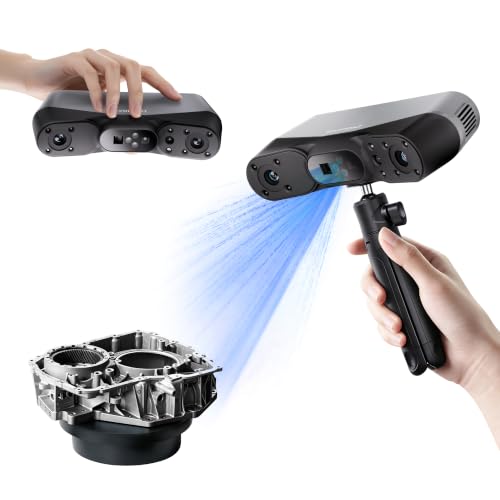
- Five modes cover detailed, rapid, laser, and deep-hole scanning
- Scans objects up to 2 × 2 × 2 m
- Wireless battery grip supports up to four hours of scanning
Best For: Mixed-size, mixed-material, and outdoor scanning
Best Wireless Workflow

- VCSEL mode is optimized for large-object scanning
- 17 blue-laser lines capture detail at up to 90 fps
- Wireless battery supports up to three hours of scanning
Best For: Portable indoor and outdoor scanning of large or difficult surfaces
Best Standalone Scanner

- Onboard processing, display, storage, and wireless file transfer
- Far and Near modes cover large surfaces and fine details
- Optional photogrammetry supports measured large-object capture
Best For: Portable standalone scanning and photogrammetric workflows
Best Wireless Versatility

- Scans objects up to 2 meters per side
- 0.03mm blue-laser accuracy
- Wireless, portable, and AI-assisted
Best For: Large-object scans that also require detailed capture
Best for Industrial-Scale Scanning

- Handles objects up to 2 × 2 × 2 meters
- Five modes for varied surfaces and geometry
- Fast capture with outdoor scanning support
Best For: Industrial, field, and reverse-engineering projects
Best for Medium Objects

- 0.05mm accuracy with 0.10mm resolution
- AI tracking and integrated JMStudio workflow
- Lightweight, quiet handheld design
Best For: Medium-size 3D-printing and display projects
Fast Precision Pick

- Up to 90 FPS scanning
- 0.01 mm single-frame precision
- Spray-free dark and shiny surface scanning
Best For: Fast industrial inspection and reverse engineering
Industrial Detail Choice

- Up to 0.01 mm precision
- 62-line marker-free structured light
- Automated dual-axis turntable scanning
Best For: Precision modeling and industrial measurement
Portable Outdoor Pick

- Lightweight 190g design
- Wi-Fi 6 and mobile scanning
- Color capture with optical zoom
Best For: Portable scanning and outdoor digital archiving
Top Precision Pick – Creality CR-Scan Raptor Pro
For shoppers seeking a 3d scanner for large objects, the Creality CR-Scan Raptor Pro stands out for its broad 5 mm-to-4 m scanning range, fast capture, and measurement-grade accuracy. Its blue-laser and NIR modes also make it suitable for demanding materials and professional workflows.
Best For: Large-object scanning, reverse engineering, automotive work, and detailed professional 3D capture.
Pros:
- Up to 0.02 mm accuracy and capture speeds of up to 660,000 points per second.
- Scans black, metallic, and some transparent glass surfaces without powder.
- Handles objects from 5 mm to 4 m and supports full-body scanning.
- Includes 24-bit color capture and compatibility with major 3D software.
Cons:
- Recommended computer specifications are relatively demanding.
- At 9.06 pounds, it is heavier than some portable alternatives.
The Raptor Pro is the strongest option here when accuracy, object-size flexibility, and material handling matter most. It is especially well suited to users who already have a capable Windows or Mac workstation and need professional-grade output.
Most Versatile Modes – Revopoint POP 4
The Revopoint POP 4 is a flexible 3d scanner for large objects that combines multiple scanning modes, wireless operation, and outdoor lighting support. Its maximum scan volume reaches 2 m per side, while blue-laser modes help with dark and reflective surfaces.
Best For: Users scanning varied object sizes and materials indoors, outdoors, or across industrial and creative projects.
Pros:
- Offers five scanning modes, including laser and VCSEL options.
- Supports objects up to 2 × 2 × 2 m and details as small as 10 mm.
- Provides up to 0.03 mm single-frame accuracy and high-speed capture modes.
- Includes Wi-Fi 6, a battery grip rated for up to four hours, and AI segmentation on Windows.
Cons:
- AI object segmentation is limited to Windows.
- Some advanced features and software details may require a compatible setup.
POP 4 is a good all-rounder for buyers who want one scanner to cover small parts, larger components, challenging surfaces, and field work. Its varied modes offer flexibility, although users should confirm their computer and software compatibility before buying.
Best Wireless Workflow – EINSTAR 2
The EINSTAR 2 is a practical 3d scanner for large objects for users who value cordless operation and straightforward field mobility. Its VCSEL infrared mode is designed for large objects, while the 17-line blue-laser mode adds detail and speed for smaller and medium-sized work.
Best For: Portable scanning of large objects, black or reflective surfaces, and projects that move between studio and outdoor locations.
Pros:
- VCSEL infrared scanning captures large objects with detailed single-scan coverage.
- Blue-laser scanning reaches up to 90 fps for faster capture.
- Wireless operation provides up to three hours of scanning with a swappable battery.
- Works on black and reflective objects without spray and supports bright-light scanning.
Cons:
- Battery runtime is shorter than some competing wireless options.
- Wi-Fi interference may require switching to a cable connection.
The EINSTAR 2 makes the most sense for buyers prioritizing portability and material adaptability over the highest stated precision. Its wireless design and outdoor-light performance are useful for large objects that cannot easily be brought into a controlled workspace.
Best Standalone Scanner – Revopoint MIRACO Plus
The Revopoint MIRACO Plus is a self-contained 3d scanner for large objects with onboard processing, a built-in display, and near and far scanning modes. Its optional photogrammetric kit is particularly useful for preserving small details across large objects while supporting measured capture.
Best For: Portable large-object scanning, photogrammetry, color models, and workflows that benefit from scanning without a computer.
Pros:
- Far mode captures large surfaces, while Near mode handles small details.
- Photogrammetric kit supports length accuracy of 0.02 mm + 0.05 mm × L(m).
- Built-in 32GB RAM, 256GB storage, 6-inch display, and onboard processing reduce reliance on a PC.
- 48MP color capture, multiple export formats, and up to 20 fps continuous scanning support varied workflows.
Cons:
- The Revo Design scan-to-CAD software is sold separately.
- Continuous scanning battery life is rated at up to two hours.
- The photogrammetric kit is an additional accessory.
MIRACO Plus is a compelling choice when portability and standalone operation are central requirements. It offers a well-integrated scanning experience, but buyers pursuing CAD conversion or photogrammetric measurement should budget for the separately sold tools and kit.
Best Wireless Versatility – Creality Pika
The Creality Pika is a strong choice if you need a 3d scanner for large objects but also want enough precision for small parts. Its NIR structured-light mode supports objects up to 2,000 × 2,000 × 2,000 mm, while the blue-laser mode reaches 0.03mm accuracy for detailed capture.
Best For: Users scanning life-size objects, bodies, mechanical parts, and collectibles in locations where wireless operation and portability matter.
Pros:
- Scans objects from 10 × 10 × 10 mm up to 2,000 × 2,000 × 2,000 mm.
- Dual blue-laser and NIR structured-light modes cover detailed and full-body scanning.
- Compact 260g design, Wi-Fi 6, dual batteries, and outdoor operation up to 110,000 lux.
- Supports marker-free scanning and exports STL, OBJ, PLY, and ASC files.
Cons:
- The full feature set may be more than casual users need.
- Battery-powered wireless scanning requires managing charge levels during longer sessions.
Choose the Pika when range and mobility are priorities. Its broad scan volume, high frame rate, and AI-assisted hole filling make it a flexible option for large-object workflows without giving up fine-detail capability.
Best for Industrial-Scale Scanning – Revopoint POP 4
The Revopoint POP 4 is designed for demanding workflows and qualifies as a 3d scanner for large objects with a maximum scan volume of 2 × 2 × 2 meters. Multiple scanning modes, fast frame rates, and support for dark or reflective surfaces make it especially adaptable for industrial and field applications.
Best For: Reverse engineering, construction, archaeological, and industrial users who need large-object coverage, outdoor capability, and multiple capture modes.
Pros:
- Supports scan volumes from 10 × 10 × 10 mm up to 2 × 2 × 2 m.
- Offers five modes, including laser options for dark, reflective, and deep-hole surfaces.
- Reaches up to 105 fps in multi-line laser mode and 5,000,000 points per second in structured-light mode.
- Wi-Fi 6 connectivity enables wireless operation and cross-screen previews.
Cons:
- The outdoor filter is sold separately.
- The 5500mAh battery grip is also an optional accessory.
- AI object segmentation is limited to Windows.
The POP 4 stands out for versatility rather than simplicity. Its extensive mode selection and outdoor-light specifications are useful when scanning conditions vary, though the optional accessories and Windows-only AI feature should be considered when planning a mobile workflow.
Best for Medium Objects – 3DMakerpro Moose Lite
The 3DMakerpro Moose Lite is a practical handheld option for medium-sized projects. While its 1,500mm maximum scan range is smaller than some choices for a 3d scanner for large objects, its 0.05mm accuracy, AI tracking, and streamlined software make it well suited to models, display pieces, and 3D-printing work.
Best For: Makers and creators scanning medium objects up to 1.5 meters for printing, display, or detailed digital models.
Pros:
- Provides 0.05mm accuracy and 0.10mm resolution.
- AI visual tracking and point-cloud processing help simplify scanning.
- JMStudio combines scanning, editing, and optimization in one software workflow.
- Lightweight 250g design with quiet, fan-free operation.
Cons:
- Its 1,500mm scan range is smaller than scanners supporting 2-meter objects.
- The listed scanning speed is 10 fps.
- The supplied notes identify it as a medium-object scanner rather than a full-size body or industrial scanner.
Moose Lite makes the most sense when portability and approachable software matter more than maximum scan size. It offers solid stated accuracy for medium objects, but users regularly capturing very large subjects should consider a model with a larger supported volume.
Fast Precision Pick – Revopoint MetroY Ultra
If you need a 3d scanner for large objects that can also handle demanding inspection work, the Revopoint MetroY Ultra emphasizes speed, precision, and flexible scanning modes. Its 34-laser cross-line mode is suited to larger areas, while blue laser scanning supports dark, shiny, and metallic surfaces without scanning spray.
Best For: Industrial inspection, reverse engineering, and fast scans of medium-sized or larger components.
Pros:
- Up to 90 FPS with an NVIDIA GPU and 60 FPS with CPU processing.
- Up to 0.01 mm single-frame precision and 0.015 + 0.04 mm × L (m) volumetric accuracy.
- Works on dark, glossy, and metallic parts without spray and supports outdoor scanning up to 100,000 lux.
- Wi-Fi 6, a 5,500 mAh battery grip, and exports to formats including STL, OBJ, PLY, and 3MF.
Cons:
- The listed Windows setup requires at least 32GB of RAM and an RTX 3060-class GPU.
- The notes describe coverage from small parts to medium-sized objects, rather than very large structures.
The MetroY Ultra is the strongest fit here when acquisition speed and measurement-oriented accuracy matter most. Its demanding computer requirements are worth planning for before purchase.
Industrial Detail Choice – Revopoint MetroX Pro
The Revopoint MetroX Pro is a practical 3d scanner for large objects when you want industrial-grade detail, multiple laser patterns, and automated capture options. Its cross-line mode helps cover flat or reflective surfaces efficiently, while structured light can capture feature-rich objects without markers.
Best For: Precision modeling, industrial measurement, reverse engineering, and repeatable scanning workflows.
Pros:
- Up to 0.01 mm single-frame precision and 0.02 mm single-frame accuracy.
- Offers 30 cross-line lasers, 15 parallel lines, and 62-line blue structured light.
- Scans shiny or dark surfaces without spray and supports up to 7 million points per second in structured-light mode.
- Dual-axis turntable scanning, RGB color capture, and feature, marker, and global-marker tracking provide workflow flexibility.
Cons:
- Revo Design and Revo Measure are paid separately and support Windows only.
- The listed package weight is 14.82 pounds, making it less convenient for highly mobile work.
Choose the MetroX Pro if your large-object scanning projects benefit from high detail, multiple tracking methods, and automated turntable capture. It is especially compelling for users already working in a Windows-based professional workflow.
Portable Outdoor Pick – Revopoint INSPIRE 2
For buyers seeking a lightweight 3d scanner for large objects and on-location work, the Revopoint INSPIRE 2 combines wireless operation, infrared structured light, and multi-line laser scanning. It is designed for varied materials and environments, including dark or reflective surfaces, while its RGB camera adds color information to captured models.
Best For: Portable scanning, outdoor work in shaded or semi-bright conditions, product design, and digital archiving.
Pros:
- Weighs just 190g and includes a tripod, markers, mini turntable, calibration board, and outdoor filters.
- Dual scanning modules support infrared structured light and 11 infrared laser lines.
- Captures dark or reflective surfaces without scanning spray and supports outdoor scanning up to 20,000 lux.
- Wi-Fi 6, full-color texture capture, and 1.5x or 2x optical zoom support flexible field work.
Cons:
- Its stated outdoor lighting limit is lower than the MetroY Ultra’s 100,000-lux capability.
- Revo Design is paid separately and supports Windows only.
- The 0.1 mm fused point distance is less fine than the MetroY Ultra’s 0.05 mm specification.
The INSPIRE 2 is the most travel-friendly option in this group. Its low weight, mobile connectivity, color capture, and included accessories make it a sensible choice when portability matters more than maximum measurement precision.
How We Picked the Best 3d Scanner for Large Objects
We evaluated these scanners by focusing on the demands of oversized subjects: reliable tracking across broad surfaces, useful scan volume, capture speed, resolution, portability, connectivity, and workflow flexibility. We also considered whether a scanner can handle difficult transitions, dark or textured surfaces, outdoor use, and long scanning sessions without becoming cumbersome.
Accuracy figures are important, but they are not the whole story. A highly accurate scanner can still be frustrating if it loses alignment, requires excessive markers, or produces files that need extensive cleanup. Models with multiple scanning modes, intelligent alignment, body completion, wireless operation, or strong processing features may be more practical for real-world projects.
Quick Comparison
| What to Compare | Why It Matters for Large Objects |
|---|---|
| Scanning technology | Laser and structured-light modes can improve tracking, detail, or versatility across different surfaces. |
| Tracking and alignment | Stable tracking helps prevent drift when scanning large areas or moving around a subject. |
| Capture speed | Higher frame rates reduce the time needed for large surfaces and moving subjects. |
| Connection type | Wireless or self-contained models are easier to use around vehicles, machinery, and outdoor subjects. |
| Software workflow | Alignment, hole filling, texture capture, and export tools can save hours after scanning. |
Key Buying Factors for a 3d Scanner for Large Objects
Accuracy, Resolution, and Working Distance
Choose accuracy according to the finished part, not the marketing maximum. Large objects often benefit from a comfortable working distance and dependable area coverage more than ultra-fine detail. Check whether the quoted accuracy applies to a particular mode, distance, or marker setup.
Tracking on Broad or Featureless Surfaces
Large, smooth, symmetrical, glossy, or dark objects can challenge optical tracking. Laser modes, markers, reference points, and texture capture may improve reliability. If you scan vehicles or industrial equipment, prioritize a model known for stable alignment across long passes.
Speed, Ergonomics, and Power
A lightweight scanner with a high frame rate is easier to use for extended sessions. Wireless operation and an integrated battery are valuable when the subject is too large to position conveniently beside a computer. For studio work, a tethered scanner may offer a simpler and more predictable setup.
Software and Output Compatibility
Confirm that the scanner exports the formats your CAD, modeling, reverse-engineering, or 3D-printing software accepts. Look for dependable mesh processing, marker management, alignment, hole filling, and texture options rather than judging the hardware alone.
Who Should Buy Which 3d Scanner for Large Objects?
Choose a laser-focused model if you need detailed reverse engineering, accurate parts, or stronger performance on challenging surfaces. A multi-mode scanner is the better all-purpose choice for users scanning everything from small components to furniture, vehicles, or body-sized subjects.
Wireless or all-in-one models suit mobile professionals, field technicians, and anyone scanning large objects away from a permanent workstation. Faster scanners are worthwhile for large equipment, vehicles, and moving subjects, while a more affordable standard model can be sufficient for occasional 3D printing and hobby projects.
Before buying, verify the included software, required computer specifications, calibration process, accessories, and support for your intended operating system. The best 3d Scanner for Large Objects is the one that combines adequate accuracy with dependable tracking and a workflow you will actually use.