The best planetarium projectors for children can turn bedtime, playrooms, and early astronomy lessons into engaging visual experiences. The options in this roundup range from simple galaxy lamps to more feature-rich projectors with solar-system discs, constellation scenes, timers, remotes, and soothing sounds.
Use the guide below to compare educational value, projection quality, controls, safety, and room-friendly features before choosing a model for your child.
Best 10 Planetarium Projectors for Children Picks for 2026
Best Astronaut Design

- Eight nebula effects with breathing green stars
- Remote control and 45/90-minute timer
- Adjustable astronaut head and decorative design
Best For: Kids’ bedrooms and calming space-themed ambience
Best Educational Pick
Dual-Mode Astronomy Planetarium

- Accurate northern and southern hemisphere star maps
- Includes four James Webb image disks
- Tabletop or wall use with three timer settings
Best For: STEM learning and children ages 8 and up
Best Variety of Scenes
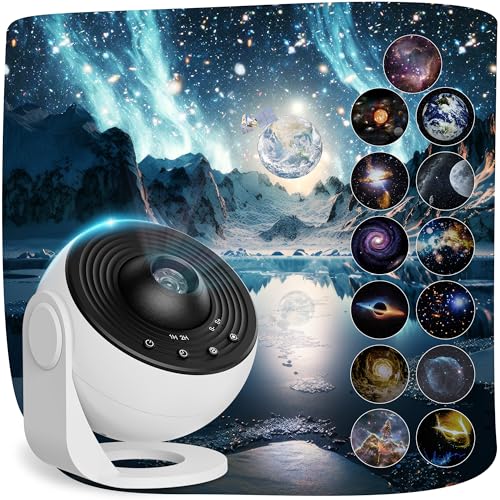
- Thirteen astronomy-themed projection discs
- 360-degree positioning and adjustable focus
- Multiple timer settings with quiet operation
Best For: Changing displays in kids’ rooms and family spaces
Best Meteor Effect
Focusable Moon Nebula Projector

- Includes a replaceable Moon Nebula disc
- Built-in focus knob for sharper images
- Dynamic meteor effect adds movement
Best For: Calming bedtime ambience and space-themed decor
Best Hands-On Option
Astronaut Galaxy Disc Projector

- 13 HD space-themed film discs
- Adjustable focus and magnetic positioning
- 1- or 2-hour timer plus default shutdown
Best For: Kids who enjoy interactive space displays
Best Beginner Pick
TOURACE Solar System Night Light

- Six interchangeable themed transparencies
- Three brightness levels and three light colors
- Projects on walls and ceilings; rotating mode
Best For: Young children needing a simple night light
Best for Sensory-Rich Space Exploration

- 16 HD space and dinosaur projection scenes
- 29 soothing sounds plus Bluetooth audio
- Remote control and 1-, 2-, and 4-hour timers
Best For: Children’s bedrooms and sensory-friendly bedtime routines
Best for Variety and Hands-On Learning

- 25 replaceable space and ocean film discs
- 360° adjustable stand for walls or ceilings
- Simple setup with focus adjustment and timers
Best For: Kids who enjoy interactive scene switching
Best for Large-Area Projection

- 13 HD astronomy-themed projection discs
- 135–754 square feet of stated coverage
- 360° rotation and multiple automatic shutoff options
Best For: Large ceilings or walls in dark indoor rooms
Best Astronaut Design – Adjustable Galaxy Night Light
For shoppers comparing planetarium projectors for children, this astronaut-shaped model emphasizes relaxing ambience and simple room-friendly controls. It projects eight nebula effects with breathing green stars, while the adjustable head helps direct the display toward a wall or ceiling.
Best For: Children’s bedrooms, calming bedtime lighting, and space-themed room decor.
Pros:
- Offers eight nebula effects with breathing green stars.
- Remote adjusts brightness, rotation speed, and breathing rate.
- Includes 45- and 90-minute auto-off timer settings.
- Magnetic head, removable moon base, and posable arm add flexibility and decorative appeal.
Cons:
- Power adapter and remote battery are not included.
- Its lighting is atmosphere-focused rather than an educational star-map experience.
This is a good choice when the priority is a soothing, visually appealing night light with an astronaut theme. Buyers should plan to supply a compatible adapter and battery before use.
Best Educational Pick – Dual-Mode Astronomy Planetarium
Among planetarium projectors for children, this STEM-oriented set stands out for its accurate star maps and included astronomy materials. The rotating dome covers both northern and southern hemispheres, while a second projector displays space images from James Webb Space Telescope imagery.
Best For: Children ages 8 and up who want a hands-on introduction to constellations and space science.
Pros:
- Includes accurate star maps for both hemispheres.
- Rotating projection demonstrates how stars move through the night sky.
- Four image disks feature authentic James Webb Space Telescope images.
- Can sit on a tabletop or hang on a wall, with 15-, 30-, and 60-minute timers.
Cons:
- Recommended age is 8 years and up, so it may be too advanced for younger children.
- Its educational projection setup may be less focused on decorative mood lighting.
This is the strongest option here for structured learning, especially for families interested in constellations and STEM activities. The included poster, disks, and dual projection modes give children more to explore than a basic star-effect night light.
Best Variety of Scenes – 13-in-1 Galaxy Projector
This 13-in-1 model is a versatile choice for shoppers seeking planetarium projectors for children with a wide range of astronomy subjects. Its interchangeable discs cover scenes from the Solar System and Moon to black holes, galaxies, and superclusters, with a focus knob for sharper images.
Best For: Families who want varied astronomy displays for bedrooms, playrooms, or occasional space-themed activities.
Pros:
- Includes 13 projection discs, each with a brief introduction to its subject.
- Projects across walls, ceilings, or floors from distances up to 16.4 feet.
- Offers 360-degree positioning and two rotation speeds.
- Includes adjustable focus, quiet operation, and one-, two-, or four-hour shutoff options.
Cons:
- Requires a 5V/2A adapter, which is not included.
- Bright rooms can reduce projection clarity.
- Disc orientation needs attention during installation.
The large selection of discs makes this a strong pick for children who enjoy changing themes and learning about different cosmic objects. Its coverage and focus adjustment also make it more adaptable than a simple fixed-effect projector.
Best Meteor Effect – Focusable Moon Nebula Projector
For a compact option among planetarium projectors for children, this model combines a replaceable Moon Nebula disc with a dynamic meteor effect. The built-in focus knob is designed to sharpen the image on a wall or ceiling, making it suitable for bedtime ambience and space-themed decor.
Best For: Kids and adults who want a calming night light with a more dynamic, realistic-looking space presentation.
Pros:
- Includes one replaceable Moon Nebula disc for an immersive star field.
- Focus knob helps adjust projection clarity.
- Meteor effect adds movement to the cosmic display.
- Compact table-mounted design works as a nightlight or room accent.
Cons:
- Only one Moon Nebula disc is included.
- It offers less subject variety out of the box than multi-disc alternatives.
- USB cable is included, but the notes do not list a power adapter.
This projector is best when visual atmosphere matters more than a broad astronomy curriculum. The meteor effect and focus adjustment give it extra character, while the replaceable disc leaves room to expand the experience later.
Best Hands-On Option – Astronaut Galaxy Disc Projector
For children who enjoy interactive planetarium projectors, this astronaut-shaped model combines hands-on film changes with clear galaxy imagery. It includes 13 HD discs, adjustable focus, color-changing light, and timer settings, making it suitable for bedroom displays and quiet learning time.
Best For: Kids who want varied space scenes and an engaging, hands-on projector experience.
Pros:
- Includes 13 HD discs covering subjects such as the Solar System, Earth, Moon, Milky Way, and galaxies.
- Adjustable focus helps produce clearer projections in a dark room.
- Automatic 1- or 2-hour timing, plus a default 4-hour shutdown function.
- Magnetic suction design and a color-changing rocket light offer flexible positioning and night-light use.
Cons:
- Best results require a completely dark room and about 6.56 feet of distance.
- Film discs must be changed manually.
- It is corded electric and has a relatively short 30-day manufacturer-defect warranty.
This is a strong choice when you want planetarium projectors for children to offer both realistic space content and a simple activity. The manual disc system can make it more engaging than a projector with fixed scenes, while the timers help with bedtime routines.
Best Beginner Pick – TOURACE Solar System Night Light
This globe-style model is one of the more approachable planetarium projectors for children, combining a night-light function with projections for bedrooms or indoor tent use. Its adjustable brightness, three light colors, rotating mode, and interchangeable transparencies provide simple variety for younger users.
Best For: Toddlers, young children, and families looking for a simple solar-system-themed night light.
Pros:
- Projects onto walls and ceilings and can also function as a regular night light.
- Includes six transparencies with themes such as the universe, ocean, star sky, Moon, birthdays, and Christmas.
- Three brightness levels—100%, 50%, and 5%—support both room decoration and sleep use.
- Offers white, yellow, and blue light plus automatic rotation.
Cons:
- The included transparencies provide fewer space scenes than the 13-disc models.
- It is intended for indoor use and is not water resistant.
- Operation uses push-button or touch controls rather than a listed remote.
The TOURACE is a practical starter option for children who need a decorative night light as much as a planetarium display. Choose it for straightforward controls and adjustable brightness rather than the most detailed or extensive astronomy content.
Best for Larger Rooms – 13-Scene HD Planetarium Projector
For families comparing planetarium projectors for children that can cover a larger area, this 13-scene projector supports projections up to 16.4 feet and an area of about 754 square feet. Its adjustable focus, 360-degree positioning, quiet operation, and auto-off timer make it useful for bedrooms, home theaters, and shared family spaces.
Best For: Families wanting detailed space scenes across a larger wall or ceiling area.
Pros:
- Includes 13 scenes featuring the Solar System, Earth, Moon, Milky Way, galaxies, and nebulae.
- Adjustable focus supports clearer images at different distances.
- Projects onto ceilings, walls, and floors with a 360-degree rotatable angle.
- Designed for quiet operation and includes a timing shutdown function.
Cons:
- The image rotation is intentionally slow, which may not suit children expecting fast movement.
- It is for indoor use and is not waterproof.
- Focus must be adjusted manually by turning the top knob.
This model stands out when projection coverage matters more than a toy-like design. Its broad range and quiet operation make it well suited to bedtime or family viewing, while the 13 films give children plenty of astronomy-themed scenes to explore.
Best for Sensory-Rich Space Exploration – 16-in-1 Galaxy Projector
For planetarium projectors for children that combine space visuals with calming audio, this model offers 16 HD projection discs, including the Solar System, planets, nebulae, Earth, and dinosaur-themed scenes. Its built-in sound machine, Bluetooth speaker, remote, and sleep timer make it more versatile than a basic projector.
Best For: Children’s bedrooms, sensory-friendly spaces, and families wanting both educational space imagery and soothing bedtime sounds.
Pros:
- Includes 16 themed HD projection scenarios with space and dinosaur subjects.
- Offers 29 built-in sounds, including nature sounds, white noise, and lullabies.
- Combines projection, Bluetooth audio, remote control, and 1-, 2-, and 4-hour timers.
- Includes a stated 36-month quality guarantee and certifications including FCC, CE, and RoHS.
Cons:
- The many audio and lighting features may be more than younger children need.
- The notes do not specify the projection distance or coverage area.
This is a strong multifunction choice if bedtime sound support matters as much as the projected sky. Families focused mainly on simple, hands-on astronomy lessons may prefer a projector with more clearly defined projection specifications.
Best for Variety and Hands-On Learning – 25-in-1 Planetarium Projector
This option stands out among planetarium projectors for children with 25 replaceable film discs covering the Solar System, Milky Way, black holes, superclusters, ocean scenes, and more. A simple three-step setup, adjustable focus, rotating stand, and auto-off timer make it practical for independent use in a child’s room.
Best For: Kids who enjoy switching between astronomy and ocean-themed scenes, and families seeking a projector with broad room coverage.
Pros:
- Provides 25 interchangeable projection discs, including educational space subjects.
- Projects onto ceilings, walls, or other surfaces with a 0–360° adjustable stand.
- Supports up to a 3-meter projection distance and a 135-square-foot projection area.
- Uses a simple insert, switch-on, and focus-adjustment process designed for kids.
Cons:
- Only two auto-off timer options are listed: one and two hours.
- Its tabletop design requires a suitable indoor placement area.
- It does not include audio or Bluetooth features in the supplied details.
With the largest disc selection in this group, this model is especially appealing for children who like variety and hands-on swapping of scenes. It is less suitable if music playback or built-in bedtime sounds are priorities.
Best for Large-Area Projection – 13-in-1 Star Projector
For shoppers comparing planetarium projectors for children by room coverage, this 13-in-1 model offers adjustable 360° rotation and a stated projection range of 1.5 to 16 feet. Its discs feature the Solar System, Earth, Moon, galaxies, black holes, wormholes, and superclusters, while the focus knob and timed shutoff keep operation straightforward.
Best For: Children or families wanting realistic-looking cosmic scenes spread across a larger ceiling or wall.
Pros:
- Includes 13 HD discs featuring planets, galaxies, nebulae, black holes, and superclusters.
- Projects from 1.5 to 16 feet and covers a stated 135 to 754 square feet.
- Offers 360° rotation for projecting onto walls, floors, or ceilings.
- Includes one- and two-hour timers, plus a four-hour automatic shutoff.
Cons:
- Offers fewer projection discs than the 25-in-1 alternative.
- It is USB-powered and does not list a built-in sound machine or speaker.
- The notes recommend using it in a dark indoor environment for best results.
This is the most compelling pick when projection scale and cosmic imagery are the priorities. Its simpler feature set keeps the focus on the visuals, but families seeking audio or more scene variety may want another option.
How We Picked the Best Planetarium Projectors for Children
We focused on features that matter in real children’s rooms rather than counting visual effects alone. Our selection includes projectors with astronomy-themed discs or scenes, plus versatile galaxy lights suited to bedtime and relaxation. We considered projection variety, ease of operation, timer and remote functions, rotation, sound options, room usability, and the balance between educational content and decorative appeal.
Because product names and included accessories can vary by seller, check the current listing for exact disc counts, power requirements, dimensions, age guidance, and included adapters before ordering.
Quick Comparison
- Best for learning: Choose a model that includes labeled or recognizable solar-system and constellation discs.
- Best for bedtime: Look for adjustable brightness, quiet operation, automatic shutoff, and calming sound options.
- Best for flexible room decor: Galaxy projectors with multiple color modes, rotation, remotes, and timers are easiest to adapt.
- Best for younger children: Prioritize simple controls, stable construction, and a projector that does not require frequent disc changes.
- Best for older children and teens: More scenes, soundtracks, ocean effects, and gaming-room lighting may provide longer-lasting appeal.
Key Buying Factors for Planetarium Projectors for Children
Educational Content
A decorative star field is not the same as a planetarium lesson. For astronomy practice, favor projectors with solar-system, moon, or constellation slides. Disc-based systems can offer clearer subject-specific content, while app-style or multicolor galaxy lights usually emphasize atmosphere over accuracy.
Projection Quality and Coverage
Check whether the projector creates sharp images or primarily colored light. Rotation and wide-angle coverage help fill a ceiling, but a bright projection can be distracting in a small bedroom. Adjustable brightness is particularly useful for bedtime.
Controls, Timer, and Sound
A remote control makes it easier to change scenes from bed, while a timer prevents the unit from running all night. Built-in sounds can be useful for relaxation, but confirm that volume can be reduced or disabled.
Safety and Durability
Use the projector according to its instructions, keep ventilation openings clear, and place it where children cannot pull it down. For younger users, avoid models with small removable parts unless an adult supervises use. A stable base and cool-running LED light are practical advantages.
Who Should Buy Which Planetarium Projectors for Children?
Choose a STEM-oriented projector if the main goal is learning planets, constellations, and basic astronomy. Choose a simple galaxy projector for a child who mainly wants colorful ceiling effects, a night light, or bedroom decor. Choose a model with sounds and many scenes for bedtime routines or sensory relaxation, provided the sound controls are easy to use. Choose a feature-rich rotating projector for older children, teens, or shared spaces where variety matters more than a strictly educational display.
Finally, match the projector to the room and routine. A compact, quiet model with a timer is usually better for sleep, while a brighter disc-based unit may work best for supervised demonstrations and family astronomy activities.