The right eyepiece can make the Moon look sharper, more detailed, and easier to study. This roundup compares 10 options across focal lengths, apparent fields of view, designs, and accessory kits.
Whether you want close-up views of craters or a flexible setup for observing the entire lunar surface, these picks cover practical choices for beginners and experienced backyard astronomers.
Best 10 Telescope Eyepieces for Moon Viewing Picks for 2026
Best Value Precision

- Four-element Plossl optics
- Comfortable rubber eyecup
- Filter-ready 1.25-inch barrel
Best For: Budget-minded Moon and planet observers
Best Wide-Field View

- Immersive 70-degree field
- 13mm eye relief
- Fully multi-coated five-element optics
Best For: Comfortable, expansive lunar viewing
Best Simple 10mm Option

- 10mm focal length
- Fully coated optical glass
- Compatible with 1.25-inch filters
Best For: Straightforward Moon and planetary observing
Best Complete Starter Set

- Two eyepieces included
- Moon filter reduces glare
- 2x Barlow and carrying case
Best For: Beginners building a versatile accessory collection
Best High-Power Detail
SVBONY 6mm 68° Wide-Angle Eyepiece

- 6mm focal length for high-magnification lunar views
- 68° field of view helps with tracking
- 17mm eye relief and fully multi-coated optics
Best For: Detailed Moon and planetary observation with a 1.25-inch telescope
Best Beginner Accessory Set
Celestron PowerSeeker Eyepieces & Filters

- Includes 15mm and 9mm Kellner eyepieces
- Moon filter helps reduce lunar glare
- Comes with color filters, cloth, and case
Best For: Beginners seeking a versatile 1.25-inch starter kit
Best Flexible Magnification
SVBONY SV135 7–21mm Zoom Eyepiece
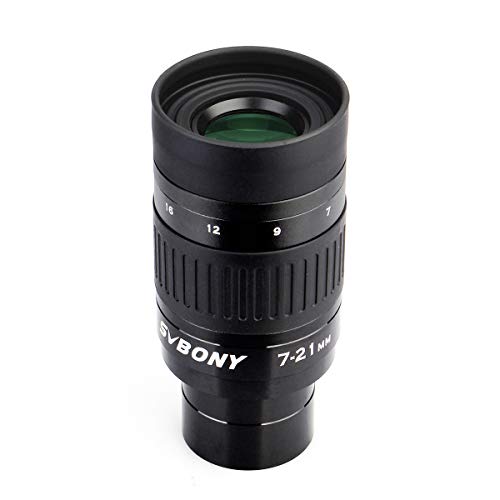
- 7–21mm range replaces several fixed focal lengths
- 40–57° field of view across the zoom range
- Long eye relief and fully multi-coated optics
Best For: Adjustable Moon and planetary viewing with one 1.25-inch eyepiece
High-Power Lunar Detail

- 4mm focal length for high-power lunar and planetary viewing
- 50° field of view with four-element, fully multi-coated optics
- 1.25-inch barrel, filter threads, and fold-down eyeguard
Best For: Close-up Moon and planet observation
Versatile Magnification Set
CelticBird Plossl Eyepiece Kit
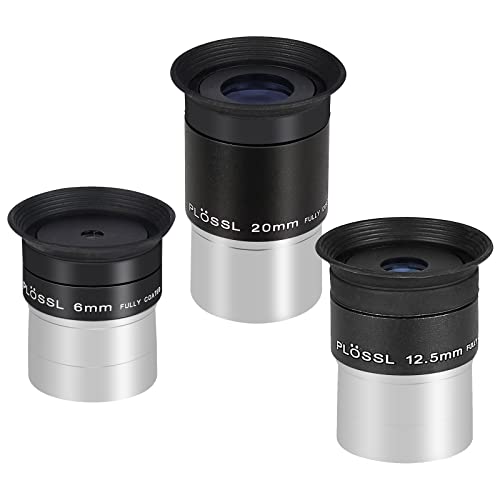
- Includes 20mm, 12.5mm, and 6mm focal lengths
- 52° field of view with fully multi-coated optics
- Metal construction and standard 1.25-inch compatibility
Best For: Flexible lunar viewing across multiple magnifications
Comfortable Wide-Field Views

- 32mm focal length for bright, lower-power views
- 19mm eye relief for comfortable extended observation
- Fully multi-coated optics with 1.25-inch filter compatibility
Best For: Broad lunar views and comfortable low-power observing
Best Value Precision – Celestron Omni 6mm
For shoppers comparing telescope eyepieces for moon viewing, the Celestron Omni 6mm is a straightforward high-magnification option. Its four-element Plossl design, rubber eyecup, and 1.25-inch filter-ready barrel suit detailed lunar and planetary observations.
Best For: Beginners and budget-conscious observers who want a dedicated 6mm eyepiece for detailed Moon and planet views.
Pros:
- Four-element Plossl optical design at an affordable price.
- Rubber eyecup can fold down for eyeglass wearers and helps improve viewing comfort.
- Blackened lens edges and matte aluminum barrel help reduce internal reflections.
- Threaded 1.25-inch barrel accepts filters.
Cons:
- The short 6mm focal length is specialized for higher-power viewing.
- It is a single eyepiece rather than a broader accessory kit.
The Omni 6mm is a practical choice when lunar detail matters more than versatility. Its included two-year US warranty and unlimited US-based support add reassurance for new astronomers.
Best Wide-Field View – SVBONY SV154 15mm
The SVBONY SV154 stands out among telescope eyepieces for moon viewing when a broader perspective is important. Its 70-degree apparent field, five-element design, and fully multi-coated optics are intended to provide bright, high-contrast views with 13mm of eye relief.
Best For: Observers who prefer a wide, immersive lunar view with comfortable eye relief.
Pros:
- Super-wide 70-degree apparent field of view.
- Five-element, four-group lens structure with fully multi-coated optics.
- 13mm eye relief and metallic twist-up eyecup support comfortable viewing.
- Safety undercut helps reduce the chance of slipping from the focuser or diagonal.
Cons:
- The 15mm focal length is less specialized for maximum lunar magnification than a shorter eyepiece.
- It uses a manual-focus, 1.25-inch mount and may require other accessories for different magnifications.
Choose the SV154 if framing and comfort are priorities. Its wide field can make lunar observing feel more expansive, while blackened lens edges and anti-reflection threading are designed to support contrast.
Best Simple 10mm Option – ZJchao Fully Coated Eyepiece
This 10mm ZJchao eyepiece is a compact option for telescope eyepieces for moon viewing and general celestial observation. Its fully coated optical glass lens and standard 1.25-inch interface are designed for brightness, clarity, and compatibility with common telescope setups and filters.
Best For: Users seeking a basic 10mm eyepiece for Moon, planet, and star-cluster observation.
Pros:
- Fully coated optical glass lens supports light transmission.
- Specially treated interior is designed to reduce stray light and improve contrast.
- Standard 1.25-inch interface works with compatible telescopes and filters.
- Wide field of view is intended to enrich observing sessions.
Cons:
- The supplied notes do not specify the exact field-of-view measurement.
- It is sold as a single eyepiece without included filters or a carrying case.
- The product information does not list a warranty.
The ZJchao is worth considering when you want a mid-range 10mm focal length and uncomplicated 1.25-inch compatibility. Its coated optics focus on clearer, higher-contrast observing without adding a larger accessory bundle.
Best Complete Starter Set – Celestron AstroMaster Kit
For beginners comparing telescope eyepieces for moon viewing, the Celestron AstroMaster Accessory Kit offers more than a single eyepiece. It combines 15mm Kellner and 6mm Plossl eyepieces with a 2x Barlow lens, Moon filter, planetary filters, cleaning cloth, and carrying case.
Best For: New astronomers who want multiple magnifications and lunar filters in one organized kit.
Pros:
- Includes both 15mm and 6mm 1.25-inch eyepieces.
- Moon filter helps reduce glare for more comfortable lunar observation.
- 2x Barlow lens expands magnification and includes T-threads for optional DSLR attachment.
- Foam-lined case keeps the eight-piece accessory set organized.
Cons:
- The kit is less targeted than buying one specialized eyepiece.
- Camera attachment requires an optional T-ring sold separately.
- Color filters are aimed at planetary viewing rather than Moon viewing.
This is the most versatile choice in the group for someone building a first astronomy accessory collection. Its two eyepieces, Barlow, Moon filter, and case provide a practical starting range, backed by Celestron’s two-year warranty and US-based support.
Best High-Power Detail – SVBONY 6mm 68° Wide-Angle Eyepiece
For telescope eyepieces for moon viewing, this 6mm SVBONY model is designed for high-magnification observation. Its 68-degree field of view, fully multi-coated optics, and 17mm eye relief make it a practical choice for examining lunar craters while keeping targets easier to center.
Best For: Detailed lunar and planetary viewing with a compatible 1.25-inch telescope.
Pros:
- 6mm focal length provides high magnification for lunar surface details.
- 68-degree wide field helps with target acquisition and tracking.
- Fully multi-coated optics and a blackened interior help reduce internal reflections.
- 17mm eye relief and a folding eyecup support comfortable viewing, including for some eyeglass wearers.
Cons:
- High magnification can be less forgiving of telescope movement or atmospheric conditions.
- Requires a telescope, diagonal, or Barlow lens that accepts 1.25-inch accessories.
This eyepiece is a focused upgrade for observers who want closer lunar and planetary views rather than a broad, low-power view. Its durable all-metal construction and included dust covers are useful for regular outdoor observing.
Best Beginner Accessory Set – Celestron PowerSeeker Eyepieces & Filters
For shoppers comparing telescope eyepieces for moon viewing, this Celestron kit offers two useful magnifications plus a dedicated Moon filter. The 15mm and 9mm Kellner eyepieces provide medium- and higher-power options, while the included case keeps the accessories organized.
Best For: Beginners who want a basic 1.25-inch eyepiece and filter collection.
Pros:
- Includes 15mm and 9mm 1.25-inch Kellner eyepieces for two viewing options.
- Moon filter helps reduce glare and reveal more lunar surface detail.
- Red and blue filters can highlight features on Mars, Jupiter, and Saturn.
- Foam-lined carrying case and cleaning cloth support storage and maintenance.
Cons:
- Fully coated Kellner optics are a more basic design than premium multi-element eyepieces.
- The kit is intended for telescopes compatible with 1.25-inch eyepieces and filters.
This is a practical starter package rather than a single specialized lunar eyepiece. It stands out by combining two focal lengths with filters and storage, making it convenient for new observers building an accessory collection.
Best Flexible Magnification – SVBONY SV135 7–21mm Zoom Eyepiece
Among telescope eyepieces for moon viewing, the SVBONY SV135 is useful when you want to vary magnification without changing eyepieces. Its 7–21mm zoom range covers lower- to higher-power observation, while fully multi-coated, six-element optics are designed for sharp lunar and planetary views.
Best For: Observers who want adjustable magnification for the Moon, planets, and other targets.
Pros:
- 7–21mm zoom range provides multiple focal lengths in one eyepiece.
- 40–57-degree field of view supports both wider and higher-power viewing.
- 18mm to 16.3mm eye relief is comfortable for many eyeglass wearers.
- Fully multi-coated, six-element design is intended to improve edge and center sharpness.
Cons:
- Field of view narrows toward the shorter focal lengths.
- A zoom eyepiece may be less specialized than a dedicated fixed-focal-length option for a particular magnification.
- Requires a telescope with a standard 1.25-inch eyepiece holder.
The SV135 is a convenient choice for observers who prefer to fine-tune framing and magnification at the telescope. Its rubber eye guard and full-metal body add practical comfort and durability for repeated visual observing.
High-Power Lunar Detail – Astromania 4mm Plossl
For telescope eyepieces for moon viewing, this 4mm Astromania Plossl is aimed at high-power observation when your telescope and conditions can support it. Its 50-degree field of view, four-element fully multi-coated optics, and standard 1.25-inch barrel make it a focused option for examining lunar and planetary details.
Best For: Lunar detail, planets, and observers who want a compact high-power eyepiece.
Pros:
- 4mm focal length supports high magnification for lunar and planetary viewing.
- Four-element, fully multi-coated optics are designed for bright, sharp images and color correction.
- Standard 1.25-inch barrel and filter threads support broad accessory compatibility.
- Fold-down rubber eyeguard can improve comfort for eyeglass wearers.
Cons:
- The fixed 4mm focal length is less versatile than a multi-eyepiece kit.
- High-power viewing can be more demanding of telescope alignment and atmospheric conditions.
This is a practical choice if your priority is close-up Moon and planet viewing rather than low-power, wide-field scanning. The included dust caps and lightweight aluminum body also make it convenient to store and carry.
Versatile Magnification Set – CelticBird Plossl Eyepiece Kit
This CelticBird kit is a flexible starting point for telescope eyepieces for moon viewing because it includes 20mm, 12.5mm, and 6mm Plossl eyepieces. The range lets you move from broader lunar views to higher magnification, while the standard 1.25-inch fit works with compatible telescopes and filters.
Best For: Beginners and observers who want several lunar magnification options in one kit.
Pros:
- Three focal lengths provide low-, medium-, and high-power viewing options.
- Fully multi-coated optics are designed to improve light transmission, brightness, and contrast.
- 52-degree apparent field of view offers a spacious viewing experience.
- Metal construction and blackened internal surfaces help with durability and stray-light control.
Cons:
- The kit requires a telescope with a 1.25-inch focuser.
- It does not include a 4mm or shorter focal length for the most extreme magnification.
For shoppers building an eyepiece collection, this set offers more flexibility than a single fixed focal length. It is also suited to medium star clusters, nebulae, and deep-sky targets when you want to use the same kit beyond lunar observation.
Comfortable Wide-Field Views – SVBONY SV131 32mm Plossl
For telescope eyepieces for moon viewing, the SVBONY SV131 32mm Plossl is geared toward bright, comfortable, lower-power views rather than close-up lunar detail. Its 19mm eye relief, 48-degree field of view, and fully multi-coated optics make it useful for taking in larger portions of the Moon and locating targets.
Best For: Comfortable wide-field lunar viewing, especially for eyeglass wearers and extended observing sessions.
Pros:
- 19mm eye relief supports more comfortable longer viewing sessions.
- Fully multi-coated optics and blackened lens edges are designed to improve clarity and reduce stray light.
- Standard 1.25-inch mount and filter threads support compatible accessories.
- All-metal construction includes a rubber anti-slip ring for handling.
Cons:
- The 32mm focal length is intended for lower power and is not the strongest choice for fine lunar detail.
- Its 48-degree field of view is narrower than the 52-degree field offered by the CelticBird kit.
This eyepiece makes sense as a comfortable low-power complement to a shorter focal-length model. It can also serve broader observing tasks, including nebulae, star clusters, and comets, while remaining filter-compatible.
How We Picked the Best Telescope Eyepieces for Moon Viewing
We focused on eyepieces that suit lunar observation across common beginner and intermediate telescope setups. The selection includes short focal lengths for higher magnification, wider-angle designs for easier tracking, Plössl options for straightforward optical performance, zoom eyepieces for flexibility, and kits that provide multiple focal lengths and filters.
We also considered practical details such as 1.25-inch barrel compatibility, apparent field of view, eye relief, optical coatings, construction, and whether an eyepiece is useful beyond the Moon. Because telescope performance depends on focal length and aperture, no single eyepiece is ideal for every observer.
Quick Comparison
- For high magnification: Choose a 4mm or 6mm eyepiece when your telescope and atmospheric conditions support detailed close-ups.
- For a wider lunar view: A 68- or 70-degree apparent field can make framing and tracking more comfortable.
- For flexibility: A 7–21mm zoom provides several magnification levels without changing eyepieces.
- For beginners: An accessory kit offers multiple focal lengths and filters in one purchase.
- For low-power viewing: A 32mm eyepiece can help locate the Moon and frame larger areas of sky.
Key Buying Factors for Telescope Eyepieces for Moon Viewing
Focal Length and Magnification
Magnification equals your telescope’s focal length divided by the eyepiece focal length. Shorter eyepieces produce more magnification, but extremely high power can create a dimmer, softer, or shakier image. A 6mm option is often a useful high-power starting point, while 10mm to 12.5mm models provide a more forgiving middle range.
Apparent Field of View
A wider apparent field shows more sky and gives the Moon more room before it drifts out of view, especially with a manual mount. Wide-angle eyepieces can be more comfortable for tracking, although field size alone does not guarantee better edge sharpness.
Eye Relief and Optical Coatings
Longer eye relief is helpful for observers who wear glasses and can make extended sessions more comfortable. Fully coated or multicoated optics can improve light transmission and reduce distracting reflections. Keep lenses capped and clean them only when necessary.
Compatibility and Telescope Limits
Most options here use a standard 1.25-inch barrel, but confirm your focuser size before ordering. Check your telescope’s practical maximum magnification as well; atmospheric turbulence and mount stability often limit useful power before the eyepiece does.
Who Should Buy Which Telescope Eyepieces for Moon Viewing?
Beginners building a kit: Choose a multi-eyepiece accessory set for several focal lengths and included filters. It is a convenient way to experiment before investing in specialty glass.
Moon and planet detail seekers: Consider a 4mm, 6mm, or 10mm eyepiece, depending on your telescope’s focal length and aperture. These are best when the air is steady and the mount is stable.
Observers who dislike frequent changes: A zoom eyepiece offers fast framing adjustments and lets you reduce magnification when seeing conditions deteriorate.
Manual-mount users: A 68- or 70-degree wide-angle model can make lunar tracking less frequent and provide a more relaxed viewing experience.
Glasses wearers or comfort-focused viewers: Prioritize generous eye relief, particularly for longer observing sessions. A slightly lower magnification with a comfortable view is often more enjoyable than maximum theoretical power.