Educational planetarium projectors can turn a bedroom, classroom, or homeschool lesson into an engaging introduction to astronomy. The best models balance clear projections with age-appropriate learning features, useful accessories, and simple setup.
This roundup compares ten options, from beginner-friendly science kits and speaking projectors to rechargeable models with constellation, solar system, and deep-space discs.
Best 10 Educational Planetarium Projectors Picks for 2026
Classic STEM Exploration
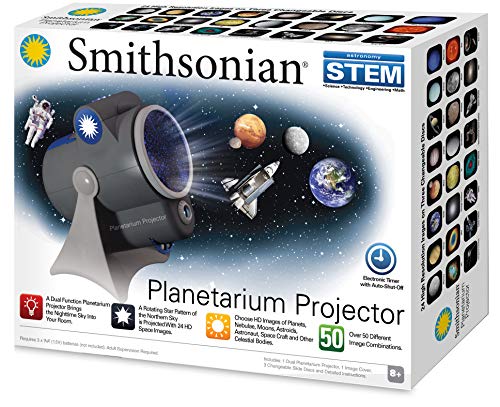
- Rotating Northern Sky star pattern
- 24 HD images with 50+ combinations
- Night-light mode and auto shutoff
Best For: Children ages 8 and up exploring stars and space images
High-Detail Relaxation

- 2-megapixel lens with 5K disc design
- Disc options include stars, planets, and Milky Way
- Rechargeable, plug-in, timer, and rotation features
Best For: Detailed space ambiance, relaxation, and casual astronomy viewing
Interactive Learning Pick

- Projects all eight planets
- Bilingual English and Spanish facts
- 24 images plus night-light functionality
Best For: Younger children learning basic solar-system concepts
NASA Image Explorer
Brainstorm Deep Space Planetarium

- 24 color NASA images on three discs
- Rotating star and constellation patterns
- Night-light dome and online learning code
Best For: Home astronomy activities built around NASA imagery
Best for Young Stargazers
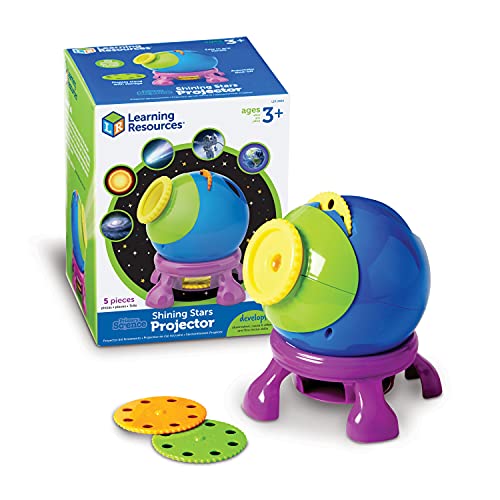
- Projects stars, planets, and space scenes up to 10 feet
- Includes 3 discs with 24 colorful images
- Suitable for ages 3 and up
Best For: Early science learning, imaginative play, and bedtime viewing
Best for Accurate Star Maps

- Includes northern and southern hemisphere star maps
- Projects James Webb Space Telescope images
- Features rotating maps and an auto-off timer
Best For: Ages 8 and up, constellation study, and STEM learning
Best for Bilingual Learning

- Provides English and Spanish learning support
- Projects motorized 360-degree constellations
- Includes 24 space images and two constellation domes
Best For: Bilingual STEM learning and introductory astronomy
Most Versatile
Galaxy Projector With Sound Machine

- 16 HD space and dinosaur projection scenes
- 29 soothing sounds plus Bluetooth 5.3 audio
- Remote control and 1/2/4-hour timer
Best For: Families seeking educational projections with calming audio features
Best for Wide Coverage

- 13 educational space and astronomy scenarios
- Up to 754 square feet of stated coverage
- 360-degree rotation with adjustable focus
Best For: Large rooms and learners exploring varied celestial topics
Classic STEM Exploration – Smithsonian Room Planetarium
Smithsonian Optics Room Planetarium and Dual Projector Science Kit, Black/Blue, Age 8 and Up
Check Price On AmazonFor families comparing educational planetarium projectors, this Smithsonian kit combines a rotating Northern Hemisphere star pattern with interchangeable space-image discs. It is designed for children ages 8 and up and offers more than 50 image combinations, including planets, nebulae, moons, astronauts, and spacecraft.
Best For: Kids who want a hands-on room planetarium with both star patterns and space photography.
Pros:
- Projects a rotating Northern Sky star pattern.
- Includes 24 HD images across four changeable slide discs.
- Can function as a night-light and includes an automatic shutoff timer.
Cons:
- Batteries are not included.
- Recommended for ages 8–15, so it may be less suitable for younger children.
- There is no manufacturer warranty listed.
This is a practical choice when you want a dedicated educational space toy rather than a purely decorative galaxy lamp. Its rotating projection and broad image selection support repeated astronomy-themed exploration.
High-Detail Relaxation – POCOCO Galaxy Projector
Among educational planetarium projectors, the POCOCO Galaxy Projector stands out for its high-detail optical system and broad disc selection. Its 2-megapixel lens and 5K disc design display constellations, star fields, the Milky Way, and planetary scenes, while rechargeable, plug-in, and timer options add flexibility.
Best For: Older children, teens, and adults who want detailed astronomy-themed projections for study, relaxation, or bedroom ambiance.
Pros:
- Uses a 2-megapixel lens and 5K Ultra HD disc design.
- Supports multiple disc series, including constellations, the Milky Way, and planets.
- Offers adjustable projection angle, rotation, timers, and battery or plug-in power.
Cons:
- The included package lists only two discs, so additional subjects may require separate disc sets.
- It is not waterproof.
- Its primary design emphasizes ambiance and relaxation rather than interactive lessons.
The POCOCO is a strong fit when image detail and flexible bedroom use matter most. Buyers seeking structured, hands-on STEM activities may prefer a projector with talking facts or a larger educational slide library.
Interactive Learning Pick – Science Can Solar System Kit
This Science Can kit is one of the more interactive educational planetarium projectors for younger learners. It projects the eight planets onto a wall or ceiling, plays astronomy facts in English and Spanish, and includes three discs with 24 images covering planets, astronauts, spaceships, and space exploration.
Best For: Children ages 3 and up who benefit from bilingual audio facts, planet models, and visual projection in one activity.
Pros:
- Projects the eight-planet solar system onto a wall or ceiling.
- Provides talking astronomy facts in English and Spanish.
- Includes 24 HD images and can also serve as a night-light or flashlight.
Cons:
- Requires three AA batteries, which are not included.
- The projection is centered on solar-system content rather than a broad star map.
- Younger children may need help with assembly and disc changes.
Choose this model if active learning is more important than advanced projection detail. Its bilingual audio, physical planet components, and projection features make it especially approachable for early STEM learning.
NASA Image Explorer – Brainstorm Deep Space Planetarium
The Brainstorm Deep Space projector offers a straightforward way to compare educational planetarium projectors for home use. It projects 24 color NASA images from three interchangeable discs, adds rotating star or constellation patterns, and can convert into a night-light with its dome.
Best For: Families wanting NASA imagery, simple room projection, and an online astronomy activity for children.
Pros:
- Projects 24 color NASA images with eight images per disc.
- Displays rotating stars or constellation patterns on walls and ceilings.
- Includes a night-light dome and an online secret-code activity about the images.
Cons:
- It requires a dark room for clear projection.
- The projected image is specified at up to one meter wide, which is smaller than a full-room display.
- Only three interchangeable discs are included.
This is a balanced option for children who enjoy recognizable NASA imagery alongside simple star patterns. The included online code adds an extra learning component, while the night-light dome helps extend its use beyond astronomy activities.
Best for Young Stargazers – Shining Stars Projector
For families seeking educational planetarium projectors for younger children, the Learning Resources Shining Stars Projector offers a simple, hands-on introduction to stars, planets, and space scenes. It projects colorful images up to 10 feet and includes an activity guide for guided exploration.
Best For: Children ages 3 and up, early science learning, imaginative play, and calming bedtime routines.
Pros:
- Includes three discs with 24 colorful space images.
- Can be used handheld or placed in its stand for room viewing.
- Compact design includes a storage base and activity guide.
- Supports observation, cause-and-effect thinking, and storytelling.
Cons:
- Requires three AAA batteries, which are not included.
- Designed for younger learners, so older children may want more advanced astronomy content.
This is a practical choice when ease of use and early STEM engagement matter most. Its colorful discs and portable format make it suitable for bedrooms, classrooms, and science centers.
Best for Accurate Star Maps – Essential STEM Planetarium
Among educational planetarium projectors, the T&K Essential STEM Tools model stands out for learners who want more detailed sky observation. Its rotating star maps cover both hemispheres, while a second projector displays James Webb Space Telescope images on walls or ceilings.
Best For: Children ages 8 and up, STEM learning, constellation study, and immersive bedroom astronomy.
Pros:
- Includes accurate star maps for the northern and southern hemispheres.
- Rotating maps help demonstrate how stars move through the night sky.
- Dual-projector design combines star maps with four space-image discs.
- Offers nightlight mode and 15-, 30-, or 60-minute auto-off settings.
Cons:
- Its astronomy-focused features may be more than younger children need.
- Requires a USB-C power connection rather than batteries.
This projector is a strong fit for families prioritizing accurate constellation references and extended STEM exploration. It can sit on a tabletop or hang on a wall, adding flexibility for study or nighttime use.
Best for Bilingual Learning – LEXiBOOK Speaking Planetarium
The LEXiBOOK Speaking Planetarium is one of the more accessible educational planetarium projectors for families wanting bilingual space learning. It projects motorized 360-degree constellations, includes English and Spanish support, and adds image discs covering major space-exploration moments.
Best For: Children ages 3 and up, bilingual STEM learning, constellation introductions, and space-themed discovery.
Pros:
- Supports learning in English and Spanish.
- Motorized 360-degree projection creates a moving starscape.
- Includes two constellation domes, three image discs, a booklet, and a map.
- Built-in focal ring helps sharpen projections on walls or ceilings.
Cons:
- The supplied dimensions appear unusually small, so buyers should confirm the physical size before ordering.
- Battery details specify alkaline/NiMH but do not state the required quantity.
This model makes a compelling choice for households that value bilingual instruction and varied content. The combination of constellation domes, space images, and supporting print materials encourages both guided learning and independent exploration.
Most Versatile – Galaxy Projector With Sound Machine
For shoppers comparing educational planetarium projectors, this model combines 16 HD space and dinosaur scenes with a built-in sound machine. Its included introductions can support casual learning, while the speaker, timer, and remote make it practical for bedrooms and calming routines.
Best For: Families wanting educational projections plus soothing audio and Bluetooth playback.
Pros:
- Includes 16 themed projection cards with space-related introductions.
- Offers 29 built-in soothing sounds and Bluetooth 5.3 speaker connectivity.
- Includes remote control, 1/2/4-hour timer, and a stated 36-month quality guarantee.
Cons:
- The extensive sound and lighting features may be more than needed for straightforward astronomy lessons.
- Only one projection card is pre-installed; the remaining cards require setup.
This is the feature-rich choice for buyers who want a planetarium-style projector to double as a sleep aid, ambient light, and Bluetooth speaker. It is less focused on a simple classroom-style astronomy presentation than the dedicated disc-based alternatives.
Best for Wide Coverage – 13-in-1 Rotating Planetarium
This is a strong educational planetarium projector pick for displaying space concepts across a large wall or ceiling. Its 13 discs cover subjects from the Solar System and planets to black holes and superclusters, with included introductions to encourage learning.
Best For: Larger bedrooms, family spaces, or learners who want varied celestial topics and broad projection coverage.
Pros:
- Includes 13 space-themed scenarios, including the Solar System, Uranus, Moon, black hole, and nebulae.
- Projects up to 16.4 feet with a stated coverage area of 135–754 square feet.
- Offers adjustable focus, 360-degree rotation, two rotation speeds, and 1/2/4-hour timing options.
Cons:
- USB-powered operation requires access to a compatible power source.
- The deliberately slow rotation may not suit shoppers wanting fast-moving effects.
Its broad coverage and varied scientific subjects make this the most classroom-like option of the three for home learning. The focus adjustment is useful when changing projection distance, while quiet operation supports bedtime use.
Best for Classic Astronomy Scenes – 13-Film Planetarium Projector
For a straightforward educational planetarium projector, this model focuses on 13 realistic astronomy scenes, including the Solar System, Earth, Moon, Milky Way, Andromeda Galaxy, and deep-space images. Adjustable focus and 360-degree projection make it adaptable for ceilings, walls, and floors.
Best For: Buyers who want a simple, quiet projector centered on realistic astronomy imagery.
Pros:
- Includes 13 astronomy-focused film discs with planets, galaxies, nebulae, and deep-field imagery.
- Projects up to 16.4 feet and covers a stated area of up to 754 square feet.
- Provides adjustable focus, 360-degree projection, quiet operation, and an auto-off timer.
Cons:
- It does not list built-in educational introductions for each disc.
- The image rotation is intentionally slow, which may feel understated for decorative use.
- The supplied details describe remote control but do not specify the timer durations.
This option keeps the feature set focused on projecting astronomy imagery rather than adding audio or extensive lighting effects. It is a practical fit for home stargazing lessons, though buyers wanting narrated context may prefer a model with printed scene introductions.
How We Picked These Educational Planetarium Projectors
We focused on projectors and astronomy kits that support active learning rather than serving only as decorative galaxy lights. Key considerations included the quality and educational value of included discs or slides, age suitability, ease of operation, projection flexibility, portability, and the availability of complementary astronomy activities.
The selection spans several use cases: early-years science exploration, elementary STEM lessons, family learning, bedroom demonstrations, and more detailed constellation or deep-space viewing. Because features vary widely, buyers should match the projector to the learner’s age and intended setting instead of choosing solely by appearance or the number of lighting effects.
Quick Comparison
- Best for structured science learning: Kits that combine a projector with astronomy models, talking features, or guided activities.
- Best for younger children: Simple controls, bright images, sturdy construction, and clearly labeled educational content.
- Best for older children and families: Projectors with constellation, solar system, and deep-space discs that support discussion and repeat use.
- Best for flexible room use: Rechargeable or compact models with adjustable projection angles and easy disc changes.
- Best for atmosphere: Galaxy projectors with sound, color effects, timers, or larger room coverage, provided their learning features meet your needs.
Key Buying Factors for Educational Planetarium Projectors
Educational Content
Check exactly what is included. Constellation maps, planet images, deep-space scenes, explanatory audio, and hands-on models provide more learning value than generic star patterns. A larger disc collection can also extend the projector’s usefulness as children advance.
Age and Learning Level
Preschool and early-elementary users usually benefit from large controls and straightforward images. Older learners may prefer more accurate astronomy content, labeled projections, and activities that encourage identifying planets, stars, or constellations.
Projection and Setup
Look for a focus adjustment, stable base, suitable projection distance, and an angle that works on ceilings or walls. Confirm whether the room must be dark for clear results. Disc storage and quick swapping are practical advantages during lessons.
Power, Sound, and Safety
Battery or rechargeable operation improves portability, while an included adapter may be preferable for regular classroom use. For children’s products, review the recommended age, small-part warnings, heat considerations, and volume controls. Sleep timers and quiet operation are useful in bedrooms.
Who Should Buy Which Educational Planetarium Projectors?
Choose a dedicated science kit if the main goal is guided learning, experiments, or a classroom-ready activity. A speaking or interactive model can be especially useful for younger children who respond well to audio prompts. For families wanting a projector that grows with a child, prioritize interchangeable astronomy discs and accurate solar-system or constellation content.
If the primary purpose is relaxing room ambiance, a galaxy projector with sound and color modes may be sufficient, but it should not be treated as a substitute for an instructional planetarium tool. Portable rechargeable designs suit travel and shared rooms, while brighter, plug-in models are often better for repeated demonstrations. Before buying, confirm the included accessories, projection size, power requirements, and whether the product’s learning content matches the child’s current level.