Planetarium projectors can turn an ordinary classroom wall or ceiling into an engaging lesson about stars, planets, and constellations. The best option depends on whether you need a hands-on astronomy kit, realistic celestial projections, or a flexible projector for demonstrations and enrichment.
We compare 10 selected models across educational features, disc content, brightness, rotation, sound options, and ease of use so teachers can choose a projector that fits their teaching space and budget.
Best 10 Planetarium Projectors for Classrooms Picks for 2026
Hands-On Classroom Explorer
Smithsonian Dual Projector Science Kit
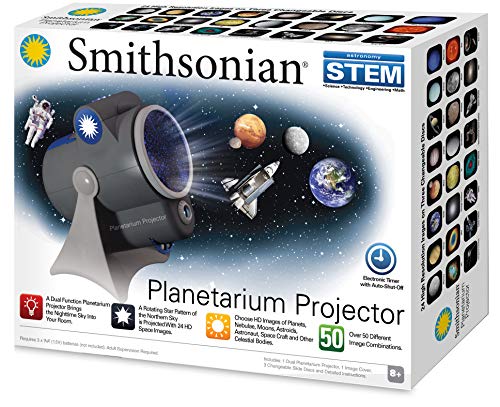
- Rotating northern-sky star pattern
- 24 HD space images on four discs
- Auto shutoff and nightlight mode
Best For: Ages 8+ STEM lessons combining stars and space images
Wide-Scene Astronomy Display
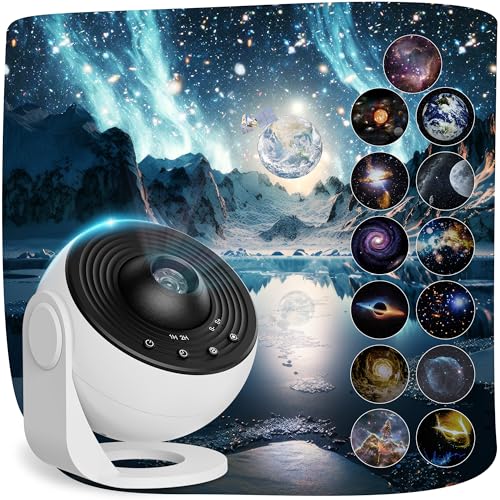
- 13 astronomy-themed projection discs
- Covers up to about 754 square feet
- Adjustable focus, rotation, and timers
Best For: Large visual displays covering diverse astronomy topics
Hemisphere Learning Kit
T&K Essential STEM Planetarium

- Accurate maps for both hemispheres
- Dual projector with Webb telescope images
- 15-, 30-, and 60-minute timers
Best For: Ages 8+ constellation and space-image lessons
Real-Sky Demonstrator

- Slowly rotating chrome-on-glass star disc
- Rechargeable and portable design
- Requires a dark room for correct viewing
Best For: Small-group constellation lessons in darkened rooms
Bright STEM Discovery

- 13 space scenes include brief educational introductions.
- 2X brighter output and 30% wider projection coverage.
- Adjustable focus, 360-degree angle, and auto-off timer.
Best For: STEM demonstrations and astronomy displays in darkened classrooms
Multisensory Space Lab

- 16 HD scenes include space, Earth, Saturn, and dinosaurs.
- Adds 29 soothing sounds and Bluetooth 5.3 audio.
- Remote control and 1-, 2-, and 4-hour timer included.
Best For: Sensory-friendly rooms and science activities using visuals and sound
Best for Wide-Area Learning Displays

- 13 space-themed projection discs
- Coverage listed up to 754 sq. ft.
- Focus adjustment and quiet 360° rotation
Best For: Group astronomy demonstrations and broad ceiling or wall displays
Best for Hands-On Classroom Use
Easy 13-Scene Galaxy Projector

- 13 solar-system, galaxy, and nebula scenes
- Three display modes and a 360° stand
- Simple insert, power, and focus setup
Best For: Small-group activities and guided astronomy exploration
Best for Calm Science Spaces
Galaxy Projector with White Noise

- 10 astronomy projection slides
- 28 built-in soothing sounds
- Up to 255 sq. ft. with focus adjustment
Best For: Quiet corners, sensory-friendly areas, and transition activities
Hands-On Classroom Explorer – Smithsonian Dual Projector Science Kit
Smithsonian Optics Room Planetarium and Dual Projector Science Kit, Black/Blue, Age 8 and Up
Check Price On AmazonFor classrooms seeking planetarium projectors for classrooms with hands-on versatility, this Smithsonian kit combines a rotating northern-sky star pattern with themed space-image slides. Its dual-function design supports both star observation and image-based lessons for learners ages 8 and up.
Best For: Elementary and middle-school STEM activities focused on the northern sky, planets, and space exploration.
Pros:
- Projects a rotating northern-sky star pattern.
- Includes 24 HD images across four changeable slide discs.
- Offers more than 50 image combinations and 360-degree motorized rotation.
- Includes an auto-shutoff timer and nightlight mode.
Cons:
- Batteries are not included.
- The star pattern covers the northern sky rather than both hemispheres.
- No manufacturer warranty is listed.
This is a practical choice when teachers want a straightforward, age-appropriate kit that mixes constellation viewing with visual space content. Plan ahead for batteries and a sufficiently dark room for clearer projections.
Wide-Scene Astronomy Display – 13-in-1 Galaxy Projector
This 13-in-1 model is one of the more flexible planetarium projectors for classrooms when the goal is to display varied astronomy subjects across a wall, ceiling, or floor. Its discs cover everything from the Solar System and Moon to galaxies, black holes, and superclusters.
Best For: Visual astronomy presentations, science displays, and classrooms that need broad projection coverage.
Pros:
- Includes 13 themed projection discs with brief subject introductions.
- Projects up to 16.4 feet away and covers approximately 135 to 754 square feet.
- Provides adjustable focus, 360-degree positioning, and two rotation speeds.
- Offers one- or two-hour timers plus a default four-hour auto-off.
Cons:
- A 5V/2A power adapter is required but not included.
- Bright rooms can reduce image clarity.
- It is USB-powered rather than battery-operated.
With its large coverage range and extensive subject selection, this projector can support visually engaging lessons in a darkened classroom. Teachers should supply a compatible adapter and test placement beforehand to ensure the desired image sharpness.
Hemisphere Learning Kit – T&K Essential STEM Planetarium
For educators comparing planetarium projectors for classrooms, the T&K Essential STEM model stands out for its accurate star maps and dual-projection setup. It includes maps for both northern and southern hemispheres, plus James Webb Space Telescope image discs for supplemental visuals.
Best For: Ages 8+ STEM instruction covering constellations, hemispheres, and space imagery.
Pros:
- Includes accurate star maps for both hemispheres.
- Uses a second projector for four space-themed image discs.
- Offers tabletop or wall-hanging use.
- Includes reduced-brightness nightlight mode and 15-, 30-, or 60-minute timers.
Cons:
- Requires a USB-C power connection.
- The supplied notes describe a small unit, which may suit focused groups better than large-room viewing.
- The product is recommended for ages 8 and up despite one conflicting age-range field.
This is a strong teaching-oriented option for lessons that compare the two hemispheres or connect authentic star maps with modern space imagery. Its dual-mode design adds flexibility, while the timer and wall-mount option help with classroom setup.
Real-Sky Demonstrator – Dark Skys DS-FX Planetarium
The Dark Skys DS-FX is worth considering among planetarium projectors for classrooms when realistic star viewing and portability matter most. Its chrome-on-glass star disc rotates very slowly, and the product is designed to show actual stars and constellations rather than only decorative patterns.
Best For: Small-group astronomy demonstrations and constellation-focused learning in a fully darkened room.
Pros:
- Uses chrome-on-glass star discs designed not to fade.
- Very slow rotation supports realistic night-sky viewing.
- Portable design includes a rechargeable lithium-ion battery.
- Includes HDMI and USB connectivity plus a cleaning kit.
Cons:
- Requires a dark room and cannot compete well with stray light.
- Its listed throw distance is limited to about 10 feet.
- The warranty is listed as 90 days.
This projector favors realism over bright, decorative effects, making it a better fit for a darkened small classroom or focused astronomy station than a brightly lit multipurpose room. Its rechargeable battery also simplifies temporary demonstrations away from a wall outlet.
Bright STEM Discovery – 13-Disc Galaxy Projector Pro
For classrooms seeking planetarium projectors for classrooms, this Pro model offers 13 space scenes with brief introductions, making it useful for visual astronomy activities and displays. Its brighter, wider projection and adjustable focus can help present images across larger darkened areas.
Best For: STEM demonstrations, astronomy clubs, and classroom presentations with access to a 5V/2A power adapter.
Pros:
- Includes 13 educational space scenes, from Earth and the Solar System to nebulae and galaxies.
- Projects up to 16.4 feet away across areas listed from 135 to 754 square feet.
- Offers adjustable focus, a 360-degree projection angle, and two rotation speeds.
- Includes 1-, 2-, and 4-hour auto-off settings with quiet operation.
Cons:
- A 5V/2A power adapter is required but not included.
- Clearer images require a dark environment and correct slide installation.
The brighter output and educational slide introductions make this a strong classroom-oriented choice, especially where a larger projection area is helpful. Verify that the room can be darkened and that the required adapter is available.
Quiet Lesson Display – 13-in-1 Planetarium Projector
This compact option for planetarium projectors for classrooms presents 13 realistic space scenes, including the Solar System, Moon, galaxies, and nebulae. Adjustable focus and projection direction make it flexible for ceiling, wall, or floor displays during lessons or room demonstrations.
Best For: Quiet classroom astronomy displays, home-school lessons, and small-group presentations.
Pros:
- Provides 13 display scenarios covering familiar and deep-space subjects.
- Focus adjusts by rotating the top head, with projection distances up to 16.4 feet.
- Supports a 360-degree rotatable angle and coverage listed up to 754 square feet.
- Includes slow rotation, a timing shutdown function, and a one-year manufacturer warranty.
Cons:
- The slow image rotation may not suit activities needing dynamic movement.
- The supplied notes do not identify classroom-specific mounting or presentation controls.
- It is not waterproof and is intended for indoor use.
Its quiet operation and flexible projection direction make it practical when lessons require minimal distraction. The remote and focus adjustment add convenience, while the 13 discs provide variety for introductory astronomy topics.
Multisensory Space Lab – 16-Disc Sound Projector
Among planetarium projectors for classrooms, this model stands out by combining 16 HD space and dinosaur scenes with a 29-sound machine and Bluetooth speaker. It can support multisensory activities, relaxation areas, or themed presentations, though its audio and gift-oriented features may be more than a basic astronomy lesson requires.
Best For: Sensory-friendly spaces, themed science activities, and classrooms that benefit from both visuals and sound.
Pros:
- Includes 16 scenes such as the Solar System, nebulae, Saturn, Earth, and dinosaur-themed projections.
- Each projection card includes an introduction to its galaxy or dinosaur subject.
- Offers 29 soothing sounds, including nature sounds, white noise, and musical selections.
- Includes Bluetooth 5.3, remote control, 1-, 2-, and 4-hour timers, and a stated 36-month quality guarantee.
Cons:
- Audio, Bluetooth, and sensory features may be unnecessary for straightforward astronomy instruction.
- The supplied notes do not specify projection distance, coverage area, or brightness.
- Some scenes focus on dinosaurs rather than astronomy.
This is the most versatile choice for classrooms that want to combine space visuals with calming audio or interactive themes. For a conventional planetarium lesson, however, confirm that its unspecified projection coverage meets the room’s needs.
Best for Wide-Area Learning Displays – 13-in-1 Rotating Planetarium
For classrooms seeking planetarium projectors for classrooms with broad ceiling or wall coverage, this model combines 13 space-themed projection discs with adjustable focus and 360° rotation. Its listed coverage of up to 754 square feet can help create an engaging backdrop for astronomy discussions, though the room should be dark enough for the projected details to stand out.
Best For: Teachers who want varied solar-system and deep-space visuals for group demonstrations.
Pros:
- Includes 13 themes, including the Solar System, Moon, Earth, Saturn, black holes, and nebulae.
- Projects up to 16.4 feet, with a stated coverage range of 135–754 square feet.
- Adjustable focus, 360° rotation, two rotation speeds, and quiet operation.
- Includes an introduction to space with each projection card.
Cons:
- USB-powered, so classroom placement depends on access to a compatible power source.
- The supplied information does not specify classroom mounting hardware or a remote control.
This is the strongest choice here for variety and room-filling visuals. Its included educational introductions add useful context, while the focus adjustment and wide stated coverage make it more adaptable for presentations.
Best for Hands-On Classroom Use – Easy 13-Scene Galaxy Projector
This compact option suits buyers comparing planetarium projectors for classrooms and looking for a simple, hands-on setup. Students can insert discs, power on the unit, and adjust focus, while the 360° stand supports ceiling or wall projection.
Best For: Small-group activities, younger learners, and classrooms that value straightforward operation.
Pros:
- Offers 13 realistic projection scenes spanning solar-system, galaxy, and nebula themes.
- Three modes let users select nebula, stars, or a combination display.
- 360° adjustable stand supports flexible ceiling or wall positioning.
- Three-step setup can encourage student participation and discussion.
Cons:
- The supplied details do not state a projection distance or coverage area.
- Its listed 30-minute and 1-hour timer options may be less flexible than longer timers.
- The product details list a 30-day warranty.
Choose this model when ease of use matters more than documented room coverage. Its disc-swapping format and simple controls are well suited to guided classroom exploration, especially in smaller spaces.
Best for Calm Science Spaces – Galaxy Projector with White Noise
Among planetarium projectors for classrooms, this model stands out by pairing celestial imagery with an integrated sound machine. It projects 10 film slides and offers 28 sounds, making it useful for calm reading areas, sensory-friendly spaces, or a classroom transition activity rather than a primary large-group teaching projector.
Best For: Quiet corners, relaxation areas, and classrooms that can benefit from visual and audio ambiance.
Pros:
- Combines 10 astronomy-themed slides with 28 sounds, including nature sounds, white noise, and outer space.
- Focus dial supports clearer images at stated distances of 6.56–9.84 feet.
- Projects up to a stated 255 square feet with brighter, larger imagery.
- Offers 0.5-, 1-, 2-, and 4-hour timers plus volume and sound memory.
Cons:
- It has fewer projection slides than the two 13-scene models.
- Audio may be unnecessary or distracting during direct instruction.
- The supplied notes do not specify a classroom mounting option.
This is the best fit when the projector needs to support atmosphere as well as astronomy content. The sound selection and memory function add convenience, but teachers should consider classroom noise policies and whether 255 square feet is sufficient for the intended space.
How We Picked the Best Planetarium Projectors for Classrooms
We focused on features that matter during real classroom use: the clarity and scale of projected images, the variety of astronomy content, setup simplicity, operating controls, and suitability for different age groups. Products with educational kits or astronomy-focused discs may be more useful for structured lessons, while bedroom-style galaxy projectors can work well for visual enrichment, quiet reading, or informal demonstrations.
We also considered practical details such as rotation, included sound features, power requirements, portability, and whether a projector is better suited to a small group than a full classroom. Because product specifications and included accessories can vary, confirm the current listing before purchasing.
Quick Comparison
| What to Compare | Why It Matters |
|---|---|
| Projection content | Determines whether lessons can cover stars, constellations, planets, or general ambiance. |
| Brightness and focus | Affects visibility in classrooms with ambient light and at longer projection distances. |
| Disc or image variety | More scenes support different lessons and keep repeat sessions engaging. |
| Rotation and controls | Helps create motion and lets teachers adjust demonstrations without interrupting class. |
| Sound features | Useful for relaxation or themed activities, but optional for science instruction. |
| Power and portability | Important when moving equipment between classrooms or storing it between lessons. |
Key Buying Factors for Planetarium Projectors for Classrooms
Educational Accuracy and Content
Look for clearly labeled astronomy discs, constellation views, solar-system imagery, or an included science guide if the projector will support curriculum-based instruction. Decorative galaxy effects can be attractive but may not show recognizable celestial objects accurately.
Visibility in Your Teaching Space
Projectors are generally easiest to see in a dimmed room. Check the expected projection distance, focus controls, and image brightness. A compact model may suit a small reading area, while a larger room may require a brighter projector or closer placement.
Ease of Classroom Operation
Simple buttons, remote controls, timers, and stable positioning reduce interruptions. A rotating base can add movement, but the ability to stop or adjust rotation is helpful when pointing out specific objects.
Age Range and Safety
Choose a model appropriate for your students and inspect the power cable, housing, and ventilation. Keep small discs or accessories away from very young children unless supervised, and never aim bright light directly at anyone’s eyes.
Who Should Buy Which Planetarium Projectors for Classrooms?
- For structured STEM lessons: Choose an astronomy-focused science kit with educational materials and identifiable celestial content.
- For small groups and activity centers: A compact projector with multiple discs and straightforward controls is usually the easiest fit.
- For immersive demonstrations: Prioritize brightness, focus adjustment, rotation, and a wide range of projection scenes.
- For calming transitions or sensory activities: Models with sound machines, timers, and adjustable lighting may be more versatile.
- For budget-conscious classrooms: A basic galaxy projector can provide visual interest, but verify that its imagery supports your lesson goals before treating it as an astronomy teaching tool.