Choosing the right mount can make or break your deep-sky results. Even a great camera and telescope won’t compensate for poor tracking or shaky support.
Below, we’ve narrowed the field to 10 of the best astrophotography mounts for 2026, focusing on portability, stability, setup speed, and upgrade potential.
Best 10 Astrophotography Mounts Picks for 2026
Portable Wide-Field Tracker
Sky-Watcher Star Adventurer 2i Pro Pack
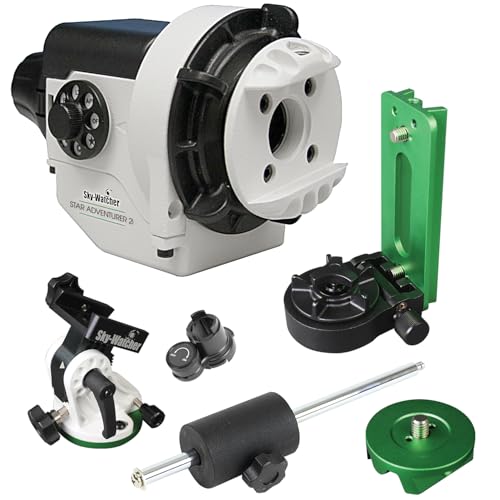
- Motorized tracking for wide-field astrophotography
- Wi-Fi control with the SAM Console app
- Deluxe equatorial base aids polar alignment
Best For: Traveling nightscape shooters and wide-field imaging
Compact Stable Mount
iOptron SkyGuider Pro Full Package

- All-metal body helps minimize vibration
- Compact 2.2 lb design for easy transport
- Illuminated polar scope simplifies setup
Best For: Portable camera-based astrophotography
Smart GoTo Equatorial Tracker

- Eight-CPU PMC-Eight controller for responsive tracking
- ExploreStars app works on major tablet platforms
- Clutched axes support precise balancing
Best For: App-controlled GOTO tracking and alignment
Portable GoTo EQ Mount
Sky-Watcher Star Adventurer GTi Head Kit

- Full GoTo tracking in a compact package
- Built-in Wi-Fi and illuminated polar scope
- Includes counterweight bar and 5 lb counterweight
Best For: Portable DSLR or mirrorless imaging
Precision Tilt Base
Equatorial Mount with 0–90° Latitude Adjustment

- 3/8-inch tripod thread fits many tripods
- 0–90° scale with micro knobs for alignment
- Aluminum alloy build aims for stable support
Best For: Compatible Star Field-style telescope and camera setups
Portable GoTo Kit
Star Adventurer GTi Full Tracking Package

- Complete kit includes tripod, pier extension, and weights
- GoTo mount with built-in Wi‑Fi and tracking rates
- Illuminated polar scope supports easier setup
Best For: Portable users who want an all-in-one tracking mount kit
Open-Source Star Tracker
Equatorial Mount with Gimbal Support

- Custom stellar, moon, and rotation speeds
- Supports both hemispheres for wider use
- USB-C powered and power-bank compatible
Best For: Tinkerers who want a customizable tracker for camera use
Low-Latitude Polar Base

- Low-latitude alignment range
- CNC-machined aluminum stability
- Made for SkyGuider Pro systems
Best For: SkyGuider Pro users in low-latitude regions
Vixen Dovetail Rail Plate

- Vixen-style dovetail compatibility
- 1/4" and 3/8" mounting screws
- Anti-slip pads with safety stop screw
Best For: Telescope and camera setups needing a Vixen-style rail
Open-Source Equatorial Tracker
Latitude Adjustment Base Mount

- Stellar, moon, and custom speeds
- Northern and southern hemisphere support
- 15 kg load capacity with Type-C power
Best For: Portable users wanting flexible tracking and hemisphere support
Portable Wide-Field Tracker – Sky-Watcher Star Adventurer 2i Pro Pack
If you want an approachable astrophotography mount for Milky Way shots, eclipses, and other wide-field targets, the Sky-Watcher Star Adventurer 2i Pro Pack is built for portable tracking. Its modular design works with existing photographic tripods, and the included equatorial base helps you dial in polar alignment for cleaner long exposures.
Best For: Travelers and nightscape shooters who want a compact tracking platform that can also handle time-lapse and telescopic use.
Pros:
- Motorized portable tracking platform for wide-field astrophotography
- Modular design integrates with existing photographic tripods
- Wi-Fi support with Sky-Watcher SAM Console app control
- Deluxe equatorial base helps with polar alignment
Cons:
- Built around wide-field work rather than heavier imaging rigs
- Requires a tripod setup you already own or add separately
For users who value portability and straightforward setup, this tracker offers a practical blend of mobility and core alignment tools. It is a strong match when your goal is to capture tracked nightscape images without moving into a larger mount system.
Compact Stable Mount – iOptron SkyGuider Pro Full Package
The iOptron SkyGuider Pro is a compact astrophotography mount aimed at stable tracked shooting in a travel-friendly package. With an all-metal body, illuminated polar scope, and adjustable base, it focuses on giving camera and lens setups dependable support for long exposures.
Best For: Photographers who want a lightweight mount with strong portability and precise polar alignment tools.
Pros:
- All-metal construction helps reduce vibration
- Compact 2.2 lb design is easy to pack and carry
- Supports up to 11 lb when balanced
- Integrated illuminated polar scope simplifies alignment
Cons:
- Maximum capacity depends on balanced loads
- Focuses on camera use rather than larger telescope rigs
This is a practical choice if you need a portable tracking solution that still feels solid in the field. The combination of low weight, decent capacity, and long internal battery life makes it well suited to serious mobile imaging sessions.
Smart GoTo Equatorial Tracker – iEXOS-100-2 PMC-Eight System
For astrophotography mounts that lean into smart control and responsive tracking, the iEXOS-100-2 PMC-Eight system stands out. It uses an eight-CPU controller, clutched dual-axis worm gears, and the ExploreStars app to make alignment, navigation, and object finding more efficient during imaging sessions.
Best For: Users who want a feature-rich equatorial tracker with app-based GOTO control and precise balance adjustments.
Pros:
- PMC-Eight system uses eight independent CPUs for responsiveness
- ExploreStars app supports Apple, Android, and Windows tablets
- Clutched RA and declination axes allow precise balancing
- Polar alignment sight hole and altitude control speed setup
Cons:
- Requires a tablet for the app-based control experience
- No polar scope is included in the described setup
This mount is a good fit if you value control, alignment aids, and modern wireless operation over pure minimalism. It should appeal to users who want an imaging platform that feels more like a connected system than a simple tracker.
Portable GoTo EQ Mount – Sky-Watcher Star Adventurer GTi Head Kit
The Sky-Watcher Star Adventurer GTi Mount Head Kit is aimed at portable astrophotography mounts with full GoTo tracking in a compact package. It includes built-in Wi-Fi, a polar scope with illuminator, and a counterweight bar, making it a practical step up for users who want more automated positioning in the field.
Best For: DSLR or mirrorless shooters who want a lightweight GoTo equatorial mount head for portable sessions.
Pros:
- Full GoTo performance in a compact package
- Built-in Wi-Fi supports wireless control
- Polar scope with illuminator helps with alignment
- Includes counterweight bar and counterweight
Cons:
- DSLR or mirrorless camera is not included
- Designed as a mount head kit rather than a complete camera package
If you want a portable mount with automated GoTo functionality, this kit delivers several useful imaging-focused features without getting overly bulky. It is especially appealing for photographers who already have camera gear and want a more capable tracking head.
Precision Tilt Base – Equatorial Mount with 0–90° Latitude Adjustment
If you’re comparing astrophotography mounts for a compact tracking setup, this equatorial base is a straightforward option with practical alignment controls. It uses a 3/8-inch tripod thread, aluminum alloy construction, and a 0 to 90 degree graduated latitude adjustment to help you dial in positioning for telescopes, trackers, and compatible camera rigs.
Best For: Astronomers, beginners, and astrophotographers who want a sturdy latitude-adjustment base for compatible Star Field-style setups.
Pros:
- 3/8-inch tripod thread works with many photography tripods.
- Graduated scale and micro-adjustment knobs support precise latitude tuning.
- Aluminum alloy build is designed for rigidity and steadier setup.
- Suitable for smart telescopes, celestial trackers, and camera setups with compatible plates.
Cons:
- Designed for Star Field and similar compatible telescopes, so fit is specific.
- Mounting plates are not included in the supplied details.
This is a practical, no-frills mounting base for users who need controlled latitude adjustment more than advanced automation. It looks best suited to portable astrophotography setups where a solid tripod connection and repeatable alignment matter.
Portable GoTo Kit – Star Adventurer GTi Full Tracking Package
Among astrophotography mounts, this Sky-Watcher kit stands out as a complete portable GoTo package for users who want tracking support without piecing together extras. It includes the mount head, tripod, pier extension, counterweight bar, and a 5 lb counterweight, plus built-in polar scope illumination, Wi‑Fi, and multiple tracking rates for field use.
Best For: Portable astrophotographers who want a complete GoTo EQ tracking kit with included support hardware.
Pros:
- Full kit includes tripod, pier extension, counterweight bar, and counterweight.
- Built-in GoTo functionality with Wi‑Fi and multiple tracking rates.
- Illuminated polar scope helps with setup and alignment.
- Portable design is aimed at lightweight astrophotography use.
Cons:
- Heavier and larger than a basic tracker-style mount.
- Water resistance is not included.
This is the most complete option in the group for users who want a ready-to-go tracking system. If you value included accessories and app-friendly control features, it offers a stronger all-in-one path than a bare mount head.
Open-Source Star Tracker – Equatorial Mount with Gimbal Support
If you want a more experimental take on astrophotography mounts, this open-source equatorial tracker offers manual setup with several useful motion modes. It supports stellar speed, moon speed, custom rotation speed, and northern or southern hemisphere switching, and it can also serve as a gimbal head for time-lapse photography.
Best For: Tinkerers and camera users who want a USB-C powered tracker with custom speed control.
Pros:
- Supports stellar, moon, and custom rotation speeds.
- Works in both northern and southern hemispheres.
- Can be powered by a power bank through USB Type-C.
- Uses a standard 1/4-inch output shaft and 38 mm quick-release baseplate.
Cons:
- Requires a ball head for camera connection.
- USB A to C cable is required; USB-C to USB-C is not allowed.
- Assembly and compatibility may require extra accessories like a 1/4 to 3/8 sleeve.
This mount is best viewed as a customizable tracker rather than a polished turnkey system. It makes sense for users who are comfortable checking compatibility and want flexible speed options for astrophotography or time-lapse work.
Low-Latitude Polar Base – SkyGuider Pro Base Mount
If you’re shopping for astrophotography mounts for a SkyGuider Pro setup in low-latitude regions, this base mount is built to improve polar alignment where standard ranges can fall short. Its CNC-machined aluminum construction focuses on rigidity and stability, helping reduce vibration and support longer exposures for tracking stars, the Milky Way, and deep-sky targets.
Best For: SkyGuider Pro users near the equator or in southern regions who need a low-latitude alignment base.
Pros:
- Designed specifically for low-latitude star tracking and alignment
- CNC-machined aluminum body for rock-solid stability
- Helps improve polar alignment accuracy and reduce drift
- Secure, wobble-free compatibility with iOptron SkyGuider Pro systems
Cons:
- Built for SkyGuider Pro compatibility rather than universal use
- Manual alignment setup still requires careful adjustment
This is a focused accessory for astrophotographers who need a stable low-latitude foundation more than a general-purpose mount. If your priority is precise alignment in challenging locations, it offers the right feature set without unnecessary extras.
Vixen Dovetail Rail Plate – 80mm Telescope Rail Bar
For astrophotography mounts that rely on a Vixen-style saddle, this 80mm dovetail rail plate gives you a simple way to attach and balance compatible gear. The long slot, reference scale, and anti-slip pads make it practical for adjusting setup position while keeping the connection secure.
Best For: Telescope and camera setups that use a Vixen-style dovetail saddle and need flexible balancing.
Pros:
- Vixen-style dovetail plate for compatible saddles
- 1/4″ and 3/8″ mounting screws add attachment flexibility
- Long slot helps with balance adjustments
- Reference scale and anti-slip pads improve setup convenience and grip
Cons:
- Only works with Vixen-style dovetail saddles
- Not water resistant
- Designed as a rail plate, not a full mount
This is a useful support piece when you need a secure interface between your gear and a compatible saddle. It won’t replace a tracker or equatorial head, but it can make balancing and mounting cleaner and more precise.
Open-Source Equatorial Tracker – Latitude Adjustment Base Mount
Equatorial Mount Star Tracker with Latitude Adjustment Base for Astrophotography
Check Price On AmazonIf you want astrophotography mounts with a more flexible tracking approach, this equatorial mount blends a latitude adjustment base with support for stellar, moon, and custom speeds. It also works in both hemispheres, includes a 15 kg load capacity, and can run from a power bank, making it a practical option for portable imaging and time-lapse work.
Best For: Portable astrophotographers who want adjustable tracking speeds and northern/southern hemisphere support.
Pros:
- Supports stellar speed, moon speed, and custom rotation speed
- Switches between northern and southern hemispheres
- All-metal CNC latitude adjustment base with 3/8″ bottom thread
- 15 kg load capacity and power-bank-friendly Type-C power
Cons:
- Camera connection requires a ball head
- No built-in battery
- Some setup may require extra adapters, such as a 1/4″ to 3/8″ sleeve
This mount stands out for users who want an adaptable, ready-to-use tracker rather than a more traditional fixed setup. Its open-source design and multiple speed modes make it especially appealing for experimentation and travel-friendly sessions.
How We Picked These Astrophotography Mounts
We prioritized mounts and tracker systems that offer dependable sidereal tracking, practical payload capacity, and a setup experience suited to real-world imaging. Portability mattered, but not at the expense of rigidity or alignment control.
We also looked at whether each option makes sense for beginners, mobile travelers, and users planning to grow from a camera-only rig into a small telescope setup.
Quick Comparison of the Best Options
Broadly, the list splits into lightweight star trackers, more capable GoTo tracking mounts, and useful support accessories such as bases, rail bars, and leveling plates. Star trackers are ideal for camera and lens work, while GoTo equatorial options are better if you want more automation and long-term flexibility.
If you want the simplest travel setup, choose a compact tracker package. If you want easier target finding and room to expand, consider a GoTo mount kit. If you already own a tracker, the accessory pieces can improve balance, latitude adjustment, and alignment.
Key Buying Factors for Astrophotography Mounts
Tracking Accuracy
For long exposures, smooth tracking is the core requirement. Look for stable periodic performance, reliable motor control, and a design that keeps flex to a minimum.
Payload and Rig Size
Be honest about your current and future setup. Camera-and-lens rigs need far less capacity than small refractors or full telescope systems. Staying well below the rated limit usually gives better results.
Polar Alignment Setup
Good polar alignment improves sharpness and lengthens the exposures you can take. Adjustable latitude bases, sturdy altitude controls, and clear alignment aids are all valuable.
Portability and Power
Travel-friendly Astrophotography Mounts should be easy to carry, quick to assemble, and efficient on power. If you image away from home, battery life and compact packing size matter a lot.
Control Features
GoTo functionality, app connectivity, and wireless control can save time in the field. Manual tracker users may prefer simpler operation and fewer points of failure.
Who Should Buy Which Astrophotography Mounts?
Choose a lightweight star tracker if you shoot with a DSLR or mirrorless camera and want the easiest portable route to sharper night-sky images. Pick a GoTo equatorial mount if you want better object locating, more automation, and a path toward telescope-based imaging.
If you already own a tracker, accessories like a latitude base, dovetail rail, or counterweight support can improve stability and workflow without replacing the whole system. For most buyers, the best choice is the mount that matches both current gear and the next upgrade you realistically plan to make.