The best sensor microcontroller starter kits make it easier to move from wiring basics to useful hands-on projects. The right bundle can provide sensors, displays, motors, jumper wires, a development board, and tutorials in one purchase.
We compared 10 kits spanning Arduino, ESP32, Raspberry Pi Pico, and beginner-focused platforms. Use the guide below to match the kit’s included hardware, software support, and learning curve to your goals.
Best 10 Sensor Microcontroller Starter Kits Picks for 2026
Versatile Arduino Lab

- 37 modules for sensing, display, timing, and control
- Compatible with UNO, MEGA, Nano, ESP-32, and STM32
- Tutorials, wiring diagrams, and example code included
Best For: Arduino-compatible prototyping and STEM experiments
Labeled Learning Collection
46-in-1 TinkerBlock Sensor Kit

- 46 labeled modules with multiple interface types
- Works with Arduino, ESP32, Pico, and STM32
- Storage case and guided learning materials included
Best For: Organized, cross-platform electronics education
Connected Project Builder

- Dual-core ESP-32 board with Wi-Fi and Bluetooth 4.2
- 35-plus components for sensors, displays, motors, and input
- 30-plus guided projects with code and diagrams
Best For: Beginner IoT and connected-device projects
Budget Sensor Sampler

- 37 assorted modules for Arduino and Raspberry Pi
- Includes sensors, switches, LEDs, relay, and joystick
- Useful for simple robot and electronics experiments
Best For: Low-cost sensor exploration and beginner robot projects
Best ESP32 Sensor Kit for Beginners
LAFVIN ESP32 Basic Starter Kit

- ESP32 board with Wi-Fi and Bluetooth
- Includes DHT11, OLED, PIR, and obstacle sensor modules
- Tutorial includes lessons and example code
Best For: Beginners learning wireless ESP32 and Arduino projects
Best Complete Arduino Project Kit
ELEGOO UNO R3 Super Starter Kit

- Includes 22-plus guided hands-on projects
- Combines sensors, displays, motors, and input modules
- Solderless setup with UNO R3 controller
Best For: Structured Arduino lessons and classroom or family STEM projects
Best Sensor Variety Kit
KEYESTUDIO 37-in-1 Sensor Module Set

- Includes 37 sensors and modules
- Works with Arduino boards and Raspberry Pi hardware
- Provides 37 illustrated projects with code
Best For: Expanding sensor experiments with an existing controller
Best Value Arduino Kit
REXQualis UNO R3 Super Starter Kit
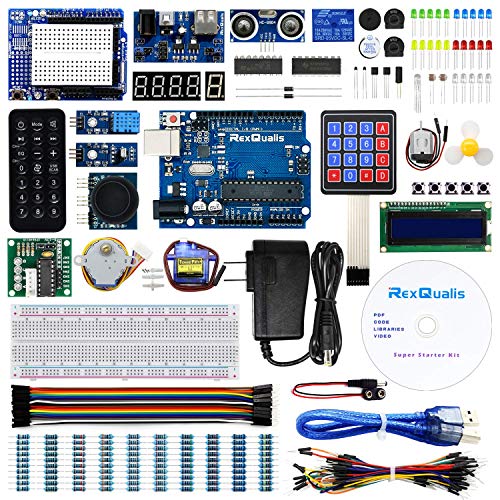
- 120 labeled components with storage box
- Arduino IDE-compatible UNO R3 board
- Includes power adapter and LCD1602 module
Best For: Affordable beginner Arduino programming and robotics projects
Best for MicroPython Learning
LAFVIN Raspberry Pi Pico Basic Kit

- RP2040 Raspberry Pi Pico platform
- Supports MicroPython, C/C++, and Piper Make
- Includes display, servo, RGB LED, buzzer, and sensing module
Best For: Guided Pico-based STEM learning and programming practice
Best for Connected Projects
ACEBOTT ESP32 26-in-1 Sensor Kit

- ESP32 board with Wi-Fi and Bluetooth
- 26 labeled modules for sensors, displays, and motors
- Includes 40+ video tutorials and no-solder Easy-Plug setup
Best For: Wireless IoT, robotics, and broad sensor experimentation
Versatile Arduino Lab – 37-in-1 Sensor Modules Kit
The ELEGOO 37-in-1 kit is a practical choice for building a broad sensor microcontroller starter kit around compatible UNO R3, MEGA 2560, Nano, ESP-32, or STM32 boards. It combines common input sensors with displays, timing modules, and control components for classroom experiments and maker projects.
Best For: Arduino-compatible prototyping, STEM lessons, and experimenting with many sensor types in one expansion kit.
Pros:
- Includes 37 modules covering motion, distance, light, sound, temperature, touch, displays, and control.
- Supports popular compatible boards including UNO, MEGA, Nano, ESP-32, and STM32.
- Provides tutorials, datasheets, wiring diagrams, and example code.
Cons:
- Controller board, USB cable, breadboard, and jumper wires are not included.
- Requires attention to pin requirements and the specified 6.5–9 V DC power range.
This is a strong module-only option when you already own a compatible development board and want varied guided experiments rather than a single focused project.
Labeled Learning Collection – 46-in-1 TinkerBlock Sensor Kit
The Lonely Binary 46-in-1 kit stands out among sensor microcontroller starter kits for its clearly labeled modules and broad board compatibility. It supports digital, analog, I2C, SPI, PWM, and IR projects without soldering, making it useful for structured learning and quick testing.
Best For: Beginners, educators, and makers who want a large, organized assortment for ESP32, Raspberry Pi Pico, STM32, or Arduino projects.
Pros:
- Includes 46 modules, including displays, input devices, environmental sensors, memory, and interface hardware.
- Modules have part numbers, labeled pins, and interface information printed on the boards.
- Includes tutorials, reference code, wiring diagrams, a storage case, and a quick-start card.
Cons:
- Development board and jumper wires are not included.
- The extensive module selection may require a learning curve for complete beginners.
Choose this kit if organization and cross-platform flexibility matter as much as the number of components. Its labeling can reduce guesswork when identifying and wiring modules.
Connected Project Builder – ESP-32 Super Starter Kit
The ELEGOO ESP-32 Super Starter Kit is a complete direction for a sensor microcontroller starter kit when you want wireless connectivity built in. Its dual-core ESP-32 board includes Wi-Fi and Bluetooth 4.2, while the included components support displays, motors, sensors, and input devices.
Best For: Beginners progressing from basic circuits to connected IoT, smart-home, weather-station, and remote-control projects.
Pros:
- Includes an ESP-32 development board with dual-core processing, Wi-Fi, and Bluetooth 4.2.
- Offers more than 35 modules and electronic components, including an OLED screen, servo, and keypad.
- Provides 30-plus guided projects with code, circuit diagrams, and step-by-step instructions.
Cons:
- Its projects are centered on the included ESP-32 platform rather than a board-neutral assortment.
- The wider IoT feature set may be more than needed for simple sensor-only experiments.
This is the most suitable pick here for connected builds. It combines the controller and components in one package, reducing the need to assemble a separate wireless development setup.
Budget Sensor Sampler – 37-in-1 Robot Project Kit
HiLetgo 37 Sensor Assortment Kit for Arduino & Raspberry Pi - 37 in 1 Robot Project Starter Kit
Check Price On AmazonThe HiLetgo 37 Sensor Assortment is a basic sensor microcontroller starter kit for exploring common Arduino and Raspberry Pi modules. Its selection includes switches, lights, magnetic sensors, temperature and humidity parts, sound sensors, a relay, joystick, and other robot-project components.
Best For: Low-cost introductions to individual sensor modules and simple Arduino or Raspberry Pi robot experiments.
Pros:
- Includes 37 assorted modules spanning light, sound, temperature, magnetic, touch, motion, and input functions.
- Offers project-oriented parts such as an obstacle-avoidance sensor, joystick, relay, laser, and heartbeat module.
- Designed for compatibility with Arduino and Raspberry Pi platforms.
Cons:
- The supplied notes do not list tutorials, wiring diagrams, or a controller board.
- The assortment is broad, but individual modules may require separate documentation and wiring research.
This kit makes sense when variety and a low-complexity starting point are priorities. Buyers who want structured lessons or included development hardware should consider a more fully documented kit.
Best ESP32 Sensor Kit for Beginners – LAFVIN ESP32 Basic Starter Kit
The LAFVIN ESP32 Basic Starter Kit is a practical entry point for anyone comparing sensor microcontroller starter kits with Wi-Fi and Bluetooth built in. Its ESP32 board works with Arduino IDE and connects to included components such as a DHT11 sensor, OLED display, PIR motion sensor, and obstacle-avoidance module.
Best For: Beginners learning introductory electronics, Arduino programming, and connected ESP32 projects.
Pros:
- Includes an ESP32 development board with Wi-Fi and Bluetooth connectivity.
- Provides a useful mix of sensors, display hardware, LEDs, buttons, buzzer, relay, and breadboard parts.
- Includes a tutorial with lessons and code for assembling the kit.
Cons:
- The kit is aimed at introductory learning rather than advanced projects.
- The tutorial must be downloaded after receiving the product.
Choose this kit if wireless connectivity and ESP32 experimentation matter more than a large number of individual sensor modules. It offers a focused set of parts for guided learning and small IoT builds.
Best Complete Arduino Project Kit – ELEGOO UNO R3 Super Starter Kit
The ELEGOO UNO R3 Project Super Starter Kit is a broad option among sensor microcontroller starter kits, combining guided sensor experiments with motors, displays, and input devices. Its 22-plus lessons cover temperature, distance, LCD output, servo and stepper control, joystick input, and more using Arduino IDE.
Best For: Beginners, homeschool projects, coding clubs, family builds, and STEM classrooms seeking varied hands-on lessons.
Pros:
- Offers 22-plus guided projects with included example code and a PDF tutorial.
- Combines an UNO R3 board with DHT11 and ultrasonic sensors, LCD, joystick, IR remote, motors, servo, and relay.
- Solderless breadboard setup and pre-soldered LCD help beginners focus on wiring and code.
- Includes a breadboard power supply, jumper wires, and a large assortment of components.
Cons:
- It uses a 16 MHz UNO R3 controller rather than a wireless microcontroller board.
- The breadboard power supply should not be used with input voltage above 9V.
- First-time builders may need to carefully check polarity, wiring, and board-port settings.
This is the strongest choice for structured, varied Arduino learning rather than wireless IoT work. The organized component range supports projects that progress from basic LED and sensor exercises to motors, displays, and interactive controls.
Best Sensor Variety Kit – KEYESTUDIO 37-in-1 Sensor Module Set
The KEYESTUDIO 37-in-1 Sensor Kit stands out among sensor microcontroller starter kits for the number of dedicated sensors and modules included. It does not include a controller, but its breakout pins work with solderless breadboards or Dupont wires and support Arduino boards as well as Raspberry Pi hardware.
Best For: Learners who already have a compatible Arduino or Raspberry Pi and want to explore many sensor types.
Pros:
- Includes 37 sensors and modules for broad electronics exploration.
- Modules have three to four pins exposed for straightforward breadboard or Dupont-wire connections.
- Provides 37 step-by-step projects with pictures and code.
- Compatible with Arduino R3, Mega 2560, Nano, Raspberry Pi, and more.
Cons:
- A main controller is not included.
- The supplied tutorials are for Arduino rather than Raspberry Pi.
- Users need separate compatible boards and connection hardware to begin.
Consider this kit when sensor variety is the priority and you already own a controller. It is less convenient as a first all-in-one purchase, but its 37 modules and project-focused tutorial provide substantial room for experimentation.
Best Value Arduino Kit – REXQualis UNO R3 Super Starter Kit
For beginners comparing sensor microcontroller starter kits, the REXQualis Super Starter Kit offers an economical Arduino UNO R3-compatible starting point with a broad selection of labeled parts. It includes a 9V 1A power adapter, pre-headered LCD1602 module, sensors, servo, motor, and supporting components for hands-on programming and robotics projects.
Best For: Beginners who want an affordable Arduino-compatible kit with many components and downloadable tutorials.
Pros:
- Includes 120 individually packaged and labeled items in a plastic storage box.
- Arduino UNO R3-compatible board works with the Arduino IDE.
- Includes a 9V 1A power adapter instead of requiring a 9V battery.
- LCD1602 module includes a pin header, so it does not require soldering.
Cons:
- It is an Arduino-compatible kit rather than a Wi-Fi- or Bluetooth-focused platform.
- The manufacturer lists a recommended age of 0–3 years, which appears inconsistent with its programming and STEM use.
This is a practical choice for learning core Arduino programming, sensors, displays, and basic motor control without assembling a parts list separately. The included PDF tutorial and datasheets add useful support for first projects.
Best for MicroPython Learning – LAFVIN Raspberry Pi Pico Basic Kit
The LAFVIN Raspberry Pi Pico Basic Starter Kit is a focused option among sensor microcontroller starter kits, pairing an RP2040-based Pico platform with beginner-friendly modules. Its support for MicroPython, C/C++, and Piper Make gives learners multiple ways to progress from graphical programming to text-based development.
Best For: STEM learners, classroom labs, and beginners who want to explore Raspberry Pi Pico projects with several programming options.
Pros:
- Uses the Raspberry Pi Pico and RP2040 microcontroller platform.
- Supports MicroPython, C/C++, and Piper Make graphical programming.
- Includes an LCD1602 display, SG90 servo, WS2812 RGB LED strip, buzzer, buttons, and a human body sensing module.
- Provides project tutorials and sample code for guided experiments.
Cons:
- Its component selection is less extensive than the larger 26-module kit in this roundup.
- The supplied details do not specify the exact number of included components.
This kit emphasizes a structured learning path rather than maximum hardware variety. It is especially useful when MicroPython practice, classroom instruction, or a gradual transition to C/C++ matters more than wireless IoT features.
Best for Connected Projects – ACEBOTT ESP32 26-in-1 Sensor Kit
For makers who want connectivity and a wide range of experiments, the ACEBOTT 26-in-1 kit is one of the more feature-rich sensor microcontroller starter kits here. Its ESP32 Max V1.0 board provides Wi-Fi and Bluetooth, while the Easy-Plug expansion system avoids breadboards and soldering for quicker module-based builds.
Best For: Beginners, educators, and hobbyists building connected IoT, robotics, sensor, and interactive projects.
Pros:
- Includes an ESP32 board with built-in Wi-Fi and Bluetooth.
- Offers 26 modules, including PIR, ultrasonic, DHT11, light, sound, Hall, tilt, joystick, display, servo, and motor modules.
- Provides more than 40 step-by-step video tutorials and projects.
- Easy-Plug modules are labeled and designed for no-solder building.
Cons:
- Batteries and wooden structures are not included.
- The broad feature set may be more than a learner needs for simple introductory circuits.
- It supports several coding approaches, but users may need to choose a learning path before starting.
This is the strongest fit for projects that benefit from wireless control, app connectivity, or numerous sensor combinations. The labeled modules and tutorials reduce setup friction, while Arduino and Python support leave room to advance beyond block-based programming.
How We Picked These Sensor Microcontroller Starter Kits
We focused on kit variety, board compatibility, included sensors and components, tutorial quality, and suitability for beginners. A strong bundle should support more than a single demonstration: it should offer enough inputs and outputs to practice digital and analog sensing, displays, motors, lighting, and basic automation.
Compatibility also matters. Arduino UNO kits are usually the simplest starting point, while ESP32 bundles add Wi-Fi and Bluetooth for connected projects. Raspberry Pi Pico kits can be attractive for MicroPython users and compact embedded builds. We also considered whether a kit includes the controller board or only the accessories.
Quick Comparison
| Kit type | Best for | What to check |
|---|---|---|
| Arduino UNO starter kit | First electronics and robotics projects | Board version, tutorial coverage, motor accessories |
| 37- or 46-sensor assortment | Experimenting with many input types | Whether a controller board is included |
| ESP32 starter kit | IoT, wireless, and connected projects | Arduino IDE support, pinout documentation, power requirements |
| Raspberry Pi Pico kit | MicroPython and compact STEM projects | Language support, USB setup, included display and servo parts |
Key Buying Factors for Sensor Microcontroller Starter Kits
Board and Software Compatibility
Choose a kit that matches the platform you already use or want to learn. Arduino IDE support is broadly documented, while ESP32 boards offer wireless features but may require more attention to voltage, libraries, and pin assignments. Pico kits are worth considering if MicroPython is a priority.
Component Variety
Sensor count alone is not the whole story. Look for a useful mix of light, sound, temperature, motion, distance, touch, and magnetic sensors. LEDs, buttons, resistors, a buzzer, a display, a servo, and a motor driver expand the kinds of projects you can build.
Tutorials and Documentation
Clear wiring diagrams, example code, pinout charts, and downloadable lessons can save substantial setup time. Beginners should favor kits with structured tutorials rather than an unlabeled assortment of modules.
Power and Expansion
Check whether the board uses USB power, needs a separate battery pack, or requires an adapter for motors and servos. Breadboards, jumper wires, spare headers, and standard interfaces make future expansion easier.
Who Should Buy Which Sensor Microcontroller Starter Kits?
Choose an Arduino UNO bundle if you are new to electronics and want the broadest beginner documentation. Pick an ESP32 kit if Wi-Fi, Bluetooth, web controls, or IoT experiments are central to your plans. A Raspberry Pi Pico package is a good fit for learners interested in MicroPython, compact hardware, and C/C++ options.
For maximum experimentation, select a larger sensor assortment such as a 37-in-1 or 46-in-1 kit, but confirm that it includes the controller board if you do not already own one. If your priority is guided learning, favor a complete project kit with a structured tutorial, display, motor, and robotics parts. Before ordering, verify the exact board model, operating-voltage requirements, included cables, and software examples listed by the seller.