The best portable sound level meters make it easier to identify excessive noise, troubleshoot audio problems, and document changing sound levels. The models in this roundup cover simple spot checks, professional measurements, and connected data logging.
Before choosing one, consider measurement range, weighting options, display readability, logging features, and how much accuracy and control your work requires.
Best 10 Portable Sound Level Meters Picks for 2026
Best Everyday Pick
TopTes TS-501B Portable Sound Level Meter

- 30–130 dB range with ±1.5 dB accuracy
- Backlit 2.25-inch display with MAX/MIN and hold
- Includes AAA batteries and carry case
Best For: Everyday home, office, workshop, and factory noise checks
Best Established Brand
Extech 407730 Digital Sound Level Meter

- 40–130 dB range with 0.1 dB resolution
- A/C weighting and fast analog bar graph
- Includes windscreen, four AAA batteries, and warranty
Best For: General monitoring from a recognized test-equipment brand
Best for Loudness Context
Goldeep SL750A Sound Level Meter

- 30–130 dB measurement range with ±1.5 dB accuracy
- Offers both dB and SONE loudness units
- FAST/SLOW response plus MAX/MIN tracking
Best For: Noise checks involving music, instruments, traffic, or perceived loudness
Best for Data Logging

- Records up to 43,000 readings for PC export
- 30–130 dB range with A/C weighting and FAST/SLOW response
- Rechargeable battery and three-color adjustable alarm
Best For: Extended surveys, reporting, and Windows-based noise analysis
Best All-Around Choice
TopTes TS-569B Portable Sound Level Meter

- 30–130 dB range with ±1.5 dB stated accuracy
- A/C weighting plus dB and Sone modes
- Fast/slow response, MAX/MIN, and data hold
Best For: Versatile home, workplace, and neighborhood noise checks
Best Budget-Style Basic Meter
Digital 30–130 dBA Sound Level Meter

- 30–130 dB range with ±1.5 dB stated accuracy
- 0.1 dB resolution with A-weighted measurement
- Fast/slow modes, MAX/MIN, hold, and backlight
Best For: Simple classroom, home, street, and workplace measurements
Best Large-Display Option
TopTes TS-501B Portable Sound Level Meter

- Large 2.25-inch backlit LCD
- 30–130 dB range with A/C weighting
- MAX/MIN, data hold, temperature, and humidity readings
Best For: Readable handheld monitoring in homes, offices, and workshops
Best Overall Value
RISEPRO HT-80A Sound Level Meter

- 30–130 dB range with ±1.5 dB accuracy
- MAX/MIN, hold, backlight, and auto-off
- Lightweight design with carrying pouch
Best For: Routine household, workplace, and industrial noise checks
Best for A/C Weighting
Tadeto SL720 Portable SPL Meter
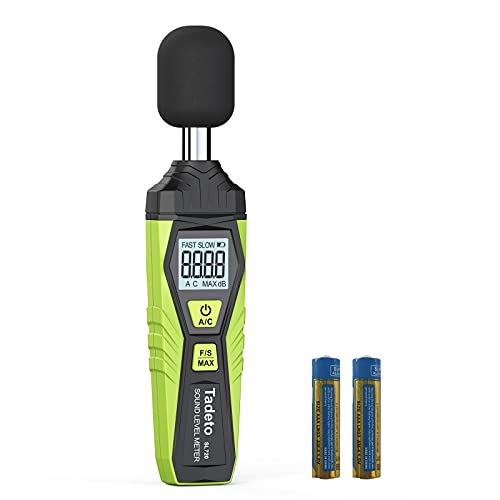
- A- and C-weighted measurement modes
- Fast and slow response settings
- Backlit LCD with 0.1 dB resolution
Best For: Ambient noise and machine or motor sound analysis
Best Simple Pick

- Bluetooth app connection for Android and iOS
- Stores over 20,000 data points
- MAX/MIN, hold, alarm, and backlight
Best For: Long-term monitoring and smartphone-based sound analysis
Best Everyday Pick – TopTes TS-501B Portable Sound Level Meter
For straightforward noise checks, the TopTes TS-501B is one of the more practical portable sound level meters. It combines a large backlit display with A/C weighting, peak tracking, and a compact, non-slip design for use around the home, office, workshop, or factory.
Best For: Home noise checks, neighbor disputes, workshops, schools, and general everyday measurements.
Pros:
- Measures 30–130 dB with stated ±1.5 dB accuracy.
- A- and C-weighting support covers environmental and higher-intensity sound checks.
- Large 2.25-inch backlit LCD, data hold, and MAX/MIN readings are easy to use.
- Includes three AAA batteries and a carry case.
Cons:
- It does not offer PC data export or long-term data logging.
- Uses replaceable AAA batteries rather than rechargeable power.
The TS-501B is a well-rounded choice when you want a readable, portable meter without advanced logging features. Its broad range and simple controls make it suitable for routine sound-level checks.
Best Established Brand – Extech 407730 Digital Sound Level Meter
The Extech 407730 is a conventional option among portable sound level meters, with A/C weighting, a digital display, and a fast analog bar graph. Its 40–130 dB range and maximum/minimum functions suit basic environmental and workplace sound monitoring.
Best For: Buyers who prefer an established Extech meter for general sound-level measurements and peak monitoring.
Pros:
- Measures 40–130 dB with 0.1 dB resolution and stated 2 dB accuracy.
- A/C weighting supports different sound-measurement situations.
- Fast analog bar graph provides a quick visual indication of changing levels.
- Includes a microphone windscreen, four AAA batteries, and a one-year parts-and-labor warranty.
Cons:
- Its 40 dB lower limit is higher than several competing meters in this roundup.
- The supplied notes do not indicate backlighting, data logging, or PC export.
Choose the 407730 for a familiar, no-frills measuring format with useful MAX/MIN and Max Hold functions. It is less feature-rich than a data-logging model, but the bar graph and A/C weighting keep routine readings practical.
Best for Loudness Context – Goldeep SL750A Sound Level Meter
The Goldeep SL750A adds useful flexibility to the portable sound level meters category by offering both dB and SONE units. Its A/C weighting, FAST/SLOW response settings, and MAX/MIN tracking make it adaptable to changing noise, steady background sound, and perceived loudness checks.
Best For: Home, traffic, classroom, construction, workplace, music, and instrument-noise checks where loudness context is useful.
Pros:
- Measures 30–130 dB with stated ±1.5 dB accuracy and a 31.5 Hz–8 kHz response.
- Switches between dB and SONE units for sound intensity and perceived loudness.
- FAST and SLOW response modes suit changing and steady-state noise.
- Includes a windbreak ball, data hold, anti-slip grip, and two AAA batteries.
Cons:
- The supplied notes do not mention PC connectivity or data export.
- It uses replaceable batteries rather than a rechargeable battery.
The SL750A stands out when a standard dB reading is not the only information you want. SONE mode and adjustable response settings make it a versatile pick for comparing both measured sound and perceived loudness.
Best for Data Logging – DANOPLUS DP-441 Data Logger
For projects that require records rather than occasional spot checks, the DANOPLUS DP-441 is the most advanced of these portable sound level meters. It records up to 43,000 readings, displays visual trends, and connects to compatible Windows computers for exporting and analyzing data.
Best For: Extended noise surveys, workplace monitoring, documentation, and users who need PC-based analysis or printed reports.
Pros:
- Stores up to 43,000 measurements and exports data through a PC connection.
- Three-color alarm indicators provide at-a-glance low, medium, and high noise alerts.
- 30–130 dB range with stated ±1.5 dB accuracy, A/C weighting, and FAST/SLOW response.
- Rechargeable 1,000 mAh battery and Windows 7, 10, and 11 compatibility.
Cons:
- Its advanced logging features may be unnecessary for simple one-time readings.
- PC connectivity is specified for Windows systems rather than broadly across operating systems.
The DP-441 is the clear choice when measurement history and reporting matter. Its logging capacity, color alarm system, rechargeable design, and computer export make it better suited to structured monitoring than casual household checks.
Best All-Around Choice – TopTes TS-569B Portable Sound Level Meter
For shoppers comparing portable sound level meters, the TopTes TS-569B combines a broad 30–130 dB range with A/C weighting, fast and slow response modes, and useful peak tracking. Its compact housing and included fabric pouch make it practical for checking household, workplace, vehicle, and neighborhood noise.
Best For: Everyday noise checks, changing sound environments, and users who want both dB and Sone readings.
Pros:
- Measures 30–130 dB with stated ±1.5 dB accuracy and a 31.5 Hz–8 kHz frequency response.
- A-weighting, C-weighting, and Sone mode support different listening and measurement needs.
- Fast/slow response, MAX/MIN tracking, and data hold make fluctuating readings easier to evaluate.
- Includes batteries, a manual, and a portable fabric pouch.
Cons:
- The supplied details list conflicting battery information, so verify the included battery type before relying on replacements.
- Automatic power-off activates after 10 minutes, which may interrupt longer unattended measurements.
The TS-569B is a feature-rich option for buyers who want more than a basic decibel display. Its weighting choices and Sone function add flexibility, while MAX/MIN and response controls help make real-world noise comparisons more useful.
Best Budget-Style Basic Meter – Digital 30–130 dBA Sound Level Meter
This straightforward digital meter is among the portable sound level meters suited to routine classroom, home, street, and workplace checks. It offers a 30–130 dB range, 0.1 dB display resolution, A-weighting, and dedicated controls for response speed, peak readings, and hold.
Best For: Basic A-weighted noise measurements where a simple display and essential measurement controls are the priority.
Pros:
- Measures 30–130 dB with stated ±1.5 dB accuracy and 0.1 dB display resolution.
- Fast and slow response modes accommodate changing or steadier sound levels.
- MAX/MIN measurement and result hold help preserve readings for comparison.
- Backlight, low-battery indicator, and automatic shutdown support convenient handheld use.
Cons:
- Only A-weighted measurement is specified, with no C-weighting or Sone mode listed.
- The automatic shutdown occurs after three minutes, which may be short for some measurement sessions.
- The supplied notes do not mention included batteries or a carrying case.
This model keeps the controls focused on common noise-testing tasks. It is a sensible choice for users who need readable A-weighted measurements, peak/minimum tracking, and hold functionality without the additional modes found on more feature-heavy meters.
Best Large-Display Option – TopTes TS-501B Portable Sound Level Meter
The TopTes TS-501B stands out among portable sound level meters with its 2.25-inch backlit LCD and added temperature and humidity functions. A/C weighting, MAX/MIN tracking, and data hold make it useful for monitoring sound in homes, offices, workshops, schools, vehicles, and factories.
Best For: Users who value an easy-to-read screen, handheld comfort, and basic environmental readings alongside sound measurements.
Pros:
- Measures 30–130 dB with stated ±1.5 dB accuracy and A/C weighting.
- Large 2.25-inch LCD with backlight improves readability in dim conditions.
- MAX/MIN measurement and data hold support quick peak and current-reading checks.
- Includes three AAA batteries, a carry case, and a stated 36-month after-sale service.
Cons:
- The listed temperature-reading accuracy is ±1°C, but the supplied notes do not provide a temperature measurement range.
- Its 30–8,000 Hz frequency specification may be less broad than some specialized sound-analysis equipment.
The TS-501B is a practical pick when screen visibility matters as much as core sound-level functions. Its large display, carry case, and environmental readings add convenience for routine inspections and household monitoring.
Best Overall Value – RISEPRO HT-80A Sound Level Meter
The RISEPRO HT-80A is a practical choice among portable sound level meters for checking noise in homes, workplaces, study areas, and industrial settings. It combines a 30–130 dB range with ±1.5 dB accuracy, fast response, and useful hold and peak-reading functions.
Best For: Everyday noise checks and users who want a compact meter with broad coverage and convenient features.
Pros:
- Measures 30–130 dB with stated ±1.5 dB accuracy.
- Includes MAX, MIN, data hold, backlight, and auto power-off functions.
- Compact 107 g design includes a carrying pouch and gift box.
Cons:
- Uses a fixed Type A frequency weighting rather than offering A/C selection.
- Its listed frequency range is 31.5 Hz to 4 kHz.
Choose the HT-80A if you want a straightforward, feature-rich meter for routine measurements. Its accuracy rating and included accessories make it a particularly well-rounded portable option.
Best for A/C Weighting – Tadeto SL720 Portable SPL Meter
The Tadeto SL720 stands out among portable sound level meters for offering both A- and C-weighted measurement. Its 30–130 dB range, selectable fast or slow response, and backlit LCD make it adaptable for ambient-noise checks and louder equipment-related measurements.
Best For: Users who need selectable A/C weighting for home, factory, construction, vehicle, or audio-system measurements.
Pros:
- Provides A-weighted and C-weighted measurement modes.
- Offers fast 0.125-second and slow 1-second response settings.
- Displays readings to 0.1 dB on a backlit four-digit LCD.
- Includes two AAA batteries and has a lightweight portable design.
Cons:
- Stated accuracy is ±2.0 dB, lower than some alternatives in this roundup.
- The supplied notes do not specify a MAX or MIN recording function.
The SL720 is a sensible pick when measurement flexibility matters more than the tightest stated accuracy. A/C weighting and two response rates give it useful range across everyday and equipment-oriented applications.
Best Simple Pick – Bluetooth Sound Level Meter
This Bluetooth model is one of the more capable portable sound level meters for recording and reviewing noise over time. It connects to Android or iOS devices through an app, stores more than 20,000 data points, and adds MAX, MIN, hold, alarm, and backlight functions.
Best For: Users who want smartphone connectivity and extended sound-level data collection rather than occasional spot checks.
Pros:
- Bluetooth connection supports data transfer and management through the dB Tester app.
- Stores over 20,000 measurement data points for monitoring and analysis.
- Offers 30–130 dB measurement with stated ±1.5 dB accuracy.
- Lightweight 3.4-ounce body includes a 1/4-inch mounting thread.
Cons:
- Requires three AAA batteries.
- App-based features may be unnecessary for simple one-time readings.
- The supplied notes specify dBA measurement but do not mention selectable C weighting.
If you need a record of changing noise levels, this Bluetooth meter is the strongest fit in the group. Its large logging capacity and phone connectivity make longer monitoring sessions easier to manage.
How We Picked These Portable Sound Level Meters
We selected meters across several common use cases, from quick household and classroom checks to workplace troubleshooting and longer-term noise documentation. Our comparison emphasizes stated measurement range, A and C frequency weighting, response modes, display design, data-holding or peak functions, and recording capabilities.
Because specifications and real-world accuracy can vary, treat these devices as practical measurement tools rather than automatic substitutes for calibrated professional instruments. For regulatory, legal, or occupational-health work, verify calibration requirements and applicable standards before relying on readings.
Quick Comparison
- Best for basic checks: A straightforward 30–130 dB meter with a backlit display and data hold.
- Best for more controlled testing: A model offering A/C weighting plus fast and slow response settings.
- Best for logging: A data-logging meter with internal memory, export, or smartphone connectivity.
- Best for professional versatility: A recognized instrument with clearly specified range, weighting, and operating controls.
Key Buying Factors for Portable Sound Level Meters
Measurement Range and Accuracy
A 30–130 dB range covers many everyday situations, including conversation, appliances, traffic, and loud recreational environments. Check the stated accuracy, resolution, and calibration guidance if measurements need to be defensible.
Frequency Weighting and Response Speed
A-weighting is commonly used to approximate human hearing, while C-weighting preserves more low-frequency energy and can help with bass-heavy or machinery noise. Fast response captures changing peaks; slow response produces a steadier reading for fluctuating sound.
Display and Controls
A backlit LCD is useful in equipment rooms, garages, and outdoor conditions. Data hold, maximum or minimum capture, automatic shutoff, and clearly labeled buttons can matter more in practice than extra features.
Logging and Connectivity
For investigations over time, choose internal recording, export, or Bluetooth app support. Confirm how many readings the device stores, whether timestamps are included, and whether the software works with your phone or computer.
Power, Portability, and Calibration
Consider battery type, rechargeable operation, included windscreen, size, and mounting options. A calibration function or compatibility with an external calibrator is especially valuable for repeatable measurements.
Who Should Buy Which Portable Sound Level Meters?
Homeowners and DIY users usually need a simple, readable meter with a broad range, backlight, and hold or maximum functions. Teachers, venue operators, and audio users should prioritize A/C weighting and selectable response speeds. Contractors and workplace users benefit from reliable controls, repeatable operation, and calibration support. Researchers or anyone documenting noise over hours or days should choose a data logger or Bluetooth model rather than relying on manually recorded spot readings.