The best weather stations give you more than a temperature reading. They can track wind, rain, humidity, pressure, and indoor conditions so you can make better decisions around gardening, outdoor plans, home comfort, and severe weather.
We compared 10 popular models across sensor coverage, connectivity, display quality, forecasting tools, installation, and smart-home features to help you find the right fit.
Best 10 Weather Stations Picks for 2026
Best Smart-Home Weather Station
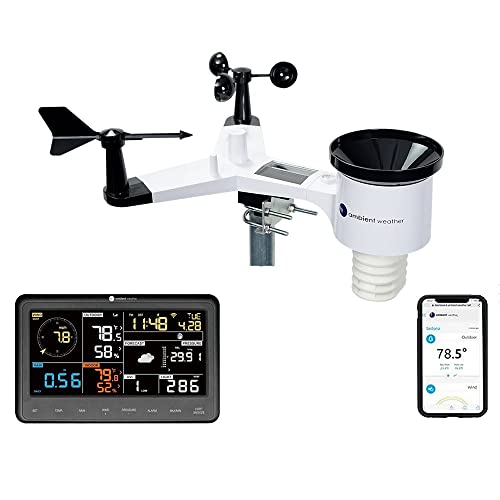
- Tracks wind, rain, temperature, humidity, UV, and solar radiation
- Wi-Fi remote monitoring with customizable alerts
- Compatible with Alexa, Google Home, and IFTTT
Best For: Connected home and garden weather monitoring
Best Easy-Read Forecast Station

- Large color display with adjustable brightness
- Tracks indoor/outdoor temperature and humidity
- Adds dew point, heat index, alerts, and atomic time
Best For: Simple household weather and comfort monitoring
Best High-Accuracy Wi-Fi Station

- Dual-band 5 GHz and 2.4 GHz Wi-Fi connectivity
- Lists ±0.2°C temperature accuracy and ±1.8% RH humidity accuracy
- Stores up to two years of data with Excel export
Best For: Detailed monitoring for greenhouses and data-focused users
Best Comprehensive Color-Screen Station
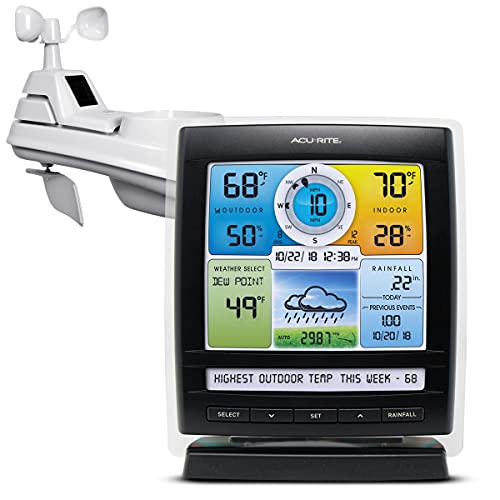
- Reports more than 55 weather data points
- Tracks temperature, humidity, wind, rain, and pressure
- Large color LCD with adjustable dimmer and 12-hour forecast
Best For: Detailed at-home monitoring without Wi-Fi
Advanced Monitoring
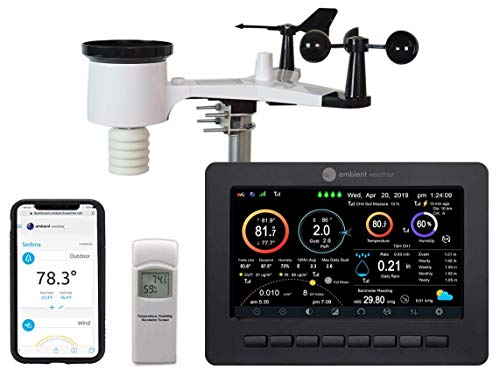
- Tracks wind, temperature, humidity, rain, UV, and solar radiation
- TFT color display with imperial and metric units
- Wi-Fi supports remote monitoring and alerts
Best For: Detailed backyard and garden weather tracking
Smart Home Weather
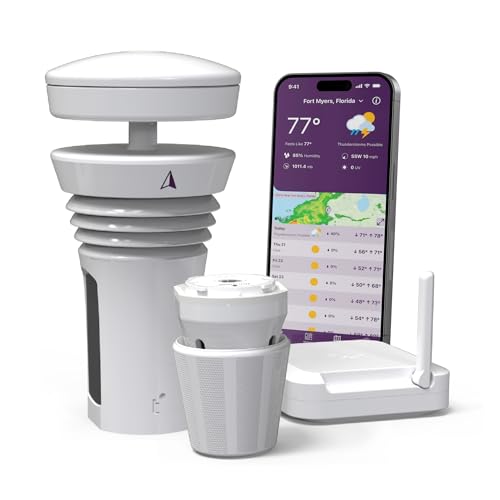
- Tracks weather, UV, lightning, and rainfall
- Solar-powered sensor updates every three seconds
- Works with Alexa, Rachio, IFTTT, and smart-home platforms
Best For: App-based monitoring and weather automation
Easy-Read Atomic Clock

- Large color display for weather and time information
- WWVB atomic clock with automatic DST adjustment
- Supports up to three outdoor sensors and temperature alerts
Best For: Simple home, office, and RV monitoring
Best Smart Wi-Fi Weather Station
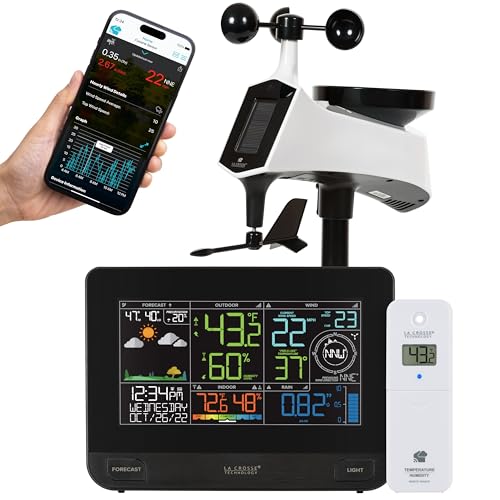
- Wi-Fi app monitoring with customizable alerts
- Wind, rain, temperature, and humidity data
- Forecasts extend to the next seven days
Best For: Connected home weather monitoring
Best Compact Weather Station
U UNNI Wireless Thermometer Hygrometer

- Accurate temperature and humidity readings
- Shows heat, dew point, and mold indexes
- Supports up to three wireless sensors
Best For: Indoor and outdoor comfort monitoring
Best Full-Feature Weather Station
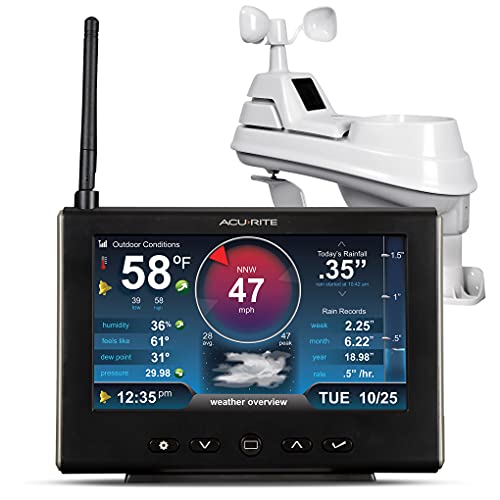
- Tracks wind, rain, pressure, temperature, and humidity
- Offers more than 25 data points and custom alerts
- Creates a 12-hour personalized forecast
Best For: Comprehensive home weather tracking
Best Smart-Home Weather Station – Ambient Weather WS-2902
Ambient Weather WS-2902 Wi-Fi Smart Weather Station | With Wi-Fi Remote Monitoring and Alerts
Check Price On AmazonThe Ambient Weather WS-2902 is a well-rounded choice among weather stations for shoppers who want hyper-local readings plus remote access. Its outdoor sensor tracks wind, temperature, humidity, rainfall, UV intensity, and solar radiation, while the included color LCD keeps key information visible indoors.
Best For: Homeowners and gardeners who want Wi-Fi monitoring, customizable alerts, and smart-home integration.
Pros:
- Measures wind, temperature, humidity, rainfall, UV intensity, and solar radiation.
- Supports remote monitoring and alerts through Wi-Fi.
- Works with IFTTT, Google Home, and Alexa.
- Solar-powered sensor array with a color LCD console.
Cons:
- Temperature accuracy is listed as ±1°C.
- Wi-Fi operates on the 2.4 GHz frequency.
- The product carries a one-year warranty.
This is a strong fit if connected features matter as much as local measurements. Choose it over a basic display-only station when you want to view conditions remotely or connect weather data to compatible smart-home routines.
Best Easy-Read Forecast Station – La Crosse C85845-INT
The La Crosse C85845-INT is one of the more approachable weather stations for everyday indoor and outdoor temperature and humidity checks. Its large color display adds forecast icons, trend arrows, comfort charts, and timekeeping features without requiring app connectivity.
Best For: Households that want a large, readable display, basic outdoor monitoring, and customizable temperature or humidity alerts.
Pros:
- Shows indoor and wireless outdoor temperature and humidity.
- Includes forecast icons, trend arrows, dew point, and heat index views.
- Large display offers adjustable brightness and comfort-level charts.
- Atomic clock, calendar, alarm, and daylight-saving adjustment are included.
Cons:
- The forecast requires 7–10 days for barometric calibration.
- The station uses corded power for its constant backlight.
- Backup batteries are optional and not included.
This model emphasizes convenient at-a-glance information rather than extensive weather measurements. It makes sense for living rooms, offices, and homes where readable forecasts and comfort data are more important than wind or rainfall tracking.
Best High-Accuracy Wi-Fi Station – Sainlogic 12-in-1
The Sainlogic 12-in-1 is designed for shoppers seeking feature-rich weather stations with app access and detailed historical records. It measures temperature, humidity, wind, rainfall, pressure, moon phase, and more, and connects through either 5 GHz or 2.4 GHz Wi-Fi.
Best For: Greenhouses, plant nurseries, wine cellars, and data-focused households that want accurate readings and long-term records.
Pros:
- Lists temperature accuracy of ±0.2°C and humidity accuracy of ±1.8% RH.
- Provides 12 weather and time readings, including wind and rainfall.
- Offers smartphone alerts through the Inercom app.
- Stores up to two years of data and supports Excel export without subscription costs.
Cons:
- Setup requires mounting and connecting the outdoor sensor to Wi-Fi.
- The available details list a battery life of 24 hours.
- App functionality depends on a compatible home Wi-Fi connection.
Among these weather stations, this is the data-oriented option. Its dual-band connectivity, stated precision, and historical export tools make it especially useful when monitoring trends matters more than simply checking today’s temperature.
Best Comprehensive Color-Screen Station – AcuRite Iris 01512
The AcuRite Iris 01512 is a practical pick among weather stations for buyers who want broad local-weather coverage on a dedicated color screen. It reports indoor and outdoor conditions, wind, rain, pressure trends, dew point, and heat index, while its sensor is designed for straightforward pole-or-post installation.
Best For: Homes, gardens, offices, and users who want extensive readings without relying on a smartphone app.
Pros:
- Provides more than 55 data points, including historical information.
- Displays outdoor temperature, humidity, wind speed, wind direction, pressure, and rainfall.
- Large color LCD includes time, date, and an adjustable dimmer.
- Uses elevation and pressure data for a personalized 12-hour forecast.
Cons:
- Its listed temperature accuracy is ±1.11°C.
- The system requires multiple AA batteries across the station and sensor.
- Wireless communication is listed as radio frequency rather than Wi-Fi.
The Iris 01512 stands out for the breadth of information available on its local console. It is a sensible choice for users who want wind and rainfall data alongside indoor comfort readings, but do not need remote app monitoring.
Advanced Monitoring – Ambient Weather WS-2000
Ambient Weather WS-2000 Smart Weather Station | With Wi-Fi Remote Monitoring and Alerts
Check Price On AmazonThe Ambient Weather WS-2000 is one of the more capable weather stations for tracking detailed backyard conditions. Its integrated outdoor array measures wind, temperature, humidity, rainfall, UV, and solar radiation, while the color console and Wi-Fi support make readings easier to review and share.
Best For: Gardeners and weather enthusiasts who want detailed outdoor measurements, a dedicated color display, and Wi-Fi remote monitoring.
Pros:
- Measures wind speed and direction, temperature, humidity, rainfall, UV, and solar radiation.
- Includes a high-definition TFT color display with imperial and metric units.
- Wi-Fi connectivity supports wireless data transmission and remote monitoring with alerts.
- Calibration is available for the supported units of measure.
Cons:
- The sensor array requires three AAA batteries, which are not included.
- The console requires the included 5V DC adapter.
Choose this model if you want a feature-rich weather station with an at-a-glance console and connected monitoring. It is more involved than a basic thermometer, but its broader sensor coverage suits detailed home and garden tracking.
Smart Home Weather – Tempest Weather Station
The Tempest Weather Station is a wireless weather station built for detailed, app-based monitoring. Its solar-powered sensor reports conditions every three seconds, covers a wide range of measurements, and works with Alexa and other smart-home platforms without relying on a traditional display.
Best For: Smart-home users who want hyper-local weather data, app access, forecasting, and automation support.
Pros:
- Monitors temperature, humidity, pressure, wind, dew point, solar radiation, UV, lightning, and rainfall.
- Solar-powered sensor transmits wirelessly more than 1,000 feet and updates every three seconds.
- Non-mechanical design is intended for near-zero maintenance.
- Integrates with Amazon Alexa, Rachio, IFTTT, and popular smart-home platforms.
Cons:
- There is no dedicated display; readings are accessed through the app or connected platforms.
- The outdoor sensor requires a suitable location for wireless transmission and solar charging.
Tempest stands out for connected households that want weather data to inform routines such as irrigation, lighting, or thermostat control. Its broad monitoring range and frequent updates make it a strong choice when app and automation features matter more than a console.
Easy-Read Atomic Clock – DreamSky Weather Station
The DreamSky Weather Station combines a large color display with indoor and outdoor temperature monitoring and an atomic clock. This approachable weather station also provides humidity, forecast information, customizable alerts, and adjustable backlighting for homes, offices, RVs, and other indoor spaces.
Best For: Households that want an easy-to-read indoor/outdoor thermometer with accurate atomic time and basic weather forecasting.
Pros:
- Large display shows temperature, forecast information, time, date, and calendar details.
- WWVB atomic time and automatic daylight-saving adjustment reduce manual clock setting.
- Supports up to three outdoor sensors and includes one sensor.
- Offers high/low alerts, max/min records, adjustable backlighting, and battery backup.
Cons:
- Only one outdoor sensor is included; additional locations require more sensors.
- Backup batteries are not included.
- On battery power alone, the display lights for 10 seconds before dimming to save power.
This is a practical pick for buyers who prioritize readable household information over advanced meteorological measurements. The atomic clock, alerts, and adjustable display add everyday convenience, while the included wireless sensor handles basic indoor/outdoor monitoring.
Best Smart Wi-Fi Weather Station – La Crosse V42-PRO-INT
For shoppers wanting connected weather stations with detailed backyard data, the La Crosse V42-PRO-INT combines a color display with wind, rainfall, temperature, and humidity monitoring. Wi-Fi connectivity adds extended forecasts, mobile alerts, and enhanced data such as UV index, air quality, and sunrise and sunset times.
Best For: Homeowners who want remote monitoring and expansive forecast information.
Pros:
- Measures wind direction, current and top wind speed, rainfall, temperature, and humidity.
- Wi-Fi access supports La Crosse View app monitoring, customizable alerts, and extended forecasts.
- Displays records, graphs, comfort information, and up to a 400-foot sensor transmission range.
Cons:
- Outdoor sensors require batteries, which are not included.
- The station requires an adapter for normal operation; its backup battery retains data but does not run the system.
- Some enhanced forecast features depend on the Wi-Fi connection.
This is a feature-rich choice among weather stations, especially if app access and long-range monitoring matter more than a simple standalone display.
Best Compact Weather Station – U UNNI Wireless Thermometer Hygrometer
This compact U UNNI model is one of the simpler weather stations for tracking indoor and outdoor comfort. Its display provides temperature, humidity, heat index, dew point, and mold index readings, while the wireless sensor transmits updates from as far as 330 feet.
Best For: Homes, garages, patios, offices, and other spaces where temperature and humidity monitoring are the priority.
Pros:
- High-precision sensor provides claimed temperature accuracy of ±0.5°F and humidity accuracy of ±2%.
- Monitors heat index, dew point, and mold index in addition to temperature and humidity.
- Supports up to three sensors and offers tabletop or wall-mount placement.
Cons:
- The display backlight remains illuminated for only 10 seconds after pressing the button.
- It focuses on temperature and humidity metrics rather than wind or rainfall measurements.
- Required batteries are not included.
Choose this weather station if you want an easy-to-read, battery-powered monitor with useful indoor-air and moisture indicators rather than a full wind-and-rain setup.
Best Full-Feature Weather Station – AcuRite Iris 01535M
The AcuRite Iris 01535M is a strong all-around option among weather stations, combining a wireless outdoor sensor with an HD indoor display. It tracks temperature, humidity, wind, barometric pressure, and rainfall, then uses current conditions to produce a 12-hour personalized forecast.
Best For: Households that want comprehensive local weather data, history, and customizable condition alerts.
Pros:
- Displays more than 25 data points, including wind, rainfall, pressure, moon phase, and feels-like temperature.
- Provides customizable alerts for temperature, humidity, wind speed, rainfall, and falling barometric pressure.
- Includes a wireless sensor, mounting bracket, clock, date display, and alarm function.
Cons:
- The optional lightning sensor is sold separately.
- The listed temperature accuracy is ±1°C, which is less precise than specialized high-accuracy monitors.
- Its display and sensor setup may be more involved than a basic thermometer.
With rainfall, wind, pressure trends, history, and alerts in one system, this AcuRite is a practical pick for buyers seeking broad everyday weather coverage.
How We Picked the Best Weather Stations
We focused on the features that matter most in daily use: dependable outdoor sensors, readable displays, useful measurement range, wireless reliability, setup requirements, and access to historical data. Models with Wi-Fi or app support were evaluated for remote monitoring and alert capabilities, while simpler stations were considered for shoppers who want quick, local readings without subscriptions or complicated configuration.
Because accuracy depends on placement and maintenance, we also considered sensor design and installation flexibility. A feature-rich station is only useful if its outdoor unit can be positioned away from heat sources, obstructions, and excess moisture.
Quick Comparison
- Best connected experience: Ambient Weather WS-2902 and WS-2000 offer broad data access and smart monitoring features.
- Best for smart-home integration: Tempest combines app access, wireless installation, and Alexa compatibility.
- Best for detailed measurements: Sainlogic’s 12-in-1 design covers a wide range of outdoor conditions.
- Best for straightforward home use: DreamSky and basic indoor/outdoor thermometer models keep operation simple.
- Best for established display systems: AcuRite Iris and La Crosse Technology models provide dedicated console options with clear at-a-glance readings.
Key Buying Factors for Weather Stations
Measurements and Sensor Coverage
Decide which readings you actually need. Temperature and humidity are enough for basic comfort monitoring, while wind speed, wind direction, rainfall, dew point, heat index, and barometric pressure are more useful for gardening, outdoor work, and detailed forecasting.
Wi-Fi, Apps, and Alerts
Wi-Fi models can deliver readings away from home and notify you about changing conditions. Check whether the station requires an account, a particular network band, or a mobile app. Dual-band compatibility can simplify setup when your router uses both 2.4GHz and 5GHz networks.
Display and Readability
A large color console is helpful in a kitchen, office, or living room. Consider viewing angle, brightness, update frequency, and whether the display remains useful without opening an app.
Installation and Maintenance
Look for a realistic wireless range between the sensor and console or hub. Outdoor units need secure mounting and periodic cleaning; rain gauges may require clearing debris, and batteries may need seasonal replacement. Solar-assisted sensors can reduce maintenance but do not eliminate it.
Who Should Buy Which Weather Stations?
Choose a connected Ambient Weather or Tempest model if remote monitoring, detailed history, alerts, or smart-home access are priorities. These are especially useful for homeowners who want conditions available from a phone.
Choose Sainlogic or a professional La Crosse model if you want broad measurement coverage, wind and rain data, and a more comprehensive home weather dashboard.
Choose AcuRite Iris if you prefer a recognizable dedicated display and practical outdoor readings without making app access the center of the experience.
Choose DreamSky or a basic wireless thermometer-hygrometer for bedrooms, nurseries, offices, or apartments where temperature, humidity, and time matter more than advanced forecasting.
Before buying, confirm the sensor range, power requirements, mounting method, network compatibility, and the measurements included. The best weather station is the one whose readings you will check regularly and whose installation suits your property.