The best advanced robotics sets turn abstract coding and electronics concepts into hands-on projects. Our 2026 picks span programmable cars, robot arms, tank platforms, hydraulic builds, coding companions, and expandable Arduino kits.
Whether you are shopping for a student, hobbyist, or aspiring engineer, the right set depends on programming support, mechanical complexity, included components, and room to build beyond the instructions.
Best 10 Advanced Robotics Sets Picks for 2026
Best Expandable Platform

- Builds 10 robot models
- Supports Arduino, Python, and Raspberry Pi
- Durable aluminum construction
Best For: Teens and adults pursuing progressive robotics projects
Best Screen-Free Learning

- Uses physical cards for coding
- Offers three interactive play modes
- Builds a color-changing robotic reptile
Best For: Younger learners exploring STEM through animal-themed play
Best FPV Tank Project
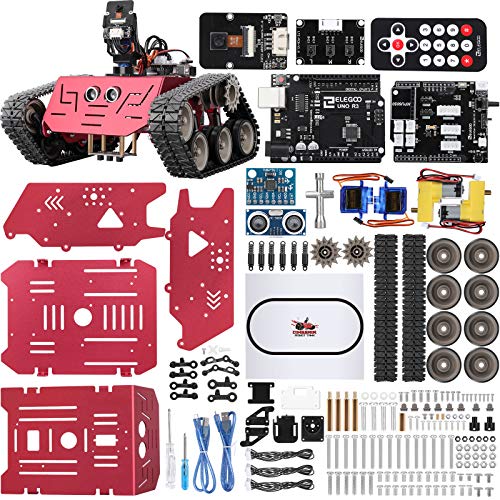
- Features Wi-Fi FPV camera
- Offers five interactive driving modes
- Includes UNO R3 and no-solder components
Best For: Ages 10+ exploring vehicle robotics and Arduino coding
Best Classic Education Set

- Includes 541 interlocking pieces
- Targets engineering and math skills
- Uses a rechargeable battery system
Best For: Classroom and structured LEGO-based robotics activities
Most Versatile
GAR Monster Arduino Robotics Kit

- Five development boards for varied projects
- 500+ sensors, modules, and robotics components
- Tutorials and organizer case included
Best For: Makers who want a broad platform for Arduino, STEM, and connected robotics experiments
Best for Coding Play

- Programs with Draw, Blocks, Python, or JavaScript
- LED matrix and sensors visualize code
- Waterproof design with 4+ hours of play
Best For: Ages 8+ learners focused on creative coding and sensor-based robotics
Best Robot Car Project

- Builds a programmable Arduino robot car
- Includes FPV, line tracking, and obstacle avoidance
- Guided wiring, tutorials, and rechargeable battery
Best For: Ages 12+ builders learning robotics through a hands-on vehicle project
Hands-On Hydraulic Builder

- Water-powered hydraulic operation
- Six axes and 270-degree rotation
- Detailed multi-hour STEM build
Best For: Ages 12+ exploring mechanical engineering and hydraulics
Programmable All-Terrain Kit

- Three reconfigurable robot designs
- Scratch and Arduino programming
- Sensors and all-terrain tracks
Best For: Ages 10+ building and coding versatile mobile robots
Modular Robotic Arm Explorer

- 5DOF programmable robotic arm
- Four modular vehicle configurations
- Arduino, Scratch, app, and remote control
Best For: Ages 12+ exploring coding, robot arms, and tracked vehicles
Best Expandable Platform – mBot Ultimate 10-in-1
For shoppers seeking advanced robotics sets that can grow with a learner, the Makeblock mBot Ultimate offers 10 buildable models, from a robotic arm to a remote-controlled tank. Its aluminum parts and support for block coding, Arduino, Python, and Raspberry Pi make it a substantial long-term project kit.
Best For: Teens and adults ages 12+ who want a versatile robotics platform for coding, mechanics, and maker projects.
Pros:
- Builds 10 different robot models.
- Supports mBlock, Arduino IDE, Python, and Raspberry Pi projects.
- Uses durable aluminum alloy parts and a MegaPi control board.
Cons:
- Requires six AA batteries, which are not included.
- Its broad capabilities may be more than beginners need.
This is a strong choice when flexibility and progression matter more than a quick first build. It offers a path from visual coding to more advanced robotics experimentation, though its size and complexity suit dedicated learners.
Best Screen-Free Learning – Coding Chameleon
This Coding Chameleon is a hands-on option for families comparing advanced robotics sets with more accessible, unplugged coding. The 133-piece build creates a 15-inch robotic reptile with gesture responses, color changes, a moving tongue, and physical action-card programming.
Best For: Children ages 8+ who enjoy imaginative animal-themed STEM activities and screen-free coding practice.
Pros:
- Teaches coding without screens, devices, or software.
- Includes coding, wild, and pet play modes.
- Uses sensors and RGB LEDs to create interactive responses.
Cons:
- Younger children may need adult help with assembly.
- Requires four AAA batteries.
Choose this set for approachable robotics concepts wrapped in interactive pretend play. It is less suited to open-ended programming than a board-based kit, but its guided activities can make coding concepts engaging for younger learners.
Best FPV Tank Project – ELEGOO Conqueror Robot
The ELEGOO Conqueror is one of the advanced robotics sets to consider for learners who want a mobile, sensor-rich build. Its metal tracked chassis, UNO R3 controller, Wi-Fi FPV camera, and five driving modes support both guided experimentation and Arduino-based customization.
Best For: Makers ages 10+ interested in vehicle robotics, live camera driving, navigation challenges, and Arduino coding.
Pros:
- Includes FPV video, obstacle avoidance, line tracking, and auto-follow modes.
- Combines visual programming with Arduino IDE development.
- Complete no-solder kit includes tools, battery, and major components.
Cons:
- Phone-based FPV operation adds setup requirements.
- Its metal tracked build may be more involved than a basic robot kit.
This tank is a practical pick for project-based learning because each mode creates a different challenge, from maze navigation to patrol routes. It balances guided entry points with enough hardware and code access for continued experimentation.
Best Classic Education Set – LEGO MINDSTORMS EV3 Core
The LEGO MINDSTORMS EV3 Core Set is a classic educational building platform for shoppers considering advanced robotics sets with a structured, engineering-focused format. It includes 541 interlocking pieces and is designed around robot construction, math, and engineering skills.
Best For: Learners and classrooms seeking a substantial LEGO-based foundation for robot-building activities.
Pros:
- Includes 541 pieces for substantial construction projects.
- Supports engineering and math-focused learning.
- Includes a rechargeable battery and is designed for educational use.
Cons:
- The supplied listing does not detail specific robot models or programming features.
- Its listed model year is 2015, so it is an older platform.
- Battery and charger component details should be verified before purchase.
EV3 remains appealing for buyers who value a familiar interlocking construction system and classroom-oriented STEM goals. Because the supplied details are limited, confirm the included electronics and accessories if programming capability is essential.
Most Versatile – GAR Monster Arduino Robotics Kit
For builders who want room to grow, this advanced robotics sets option combines five development boards with more than 500 components, including sensors, displays, wireless modules, motors, and networking hardware. It is a broad Arduino-compatible platform for experimenting with coding, electronics, and connected robotics projects.
Best For: Beginner-to-advanced makers, families, classrooms, and users who want a large parts library for varied Arduino and STEM projects.
Pros:
- Includes UNO R3, Mega 2560, Nano V3, ESP32, and ESP8266 boards.
- Provides a wide selection of sensors, modules, motors, displays, and wireless components.
- Includes tutorials, datasheets, and video links with no soldering required.
- Comes in a durable adjustable-compartment organizer with lifetime parts replacement support.
Cons:
- The large component assortment may feel overwhelming for complete beginners.
- Its broad selection is better suited to experimentation than to one focused robot build.
This is the strongest choice when flexibility matters most. The multiple boards and extensive component selection support both introductory exercises and more ambitious connected robotics projects.
Best for Coding Play – Sphero BOLT Coding Robot
Sphero BOLT makes advanced robotics sets approachable through a ready-to-use robot ball rather than a traditional assembly project. Its programmable sensors, LED matrix, and app-based coding tools let learners explore movement, inputs, outputs, and visual feedback with Draw, Blocks, Python, or JavaScript.
Best For: Learners ages 8 and up, classrooms, and families seeking an engaging introduction to programming and sensor-based robotics without chassis assembly.
Pros:
- Supports Draw, block-based, Python, and JavaScript programming.
- LED matrix provides immediate visual feedback for messages, movement, and data.
- Includes programmable sensors for exploring light, direction, and speed.
- Waterproof, scratch-resistant design offers up to four hours of play per charge.
Cons:
- It is a single finished robot, so it offers less hands-on mechanical assembly.
- Requires a compatible device and the Sphero Edu app for app-enabled programming.
BOLT is a polished choice for coding-first learning. It emphasizes creative programming and real-time feedback, making robotics concepts easier to see and test than with a parts-heavy construction kit.
Best Robot Car Project – ELEGOO UNO R3 Smart Robot Car
This ELEGOO kit offers a practical build-and-drive route into advanced robotics sets, combining an Arduino-compatible controller with motors, sensors, camera functionality, and wireless control. Builders assemble the car, then explore FPV video, line tracking, obstacle avoidance, and custom Arduino programming.
Best For: Ages 12 and up, STEM classes, coding clubs, and families wanting a guided robot-car project with tangible driving and sensing challenges.
Pros:
- Supports FPV video, line tracking, obstacle avoidance, auto-follow, app control, and IR control.
- Keyed connectors and an illustrated tutorial help reduce wiring errors.
- Includes an UNO R3 board, camera and Wi-Fi module, sensors, motors, remote, and rechargeable battery.
- Example programs can be modified for custom routes and reactions.
Cons:
- Assembly and first-time programming may require adult guidance.
- Its focus is centered on one robot-car build rather than a broad parts assortment.
- The listed manufacturer warranty is six months.
Choose this kit when the goal is to build a working robot vehicle and immediately test it in the real world. It balances guided assembly with enough Arduino programming flexibility for follow-up experiments.
Hands-On Hydraulic Builder – Hydrobot Arm
For shoppers comparing advanced robotics sets, the TEACH TECH Hydrobot Arm offers a focused introduction to mechanical engineering through a genuine build project. It uses water-powered hydraulics rather than batteries, with six axes, 270-degree rotation, and a working gripper.
Best For: Kids ages 12 and up who enjoy detailed construction projects and want to explore hydraulics, mechanics, and engineering without coding.
Pros:
- Builds into a working hydraulic robotic arm controlled by levers.
- Six axes and up to 270-degree rotation provide meaningful movement.
- Gripper can open and close, with suction components available for picking up objects.
- Detailed instructions support problem-solving and hands-on STEM learning.
Cons:
- Assembly is an in-depth project that may take multiple hours.
- Designed for ages 12 and up, so it may be too challenging for younger children.
- Its water-powered design focuses on mechanical robotics rather than programming.
This is a strong choice when the goal is to understand fluid power and mechanical motion through building. Choose it over a programmable rover if a slower, engineering-focused project is the priority.
Programmable All-Terrain Kit – mBot Ranger 3-in-1
The Makeblock mBot Ranger is one of the more versatile advanced robotics sets for kids who want to build, code, and reconfigure the same platform. Its three designs include a tracked Land Raider, self-balancing Nervous Bird, and three-wheel Dashing Raptor.
Best For: Kids ages 10 and up who want a reusable robotics project with Scratch and Arduino support, app control, sensors, and indoor or outdoor mobility.
Pros:
- Three robot configurations offer varied building and programming challenges.
- Supports Scratch and Arduino through the mBlock5 programming app.
- Includes multiple sensors, Bluetooth, RGB LEDs, a buzzer, and a gyroscope.
- Metal parts, tracks, and powerful motors support different terrains.
Cons:
- Six AA batteries or lithium batteries are required and not included.
- The advanced feature set may require adult guidance for some builders.
- Its many configurations and modules can make the project more involved than a basic robot kit.
The Ranger stands out for long-term experimentation: builders can move from assembly to block coding and then toward Arduino projects. It is the better fit for learners who want programming depth and multiple robot forms rather than a single-purpose build.
Modular Robotic Arm Explorer – ACEBOTT 4-in-1 Robot Arm
The ACEBOTT 4-in-1 combines a programmable 5DOF arm with a robot car and tank-track expansions, making it a particularly broad option among advanced robotics sets. Guided tutorials, app control, remote control, and Arduino and Scratch compatibility help connect the mechanical build with coding practice.
Best For: Kids and teens ages 12 and up who want to build several robot configurations and practice robotic-arm control, vehicle navigation, and programming.
Pros:
- Modular design supports a robot car, tank, robotic-arm car, or robotic-arm tank.
- Five-degree-of-freedom arm teaches grabbing, lifting, and placing objects.
- ESP32 controller works with Arduino and Scratch.
- Includes 16 guided tutorials, HD assembly videos, app control, and IR remote control.
Cons:
- Its multiple modules and programming features may be demanding for beginners.
- Online access is needed to download tutorials and code from the official resource site.
- Despite broad play descriptions, the supplied age recommendation is 12 years and up.
This kit is compelling for learners who want one platform that can evolve from guided assembly into more ambitious robotics experiments. The combination of an articulated arm, tank tracks, sensors, and software support gives it strong project potential for home learning or STEM activities.
How We Picked These Advanced Robotics Sets
We selected kits that offer more than a simple construction activity. Each product supports meaningful experimentation through coding, sensors, motors, mechanical systems, or expandable electronics. The lineup includes approachable options for younger learners as well as technically deeper platforms for teens, adults, and experienced makers.
We also considered the included controller, programming ecosystem, project variety, documentation, compatibility, and the likelihood that a buyer can continue learning after completing the first few builds. Because “advanced” means different things to different users, the list balances polished educational systems with open-ended Arduino-compatible kits.
Quick Comparison
| Best For | Look For |
|---|---|
| Structured learning | Guided lessons, clear instructions, and a reliable coding app or software platform |
| Arduino experimentation | UNO, Mega, Nano, ESP32, or ESP8266 compatibility and accessible electronic components |
| Mechanical engineering | Robot arms, tank drives, hydraulic components, gears, and multiple build configurations |
| Creative coding | Scratch support, block coding, sensors, autonomous behaviors, and reusable projects |
| Long-term value | Expandable parts, replacement availability, community projects, and open documentation |
Key Buying Factors for Advanced Robotics Sets
Programming and Hardware Compatibility
Check which languages and platforms are supported before buying. Block-based coding is useful for visual learners and younger students, while Arduino, C/C++, Python, or a manufacturer-specific environment can provide a deeper path for advanced users. Confirm whether a computer, phone, tablet, or separate programming cable is required.
Mechanical and Electronic Complexity
Robot cars are often easier to assemble and modify, whereas arms, hydraulic systems, and multi-configuration kits introduce more challenging concepts such as torque, control precision, balance, and sequencing. Count the motors, sensors, boards, and accessories included rather than judging complexity by the product name alone.
Documentation, Safety, and Maintenance
Good diagrams and tested example programs can make a major difference. Look for downloadable manuals, wiring references, troubleshooting help, and active user communities. Younger builders may need supervision around small parts, tools, batteries, moving mechanisms, and pressurized or fluid-based systems.
Age Range and Learning Goals
Use the stated age as a starting point, not a guarantee. A motivated beginner may prefer a guided kit, while an experienced maker may value an open board and the freedom to design new projects. Consider whether the goal is school enrichment, family building, coding practice, engineering fundamentals, or a long-term hobby.
Who Should Buy Which Advanced Robotics Sets?
Choose a guided coding robot or educational companion for a learner who needs quick, encouraging results. A programmable car or tank kit is a strong choice for builders interested in Arduino, sensors, navigation, and remote control. Robot-arm kits suit users who want to explore mechanical movement, gripping, degrees of freedom, and automation.
For broad electronics practice, a multi-board Arduino starter kit offers the most flexibility, especially for buyers who already know they want to experiment with different microcontrollers and sensors. A modular multi-build platform is better for families or clubs sharing one kit, while a specialized hydraulic or arm project is more appropriate when the mechanism itself is the main attraction.
Before ordering, verify the current contents, required batteries, software support, and device compatibility. The best Advanced Robotics Sets are the ones that match the builder’s current skill level while leaving enough room for increasingly ambitious projects.