The best beginner robotics sets make coding and engineering approachable through hands-on projects. These kits let children build moving robots, explore simple electronics, and practice problem-solving without needing advanced experience.
Our selection includes guided starter kits, programmable robot cars, solar-powered builds, and multi-project sets for a range of ages. Use the guide below to match the right kit to a child’s interests, patience, and learning goals.
Best 10 Beginner Robotics Sets Picks for 2026
Best Entry-Level Coding Robot

- Assembles in about 15 minutes
- Teaches Scratch and Arduino basics
- Supports line following and obstacle avoidance
Best For: Kids 8+ starting guided robotics and coding
Best Feature-Rich Robot Car

- Includes FPV camera and Wi-Fi module
- Supports line tracking and obstacle avoidance
- Uses guided Arduino programming lessons
Best For: Older beginners and classroom robotics projects
Best Multi-Project Variety Set

- Includes six different robot-themed projects
- Covers circuits, motors, and engineering
- Designed for ages 8–12
Best For: Kids who enjoy varied science and building activities
Best Build-and-Play Progression
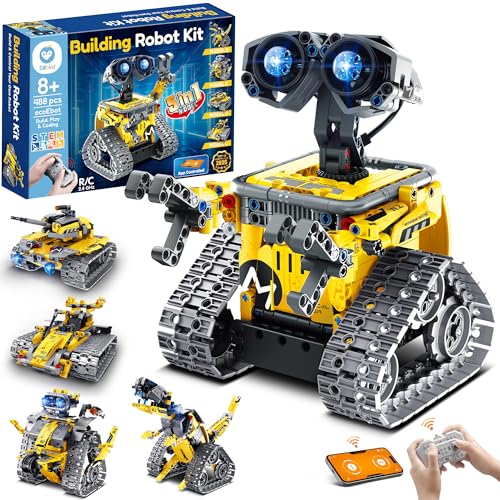
- Builds five different robot-themed models
- Offers app and remote control
- Includes 488 pieces and a rechargeable battery
Best For: Kids wanting repeatable builds and creative play
Solar Builder Pick

- Builds 13 land- and water-moving robots
- Runs with solar power
- Includes reusable construction parts
Best For: Kids 8+ learning robotics through hands-on family projects
Mechanical Coding Pick

- Programs actions with a coding wheel
- Teaches mechanical engineering basics
- Offers a detailed multi-hour build
Best For: Ages 10+ ready for a deeper coding project
Multi-Project Value Pick

- Includes six robot and science projects
- Comes with a screwdriver and manuals
- Supports construction and problem-solving
Best For: Kids 8–12 wanting varied hands-on STEM activities
Best Multi-Project Starter

- Builds five different robot designs
- Includes 30+ components and an illustrated manual
- Designed for hands-on STEM learning ages 8-13
Best For: Kids who want several beginner-friendly robotics projects in one kit
Best Family Build Set

- Includes six science and electronics projects
- Comes with a mini screwdriver and instructions
- Encourages family building and science-fair activities
Best For: Families seeking varied, guided projects for kids ages 8-12
Best Programmable Upgrade

- Supports Scratch, Arduino, and Python
- Includes 16 tutorials and no-solder assembly
- Works with mobile devices, an app, and IR remote
Best For: Beginners who want a robot kit that can grow into coding
Best Entry-Level Coding Robot – Makeblock mBot
The Makeblock mBot is a practical starting point for families looking for beginner robotics sets that introduce electronics, construction, and coding without an especially complicated build. It assembles in about 15 minutes and supports learning paths from Scratch to Arduino, while also working as a remote-control vehicle with line-following and obstacle-avoidance functions.
Best For: Kids ages 8 and up who are ready to move from basic building into guided coding and robotics projects.
Pros:
- Quick assembly with clearly presented building instructions.
- Supports Scratch and Arduino learning with coding cards, lessons, apps, and mBlock software.
- Offers interactive functions such as remote control, line following, and obstacle avoidance.
- Open-source design can work with Makeblock add-on modules and compatible LEGO parts.
Cons:
- 4 AA batteries for the robot and a CR2025 battery for the remote are not included.
- Its introductory design may be less challenging for experienced young makers.
mBot is a strong beginner-friendly choice when ease of assembly and structured learning matter most. Its expandable platform also gives children room to continue experimenting after they master the included activities.
Best Feature-Rich Robot Car – ELEGOO UNO R3 Smart Robot Car
The ELEGOO UNO R3 Smart Robot Car Kit is suited to beginners who want beginner robotics sets with more advanced features to explore. Its guided wiring, illustrated tutorial, and example programs lead users through assembly before introducing Arduino programming, FPV video, line tracking, and obstacle avoidance.
Best For: Older children, families, classrooms, and coding clubs ready to build and program a sensor-equipped robot car.
Pros:
- Keyed connectors help reduce wiring mistakes during assembly.
- Includes FPV video, app and IR control, line tracking, and obstacle avoidance.
- Arduino IDE support encourages experimentation with movement, sensors, and control logic.
- Includes a rechargeable 2000 mAh lithium-ion battery.
Cons:
- The manufacturer recommends it for ages 12 and up, despite some listing language mentioning age 8+.
- Its combination of wiring, programming, camera, and sensors may require adult guidance for first-time builders.
This kit offers a deeper technical progression than a simple remote-control robot. It is a good fit when the goal is to move beyond assembly into Arduino-based experiments and sensor-driven behavior.
Best Multi-Project Variety Set – STEM Robotics Six-Set Kit
This six-set collection gives children a broad introduction to beginner robotics sets through several hands-on builds rather than one programmable platform. Projects include a bubble machine, doodling robot, balance robot car, fiber optic light, reptile robot, and obstacle-avoidance robot car, making it useful for screen-free science and craft activities.
Best For: Children ages 8–12 who enjoy trying multiple simple robot-themed projects and science activities.
Pros:
- Includes six different robotics and science-themed projects.
- Provides varied activities involving circuits, motors, engineering, and construction.
- Designed as approachable indoor activities for elementary-age children.
- Can suit individual play, classroom projects, or science-fair-style exploration.
Cons:
- AA batteries and bubble solution are not included.
- The set emphasizes simple builds and activities rather than a single advanced coding system.
- Its many projects may offer less depth in any one robotics platform.
Choose this kit for variety and accessible experimentation. It works especially well when keeping children engaged across several short projects is more important than developing a long-term Arduino or app-coding pathway.
Best Build-and-Play Progression – Sillbird 5-in-1 Robot Kit
The Sillbird 5-in-1 Robot Building Kit combines progressive construction with app and remote control, making it one of the more flexible beginner robotics sets for children who want to keep rebuilding. Its 488 pieces can be used to create a robot, dinosaur, car, tank, and other models, with clear illustrated instructions to support independent or family assembly.
Best For: Kids ages 8–16 who value repeated building, creative model changes, and screen-free robotic play.
Pros:
- Five buildable model types provide varied replay value.
- Offers Bluetooth app control and remote control, plus basic programming and path functions.
- Clear, colorful instructions are designed to make the 488-piece build approachable.
- Rechargeable battery provides up to 40 minutes of play on a charge.
Cons:
- The large piece count may make the first build more time-consuming than a quick-start kit.
- Its progressive models may still benefit from family help for younger builders.
This is a compelling option for children who may outgrow a single robot quickly. The combination of multiple models, dual controls, and rechargeable play supports repeated building while gradually introducing programming concepts.
Solar Builder Pick – 13-in-1 Solar Robot Kit
For families comparing beginner robotics sets, this 13-in-1 kit offers a broad introduction to building, rebuilding, and solar power. Children can follow the step-by-step manual to create different land- and water-moving robots from reusable parts.
Best For: Kids ages 8 and up who enjoy hands-on construction and family STEM projects.
Pros:
- Includes 13 robot designs to build and reassemble.
- Uses solar power rather than conventional electric power.
- Supports problem-solving, creativity, construction, and engineering skills.
- Smooth, non-toxic ABS parts are designed for safer play.
Cons:
- Assembly requires following detailed instructions and handling many small parts.
- Solar-powered operation may depend on suitable light conditions.
This is a versatile choice for beginners who want variety and an introduction to renewable energy. Its multiple builds also make it suitable for shared parent-child activity.
Mechanical Coding Pick – Mech-5 Coding Robot
Among beginner robotics sets, the TEACH TECH Mech-5 stands out for combining a substantial build with mechanical coding. Users snap coding buttons onto a coding wheel to program actions such as throwing, lifting, kicking, and drawing.
Best For: Future engineers ages 10 and up who are ready for a multi-hour construction and coding project.
Pros:
- Introduces mechanical engineering principles and coding basics.
- Can be programmed to perform several physical actions.
- Provides an in-depth, hands-on build rather than a pre-assembled toy.
- Includes assembly parts and an English instruction manual.
Cons:
- Requires multiple hours of careful assembly.
- Recommended for ages 10 and up, so it may be too advanced for younger beginners.
- Requires two AAA batteries.
Mech-5 is a strong fit when the goal is to move beyond simple assembly into programmable mechanical behavior. Plan for patience and uninterrupted build time.
Multi-Project Value Pick – 6-in-1 Robotics STEM Set
This 6-in-1 set is a practical option for families seeking beginner robotics sets with several activities in one package. Kids can build projects including a reptile robot, balance car, bubble machine, fiber lamp, and sliding plane while practicing construction and problem-solving.
Best For: Kids ages 8–12 who want varied science projects for individual or family activity time.
Pros:
- Provides six separate robot and science experiment projects.
- Encourages creativity, logical thinking, coordination, and construction skills.
- Includes a screwdriver and step-by-step instruction manuals.
- Suitable for family bonding, classroom activities, or gift giving.
Cons:
- The set includes several different projects rather than one advanced robot.
- Some builds may require adult guidance for younger children.
- Project variety can mean more parts and instructions to organize.
Choose this kit if variety matters more than advanced programming. Its six projects provide repeated opportunities to practice assembling and experimenting with electronic motor crafts.
Best Multi-Project Starter – 5-in-1 Smart Robot Car Kit
For shoppers comparing beginner robotics sets, the Butterfly EduFields kit is a versatile option for children who want to build more than one project. It includes components for five robot designs, along with a colorful 32-page manual and more than 30 parts.
Best For: Kids ages 8-13 who enjoy hands-on building, science activities, and experimenting with multiple robot designs.
Pros:
- Supports five different robot builds.
- Includes an IR sensor, geared motor, processor, battery holder, and car chassis.
- Step-by-step, 32-page multicolor instructions support independent assembly.
- Targets construction, motor, observation, problem-solving, and STEM skills.
Cons:
- Requires four AA batteries, which are not included.
- The listed age details vary between 8-13 and 8-15.
This is a strong introductory choice when variety matters more than advanced programming. Its multiple builds can keep younger learners engaged, while the included electronics provide a practical introduction to robotics concepts.
Best Family Build Set – 6-in-1 Robotics STEM Kit
This BeAndge set stands out among beginner robotics sets by combining six different science and electronics projects. Children can assemble a reptile robot, balance car, bubble machine, fiber lamp, and buzzer wire game, making it suited to shared projects and repeated experimentation.
Best For: Families, elementary students, and children ages 8-12 who benefit from guided building and varied science activities.
Pros:
- Offers six projects, including a reptile robot and balance car.
- Includes a mini screwdriver and detailed step-by-step manuals.
- Uses odorless, safety-focused materials according to the supplied notes.
- Suitable for family activities, home learning, and science fairs.
Cons:
- AA batteries and bubble solution are not included.
- The projects may require adult participation for younger builders.
- It emphasizes assembly and experiments rather than multiple programming languages.
Choose this kit if the goal is variety and family bonding rather than a single programmable robot. The mix of mechanical and electronic activities gives beginners several ways to explore circuits, motion, and simple engineering.
Best Programmable Upgrade – ACEBOTT Smart Robot Car Kit
For beginners who may want to progress into coding, the ACEBOTT is a more expandable choice among beginner robotics sets. Its ESP32-based robot supports Scratch, Arduino, and Python, with story-based tutorials, app or IR-remote control, and no-solder assembly.
Best For: Children and teens ages 8-16 who want to start with block coding and later explore Arduino or Python.
Pros:
- Supports Scratch, Arduino, and Python programming.
- Includes 16 story-based tutorials plus illustrated instructions and HD videos.
- Can be coded using computers, tablets, and mobile devices.
- Offers smartphone app control and an included IR remote.
Cons:
- Batteries are not included.
- The product details list a manufacturer recommended age of 12+, despite marketing that also mentions ages 8-12.
- Its programming features may be more involved than needed for children seeking only basic assembly.
This is the best fit when long-term learning potential is important. Scratch provides an accessible starting point, while Arduino and Python give older or more motivated learners room to continue developing coding skills.
How We Picked These Beginner Robotics Sets
We selected Beginner Robotics Sets that emphasize hands-on construction, clear learning value, and age-appropriate challenges. The roundup covers several formats, including programmable Arduino-compatible cars, remote-control robots, solar-powered projects, coding platforms, and kits with multiple builds. We also considered whether a set can support progression from guided assembly to more independent experimentation.
Because contents and instructions vary, check each product listing for the exact parts, software requirements, battery needs, and recommended age before purchasing.
Quick Comparison
- Best for guided coding: Makeblock mBot and TEACH TECH Mech-5.
- Best for programmable robot cars: ELEGOO UNO R3 and ACEBOTT kits.
- Best for variety: The 13-in-1 solar kit and Butterfly EduFields 5-in-1 set.
- Best for younger builders: Sets labeled for ages 8 to 10 with simpler construction and broader STEM activities.
- Best for remote-control play: Sillbird and similar kits that combine building with direct control.
Key Buying Factors for Beginner Robotics Sets
Age and Difficulty
Age labels are useful starting points, but building experience matters just as much. Younger children may need adult help with small parts, wiring, or software installation. For a first kit, prioritize visual instructions, fewer complicated connections, and projects that produce results quickly.
Coding Platform and Compatibility
Some kits use block-based coding, while others support Arduino programming or Scratch. Block coding is usually more accessible for beginners; Arduino compatibility offers greater room to expand but may require more setup and troubleshooting. Confirm that the required app or computer software works with your child’s device.
Project Type and Parts
Robot cars are engaging and often provide a clear introduction to sensors, motors, and control systems. Multi-project and solar kits offer more variety but may involve simpler mechanisms or repeated disassembly. Check whether motors, batteries, cables, tools, and controllers are included.
Support and Expandability
Look for readable manuals, tutorial availability, replacement-part access, and an active project community. A kit is more valuable when children can modify the design after completing the first build.
Who Should Buy Which Beginner Robotics Sets?
Choose a guided coding robot for a child who wants structured lessons and immediate feedback. Select an Arduino-compatible car for an older beginner interested in sensors, apps, and future programming projects. A solar or multi-build kit suits children who prefer variety and mechanical experimentation, while a remote-control set is a good choice when play value is the main priority.
For a first purchase, match the kit to the child’s attention span and available adult support rather than choosing solely by the number of projects. The best Beginner Robotics Sets are those the child can finish, understand, and confidently modify.