The best robotics sets for homeschool turn abstract STEM concepts into hands-on projects children can build, test, troubleshoot, and improve. This roundup compares ten options across coding, electronics, mechanics, sensors, and creative engineering.
Use the guide below to match each kit with your child’s age, experience, learning goals, available supervision, and preferred type of play.
Best 10 Robotics Sets for Homeschool Picks for 2026
Most Versatile Project Kit

- 40-plus robotics and home automation projects
- 100-plus parts with reusable sensors
- No soldering or coding knowledge required
Best For: Homeschoolers seeking a wide range of hands-on STEM projects
Best for Early Coding

- Screen-free remote-controlled coding play
- Includes cards, boards, and obstacles
- Teaches sequencing with progressive challenges
Best For: Young learners starting with coding and robotics
Best for Engineering Concepts

- Builds two water-powered boxing robots
- Explores gears, cylinders, and pistons
- Includes a scoreboard for robot battles
Best For: Older homeschool learners studying mechanical physics
Best for Progressive Builds
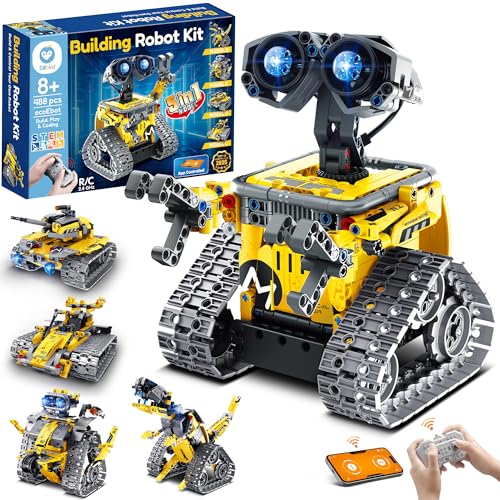
- Builds five models with varying difficulty
- Offers app and remote-control modes
- 488 pieces with rechargeable operation
Best For: Children developing building and beginner programming skills
Best Unplugged Coding Pick

- Screen-free coding with physical action cards
- Three interactive play and learning modes
- Includes sensors, LEDs, and a 48-page guide
Best For: Ages 8+ and homeschool coding lessons without devices
Best Renewable Energy Project

- Builds 12 robot, vehicle, and boat models
- Explores solar power and renewable energy
- Works outdoors or indoors with a flashlight
Best For: Ages 8–13 learning through repeatable engineering projects
Best Multi-Project Value

- Includes six different STEM project builds
- Practices construction and problem-solving skills
- Includes screwdriver and detailed instructions
Best For: Families seeking varied collaborative projects for ages 8–12
Best Multi-Project Starter

- Six build-and-experiment activities
- Step-by-step assembly with included screwdriver
- Designed for hands-on learning ages 8–12
Best For: Families wanting varied introductory robotics and circuit projects
Best for Coding Progression

- Scratch, Arduino, and Python support
- 16 story-based tutorials with video guidance
- App and IR remote control options
Best For: Students ready to move from beginner coding to Python
Best for Rebuildable Engineering

- 780 pieces and six rebuildable models
- App and remote control with coding modes
- Rechargeable battery and motor system included
Best For: Kids who enjoy larger construction projects and repeat builds
Most Versatile Project Kit – 40-in-1 STEM Robotics Kit
For families seeking robotics sets for homeschool, this ButterflyEdufields kit offers a broad selection of hands-on projects for children ages 8–12. With more than 100 parts, reusable sensors, and no-solder assembly, it supports practical exploration of electronics, automation, and basic robotics.
Best For: Homeschoolers who want many screen-free STEM projects in one kit.
Pros:
- Includes 40-plus project ideas, including a line-following car, drawing robot, and flame extinguisher robot.
- Provides more than 100 components, including motors, wheels, LEDs, a pump, processor, and sensors.
- Plug-and-play design requires no soldering, special tools, or prior coding knowledge.
- Concept manuals and instructions help explain how the components work.
Cons:
- Requires AA batteries, and the supplied holder is not suitable for Duracell batteries.
- The large number of projects may require adult help for younger children or more complex builds.
This is a strong choice when variety matters most. Its reusable sensors and project-focused format can support extended homeschool lessons, though families should plan for battery purchases and organized component storage.
Best for Early Coding – Botley 2.0 Coding Robot Set
Botley 2.0 is a straightforward option for families comparing robotics sets for homeschool with younger learners in mind. Its remote control, coding cards, boards, and obstacles introduce sequencing and problem-solving without requiring a screen.
Best For: Children ages 5–7 who are beginning to learn coding concepts through play.
Pros:
- Uses a simple remote programmer to teach cause and effect, planning, and sequencing.
- Includes 40 coding cards, six double-sided boards, and stackable obstacle pieces.
- Supports multi-step paths, 45-degree turns, and object-sensing challenges.
- Lights, sounds, music, and 16 secret code combinations add variety to play.
Cons:
- Requires five AAA batteries.
- Designed for one player at a time.
- Its early-coding focus may be less challenging for older students.
Botley 2.0 works well as an introductory homeschool robotics activity, especially when the goal is building confidence with commands and sequencing. The included maze materials make it easy to create fresh challenges without adding a screen.
Best for Engineering Concepts – Hydraulic Boxing Bots
For homeschool families looking beyond electronic robots, Thames & Kosmos Hydraulic Boxing Bots provides a hands-on way to study engineering and physics. Students build two water-powered robots and explore how gears, cylinders, and pistons create movement.
Best For: Learners ages 10 and up who enjoy mechanical building and practical physics.
Pros:
- Builds two working boxing robots powered by hydraulics rather than batteries.
- Demonstrates gears, cylinders, pistons, and water-powered mechanisms.
- Independent upper- and lower-body movement allows dodging, punching, and jabbing.
- Includes a scoreboard for friendly robot battles with another player.
Cons:
- Requires careful assembly of hydraulic cylinders and tubes.
- Its competitive boxing theme may be less appealing to children seeking programmable robots.
- No batteries are included or required, but the set depends on hydraulic operation instead.
This set is a good fit for a focused engineering lesson rather than a broad robotics curriculum. The two-robot format also gives homeschool families an engaging way to turn concepts about force and motion into a shared activity.
Best for Progressive Builds – Sillbird 5-in-1 Robot Kit
The Sillbird 5-in-1 set is a flexible choice among robotics sets for homeschool, combining construction, remote control, and basic programming. Its 488 pieces allow children ages 8 and up to progress from simpler models to more involved robots, cars, tanks, and dinosaur builds.
Best For: Children who want multiple build options with app and remote-control play.
Pros:
- Offers five buildable models with varying difficulty levels.
- Supports both Bluetooth app control and traditional remote control.
- Includes basic programming, path planning, and precise movement features.
- Rechargeable design provides up to 40 minutes of play per charge.
Cons:
- The 488-piece assembly may require patience or family support.
- App control depends on a compatible Bluetooth device.
- Battery life is listed as up to 40 minutes per charge, so recharging may interrupt longer sessions.
This kit suits families looking for a build that can grow with a child’s skills. The combination of progressive models, app control, and programming creates more variety than a single fixed robot, while the detailed instructions support independent or collaborative assembly.
Best Unplugged Coding Pick – Coding Chameleon
For families seeking robotics sets for homeschool without screens or software, the Thames & Kosmos Coding Chameleon combines model building with hands-on programming. Children assemble a 133-piece robotic reptile that responds to gesture, color, touch, and physical action cards.
Best For: Homeschool learners ages 8 and up who enjoy animal-themed projects and unplugged coding activities.
Pros:
- Uses color-coded action cards for screen-free programming.
- Includes three modes: Coding, Wild, and Pet.
- Introduces sensors, RGB LEDs, articulated movement, and bionic design.
- Comes with a 48-page guide for assembly and exploration.
Cons:
- Children ages 8 and up may need adult assembly help.
- Requires four AAA batteries.
- Designed for one player at a time.
This is a particularly engaging choice when you want coding concepts tied to creative play. Its physical cards and responsive features make robotics lessons approachable, though the assembly and battery requirements should be part of your planning.
Best Renewable Energy Project – 12-in-1 Solar Robot Kit
The Sillbird solar robot kit is a flexible option for robotics sets for homeschool, with 12 models that let children explore building, motion, and renewable energy. Its 190 parts support projects ranging from robots to cars and boats, using sunlight or a flashlight indoors.
Best For: Homeschool students ages 8–13 who benefit from progressive building challenges and practical solar-energy activities.
Pros:
- Offers 12 build experiences from one 190-piece set.
- Introduces solar power and renewable energy through hands-on play.
- Can be used outdoors in sunlight or indoors with a flashlight.
- Step-by-step instructions support independent building and parent-child projects.
Cons:
- Solar operation depends on adequate light.
- Children may need help with some of the more advanced builds.
- The set focuses on building and power concepts rather than programmable coding.
Its model variety makes this a strong choice for recurring homeschool activities rather than a one-time build. The increasing challenge level can help children practice persistence while connecting robotics with renewable-energy concepts.
Best Multi-Project Value – Six-Set Robotics STEM Kit
Families comparing robotics sets for homeschool may appreciate this six-project STEM bundle. It includes separate builds such as a reptile robot, balance car, bubble machine, fiber lamp, and sliding plane, giving children multiple opportunities to practice assembly, experimentation, and problem-solving.
Best For: Homeschool families wanting several collaborative science-and-engineering activities for children ages 8–12.
Pros:
- Provides six separate project activities in one set.
- Supports construction, logical thinking, motor skills, and problem solving.
- Includes a screwdriver and step-by-step instruction manuals.
- Works well for family bonding or classroom-style group projects.
Cons:
- The supplied notes do not specify programming functionality.
- Some projects may require adult guidance during assembly.
- Its broad age listing includes younger children, but the activities are primarily described for ages 8–12.
This bundle stands out for variety: children can move between mechanical, motorized, and experimental builds instead of repeating one model. It is a practical pick when your homeschool schedule benefits from several shorter STEM projects and shared building time.
Best Multi-Project Starter – 6-in-1 Robotics STEM Kit
For families comparing robotics sets for homeschool, this 6-in-1 kit offers several compact projects rather than one programmable robot. Children can build a reptile robot, balance car, bubble machine, fiber lamp, or buzzer-wire game while practicing basic circuits, motor skills, and problem-solving.
Best For: Homeschool families seeking guided, hands-on STEM activities for children ages 8–12, especially with parent participation.
Pros:
- Six different science and electronics projects provide variety.
- Includes a mini screwdriver and step-by-step instructions.
- Supports motor skills, problem solving, and introductory circuit learning.
- Gift-box packaging and a stated lifetime warranty against manufacturer defects add convenience.
Cons:
- AA batteries and bubble solution are required but not included.
- This is primarily an assembly and experiment kit, rather than a multi-language coding platform.
This is a practical entry point for younger homeschool learners who benefit from short, varied builds. Choose it when project variety and family learning matter more than app control or advanced programming.
Best for Coding Progression – ACEBOTT Smart Robot Car
For homeschoolers looking beyond simple assembly, this ACEBOTT kit combines robot-car construction with coding practice. It supports Scratch, Arduino, and Python, and includes story-based tutorials, app control, and an IR remote for an adjustable learning path.
Best For: Homeschool students ages 8–16 who want to progress from block coding into Arduino or Python programming.
Pros:
- Supports Scratch, Arduino, and Python for multiple skill levels.
- Includes 16 story-based tutorials, HD videos, and illustrated instructions.
- Can be programmed on computers, tablets, smartphones, and iPads.
- App and IR-remote control provide immediate feedback during learning.
Cons:
- Batteries are not included.
- The product information gives mixed age guidance, listing ages 8–16 in the description and 12 years and up in the specifications.
- It requires access to a compatible device for mobile or computer-based coding.
This is the strongest choice of the three for a structured coding progression. It costs more in setup effort than a simple motor kit, but its language support and device flexibility can make it more useful across multiple homeschool years.
Best for Rebuildable Engineering – 6-in-1 Space Robot Kit
Among robotics sets for homeschool, this 780-piece space-themed kit emphasizes construction, rebuilding, and interactive control. Children can create six different vehicle or robot models one at a time, then use the app or remote for driving, path coding, and other play modes.
Best For: Homeschool learners ages 8–14 and older who enjoy extended building sessions, vehicle designs, and hands-on engineering challenges.
Pros:
- 780 pieces can be rebuilt into six space-themed models.
- App and 2.4GHz remote offer driving, gravity control, path coding, and programming modes.
- Rechargeable battery, motor system, and lights support interactive play.
- Encourages construction skills, logical thinking, creativity, and problem solving.
Cons:
- Only one model can be built at a time.
- The relatively high piece count may require more time and organization during assembly.
- The supplied information identifies construction skills as the educational objective, without specifying programming languages.
This kit suits learners who want a substantial build with repeatable rebuild value. It offers more construction depth than a small introductory set, while its app modes add interactivity without promising the language-based progression of the ACEBOTT kit.
How We Picked These Robotics Sets for Homeschool
We focused on kits that support meaningful hands-on learning rather than simple assembly alone. The selection includes programmable robots, remote-controlled builds, hydraulic machines, solar-powered models, sensor-based projects, and beginner-friendly coding activities. We also considered stated age ranges, project variety, reusability, included components, control methods, and how well each set can fit into a homeschool lesson.
Because children differ widely in reading ability and technical experience, no single kit is ideal for every learner. Adult guidance may be useful for younger children, advanced wiring, software setup, or troubleshooting.
Quick Comparison
| Best For | Look For | Suitable Kit Types |
|---|---|---|
| First robotics experience | Simple controls and guided activities | Activity sets and entry-level robot kits |
| Coding practice | Programmable behavior, apps, Scratch, or coding cards | Bot-style and Arduino-compatible kits |
| Engineering concepts | Gears, hydraulics, structures, and mechanical movement | Building and hydraulic robotics sets |
| Creative project work | Multiple builds and reusable parts | Multi-in-one construction kits |
| Low-screen learning | Manual controls or physical mechanisms | Hydraulic, solar, and remote-control models |
Key Buying Factors for Robotics Sets for Homeschool
Age, Reading Level, and Supervision
Check the manufacturer’s age range, but also consider the child’s patience, fine-motor skills, and ability to follow sequential instructions. A kit labeled for older children may still require adult help with wiring or programming.
Learning Objective
Choose a set that supports the lesson you want to teach. Coding-focused kits are useful for sequencing, logic, and debugging, while mechanical sets demonstrate force, motion, gears, balance, and design. Solar and hydraulic projects add clear real-world connections to energy and fluid pressure.
Programming and Compatibility
Confirm whether programming requires an app, computer, tablet, or specific operating system. Arduino or Scratch compatibility can make a kit more useful for future projects, but beginners may benefit from visual controls, remotes, or guided activities first.
Parts, Power, and Project Variety
Look for durable components, clearly labeled pieces, replacement-part availability, and more than one activity. Check whether batteries, chargers, tools, or a compatible device are included. A larger parts count is valuable only when the instructions are organized and the projects are achievable.
Who Should Buy Which Robotics Sets for Homeschool?
Choose an activity-based coding robot for a young beginner who needs quick, confidence-building lessons. Select a programmable car or Arduino-compatible kit for a learner ready to explore sensors, apps, Scratch, and increasingly independent troubleshooting. Building kits with remote control suit children who enjoy construction and immediate movement, while hydraulic or solar models are strong choices for screen-free demonstrations of engineering and energy.
For families planning a full homeschool unit, prioritize multi-project kits with reusable parts and progressively harder builds. If the goal is an occasional STEM activity, a focused robot or themed engineering set may be easier to start and less overwhelming. Whichever option you choose, schedule time for testing and redesigning—the problem-solving process is often the most educational part of robotics.