Choosing among the many solar system models for children can be difficult when age range, assembly style, educational depth, and available space all vary. The right kit should make astronomy easier to understand while keeping children actively involved.
We’ve compared 10 hands-on options for preschoolers, school-age children, and young teens, including buildable models, puzzles, talking kits, projectors, and glow-in-the-dark planetariums.
Best 10 Solar System Models for Children Picks for 2026
Glow & Build
National Geographic Solar System

- Paint and assemble eight planets and the sun
- Glow-in-the-dark accents for display
- Movable arms support rearrangement
Best For: Ages 8+ and creative space-themed projects
Classroom Creator

- Includes foam pieces and craft supplies
- Designed for coloring and assembly
- Useful for home or school projects
Best For: Ages 6–12 and classroom learning
Glow Planetarium
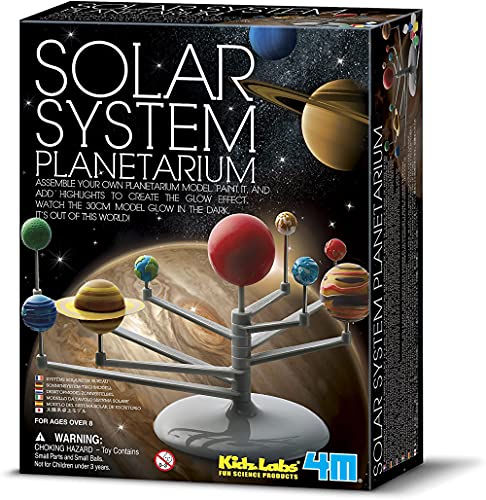
- Assemble and paint a glowing planetarium
- Includes wall chart and quiz questions
- Requires no batteries
Best For: Ages 8+ and STEM astronomy activities
Play & Learn

- Includes 11 foam space balls
- Comes with 12 educational flashcards
- Supports tactile and imaginative play
Best For: Ages 3+ and early space learning
Best Interactive Pick
Talking Solar System Projector

- Projects eight planets and 24 space images
- Includes English and Spanish planet facts
- Doubles as a night light or flashlight
Best For: Young children who enjoy interactive space play
Best Hands-On Preschool Pick

- Includes eight wooden planets and a puzzle board
- Adds astronaut figures and double-sided fact cards
- Encourages screen-free matching and exploration
Best For: Toddlers and preschoolers learning through tactile play
Best DIY STEM Pick

- Builds a hand-cranked rotating planet model
- Teaches orbits, gears, and day and night
- Includes fact cards, a spinner, and instructions
Best For: Ages 8–14 who enjoy building and mechanical STEM projects
Best Hands-On Pick
Wooden Solar System Puzzle Board

- Smooth beech-wood puzzle format
- Includes planets, astronauts, and fact cards
- Designed for ages 3 and up
Best For: Preschool matching play and early space learning
Best Interactive Project
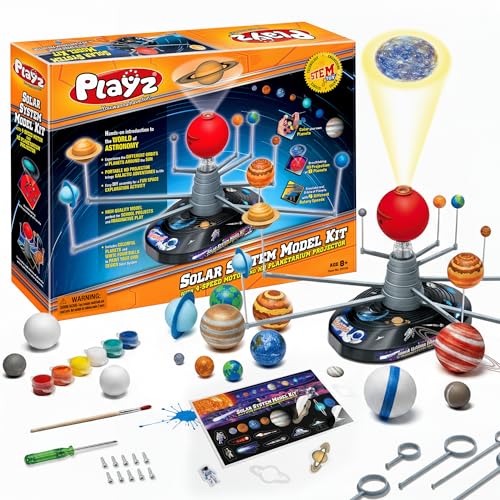
- Four-speed orbit motor
- HD planet projector and nightlight function
- 75+ parts for an ages-8-and-up DIY build
Best For: STEM projects and interactive space displays
Best Science-Fair Kit

- Wood model, puzzle, fact cards, paint, and brushes
- Covers the Sun and eight named planets
- Build time is approximately one to two hours
Best For: Ages 8–12 science fairs and classroom displays
Glow & Build – National Geographic Solar System
For children seeking solar system models for children with a creative display element, this National Geographic kit combines planet painting, assembly, and glow-in-the-dark decoration. The movable arms also let kids adjust the finished model for hands-on exploration or bedroom display.
Best For: Ages 8 and up, space-themed room decor, and hands-on astronomy or STEM projects.
Pros:
- Includes planets, sun, paints, glow paint, brush, palette, decals, and a fact poster.
- Movable arms allow children to rearrange the planets.
- Builds construction, creative, coordination, and problem-solving skills.
Cons:
- Recommended for ages 8 and up, so it may not suit younger children.
- Requires painting and assembly before the display is complete.
This is a strong choice when you want a customizable model that serves as both an educational activity and glowing space decor. Its all-inclusive setup keeps the project convenient, while the movable design adds play value after construction.
Classroom Creator – 64-Piece Solar System Kit
This 64-piece kit is a practical option among solar system models for children who enjoy making a project from individual components. Foam pieces, paints, brushes, sticks, flags, and instructions give kids the materials to create a personalized solar system at home or in class.
Best For: Ages 6–12, classroom activities, school projects, and family craft sessions.
Pros:
- Includes foam discs, balls, stars, bamboo sticks, flags, 12 colors, two brushes, and a palette.
- Foam surfaces are designed to be easy to color.
- Supports planet recognition, hand-eye coordination, focus, and artistic skills.
Cons:
- The foam construction may be less substantial than a rigid plastic model.
- Children must paint and assemble the project themselves.
Choose this kit when quantity and project supplies matter most. Its broad assortment makes it useful for guided learning, though younger children may benefit from adult help with assembly and the included small components.
Glow Planetarium – 4M DIY Astronomy Model
The 4M Solar System Planetarium is a focused DIY choice for families comparing solar system models for children ages 8 and up. Kids assemble and paint the planets, then use the rods, string, and glow paint pen to create a ceiling or room display while learning from the wall chart and quiz questions.
Best For: Ages 8 and up, STEM learning, astronomy activities, and glow-in-the-dark room displays.
Pros:
- Includes planets, stencils, glow paint pen, rods, string, and assembly instructions.
- Comes with a fact-filled wall chart and 10 sets of Kidz Quiz questions.
- No batteries are required.
Cons:
- Pluto is not included.
- Painting and assembly require time and careful following of instructions.
This kit suits children who want an activity that extends beyond a tabletop model. The included educational materials add structure to the project, while the glow feature helps turn the finished build into a room display.
Play & Learn – Planet Stress Ball Set
For younger children, this set offers a more tactile alternative to traditional solar system models for children. Eleven foam planet balls, including the sun, planets, Pluto, and the moon, can support imaginative play, while the flashcards introduce planet images and facts.
Best For: Ages 3 and up, early space learning, sensory play, and portable educational activities.
Pros:
- Includes 11 foam solar system balls and 12 educational flashcards.
- Can be used for planet learning, pretend play, school projects, and themed activities.
- Soft squeeze-ball format offers a tactile play option.
Cons:
- It is a collection of foam balls rather than a structured orbital model.
- Flashcards and balls provide learning support but do not replace a detailed assembly kit.
This is a flexible pick for preschool-age children who may not be ready for painting or construction. Its soft, portable design makes it easy to use for informal learning, though older children seeking a true display model may prefer a buildable kit.
Best Interactive Pick – Talking Solar System Projector
For children who learn best through play and visual discovery, this solar system model for children combines a tabletop planet display with a projector, talking planet facts, and a night-light feature. It supports English and Spanish audio and includes slides showing planets, astronauts, and space scenes.
Best For: Young space enthusiasts ages 3 and up who enjoy interactive lights, sounds, and pretend planetarium play.
Pros:
- Projects the eight planets and 24 colorful space images onto a wall or ceiling.
- Offers educational planet facts in both English and Spanish.
- Works as a night light or flashlight as well as a learning toy.
- Uses snap-and-lock assembly designed for quick setup.
Cons:
- Requires three AA batteries, which are not included.
- The projector and lights may appeal more to children who enjoy electronic features than hands-on building.
This is a versatile choice when you want a solar system model that doubles as an interactive bedtime companion. Its strongest features are the bilingual audio and ceiling projection, while the battery requirement is worth planning for.
Best Hands-On Preschool Pick – Wooden Planet Puzzle Board
This wooden solar system model for children emphasizes tactile matching and early learning. The set includes eight wooden planets, a puzzle board, astronaut figures, and double-sided knowledge cards, giving preschoolers several ways to explore colors, planet recognition, and basic space concepts.
Best For: Toddlers and preschoolers who benefit from graspable pieces, matching activities, and screen-free parent-child play.
Pros:
- Includes large wooden planets intended for easy grasping.
- Knowledge cards provide realistic planet images and additional facts.
- Supports color recognition, observation, imagination, and hands-on learning.
- Wooden board can also serve as space-themed room decor.
Cons:
- Its puzzle-board format may offer less motion or interactivity than a rotating model.
- The set is aimed primarily at younger children, so older learners may outgrow it sooner.
Choose this model when durability, simple manipulation, and early-learning play matter more than advanced astronomy detail. The included cards add teaching value beyond the basic planet-matching activity.
Best DIY STEM Pick – Gear-Driven Solar System Kit
For older children who want to build rather than simply inspect, this solar system model for children uses a hand-cranked gear system to move all eight planets around the Sun. The kit combines construction, mechanical motion, planet facts, and STEM explanations for a more involved learning project.
Best For: Kids ages 8–14 who enjoy DIY projects, mechanical mechanisms, and learning how orbits and gears work.
Pros:
- Children assemble the model and operate it with a hand crank.
- Explains planets, orbits, day and night, and gear-driven movement.
- Includes nine fact cards, a spinner, and pre-colored planets, so no painting is needed.
- Offers free lifetime replacement parts for missing or broken pieces.
Cons:
- Requires more time and patience than a ready-to-play planet model.
- Recommended for ages 8–14, making it less suitable for preschoolers.
This is the strongest fit for families seeking an engaging build-and-learn activity rather than a decorative model. Its crank-operated movement makes the astronomy concepts tangible, while the included cards extend play after assembly.
Best Hands-On Pick – Wooden Solar System Puzzle Board
For younger children, this wooden solar system model offers a tactile way to match planets, explore colors, and begin learning about space. Its compact puzzle-board format suits preschool play, while the included cards add simple educational context.
Best For: Preschoolers and toddlers who benefit from hands-on matching and guided parent-child learning.
Pros:
- Natural beech wood with a smooth, burr-free surface and CPC safety testing noted by the manufacturer.
- Includes a wooden puzzle board, eight wooden planets, three resin astronauts, and eight double-sided knowledge cards.
- Large planet pieces support grasping and develop color recognition, concentration, imagination, and hands-on skills.
Cons:
- Recommended for ages 3 and up, so it is not intended for infants.
- The board focuses on matching and recognition rather than a moving or projecting model.
This is a practical choice among solar system models for children when safety, simple play, and early space vocabulary matter more than advanced mechanics. It can also serve as space-themed room décor.
Best Interactive Project – Playz Solar System Model Kit
Older children who want to build, paint, and display a working model may prefer this Playz kit. It combines a four-speed orbit motor, a large DIY assembly, and a sun projector, making it one of the more activity-rich solar system models for children.
Best For: Kids ages 8 and up who enjoy STEM projects, model building, and interactive demonstrations.
Pros:
- Includes 75+ parts, a color instruction manual, paint supplies, and foam balls for hands-on assembly and customization.
- Four-speed orbit motor creates a moving solar system display.
- The sun functions as an HD projector for displaying eight planets and can also work as a nightlight or flashlight.
- Large finished model measures approximately 26 by 18 by 11 inches.
Cons:
- Four AA batteries are required and are not included.
- Its large size may require dedicated display or project space.
- Recommended for ages 8 and up, making it less suitable for preschool children.
The Playz kit stands out when you want a substantial science activity rather than a simple toy. Its combination of moving parts, painting, projection, and astronomy facts gives children several ways to engage with the project.
Best Science-Fair Kit – Nine Planets DIY Model
This Nine Planets kit is geared toward elementary-age children who want a structured build-and-learn activity. It combines a wooden model, puzzle, fact cards, paint, and brushes, making it a useful option among solar system models for children preparing a display or science project.
Best For: Kids ages 8–12 working on a classroom display, science fair project, or guided astronomy craft.
Pros:
- Includes materials to build and paint a model featuring the Sun and eight named planets.
- Fact cards provide quick solar system information alongside the hands-on activity.
- Includes a puzzle and is designed to take approximately one to two hours to build.
- Compact dimensions of approximately 12.6 by 2.2 by 6.5 inches suit bedroom, classroom, or display use.
Cons:
- Recommended for ages 8–12, so younger children may need adult guidance.
- The listed 30-day manufacturer warranty is relatively limited.
- The kit uses craft materials such as paper, wood, and styrofoam balls, which may require careful handling.
Choose this kit for a focused craft-and-study experience with a clear project endpoint. It is especially well matched to children who want to paint their own planets and explain what they learned using the included cards.
How We Picked These Solar System Models for Children
We focused on kits that combine astronomy learning with meaningful play. Our comparison considers the recommended age, construction method, included planets and accessories, opportunities for creative or STEM-based activity, and how clearly each model supports lessons about planetary order, scale, motion, and space exploration.
Because children learn differently, the selection includes simple tactile boards for younger learners, guided project kits for school projects, and more involved gear-driven or DIY models for older children. We also considered whether a model works primarily as a display, an activity, or both.
Quick Comparison
| Best For | Look For |
|---|---|
| Preschool learning | Large pieces, simple planet recognition, and sturdy wooden or tactile components |
| School projects | Painting supplies, fact cards, clear instructions, and a complete planet set |
| STEM building | Moving parts, gears, assembly challenges, or electronics |
| Room decor and repeat play | Glow features, projectors, or an attractive finished display |
| Independent learning | Talking features, labels, puzzles, or included astronomy facts |
Key Buying Factors for Solar System Models for Children
Age and Supervision
Check the manufacturer’s age recommendation before buying. Preschool models should have easy-to-handle parts and minimal assembly, while kits for children eight and older may include smaller pieces, paint, tools, or multi-step construction. Adult help may still be useful for complex builds.
Learning Objective
For basic recognition, choose a labeled board, puzzle, or large-piece set. For a classroom assignment, prioritize complete kits with paint, instructions, and educational facts. Gear-driven models and planetariums are better when the goal is to demonstrate movement or encourage deeper STEM exploration.
Materials and Durability
Wooden models can withstand repeated handling, while plastic components may offer more detailed planets or interactive features. Review the size of the finished model, especially if it will be displayed in a bedroom or used on a small desk.
Features and Setup
Glow-in-the-dark finishes and projectors add visual appeal but may require a dark room, batteries, or charging. Talking models can support independent learning, whereas DIY kits require more time and patience. Confirm what tools, batteries, paints, and adhesives are included.
Who Should Buy Which Solar System Models for Children?
For preschoolers, select a simple wooden board, puzzle, or large-ball set that emphasizes tactile exploration and planet names. For children completing a science assignment, a complete paint-and-build kit with facts and instructions is usually the most practical choice.
Choose a gear-driven or more advanced DIY model for children who enjoy construction and engineering challenges. A glow-in-the-dark planetarium or projector is a strong option for children who prefer visual discovery and want a finished display. If independent fact-based learning is the priority, consider a talking model or kit with labels and astronomy information.
Before ordering, match the kit to the child’s age, available workspace, tolerance for assembly, and desired outcome. A model that fits the child’s interests will usually provide more educational value than the most elaborate option.