The best solar system models turn astronomy concepts into something children can build, explore, and remember. This roundup compares hands-on kits, orbital demonstrations, puzzles, interactive models, and projector-style options for different ages and learning goals.
Whether you need a classroom project, a STEM gift, or an engaging bedroom display, these picks vary in realism, assembly, durability, and educational depth.
Best 10 Solar System Models Picks for 2026
Best Glow-in-the-Dark Pick
National Geographic Solar System Model

- Builds and paints all 8 planets and the Sun
- Glows in the dark for space-themed decor
- Movable arms allow display adjustments
Best For: Creative astronomy projects for kids ages 8 and up
Best Interactive Building Set
LEGO Planet Earth and Moon in Orbit
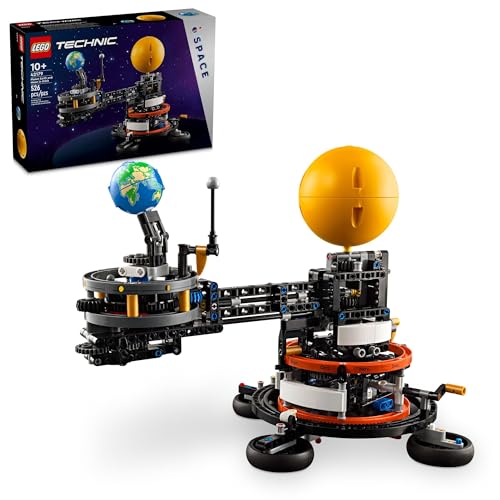
- 526-piece LEGO Technic construction set
- Crank demonstrates Earth and Moon orbits
- Includes month and moon-phase details
Best For: Hands-on space learning for builders ages 10 and up
Best Classroom Project Kit

- Includes foam components and 12 acrylic paints
- Designed for school or home projects
- Encourages art, focus, and science learning
Best For: Paint-and-build activities for ages 6 to 12
Best Rebuildable 3D Puzzle
Ravensburger Solar System 3D Puzzle

- 540-piece interlocking 3D puzzle
- No glue required with Easy Click Technology
- Includes stands, Sun, Moon, and fact poster
Best For: Reusable space puzzles for kids, adults, and families
Hands-On Pick
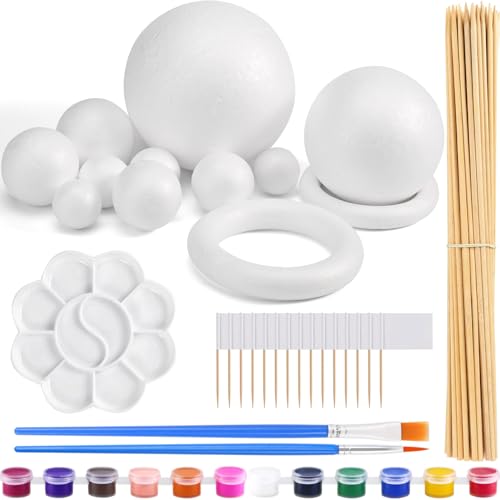
- 10 foam ball sizes support scale comparisons
- Includes paints, brushes, sticks, rings, and flags
- Glue-free assembly for DIY projects
Best For: Hands-on school science and craft activities
Atmosphere Pick

- 13 discs include Solar System and galaxy scenes
- Projects across walls, floors, or ceilings
- 360-degree rotation and sleep timer
Best For: Immersive bedroom displays and space-themed decor
Interactive Learning Pick
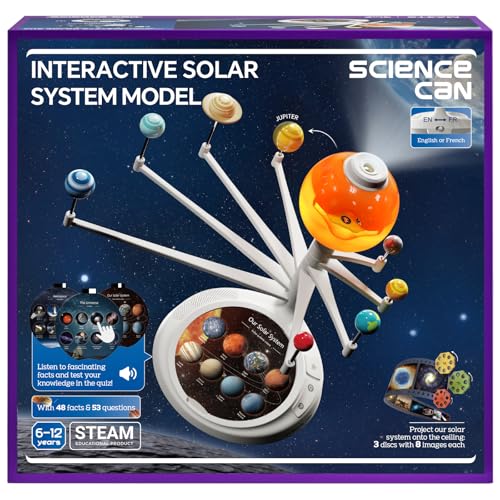
- Includes 48 facts and 53 quiz questions
- Bilingual English and French options
- Projects 24 colorful space images
Best For: Interactive STEM learning for children ages 6–12
Best Interactive Build
DOLIVE Solar System Building Kit

- 556-piece hands-on STEM project
- Planets rotate with a turning handle
- Lighted Sun and anti-tipping base
Best For: Ages 8–14 who enjoy building and moving displays
Best Glow-in-the-Dark Project
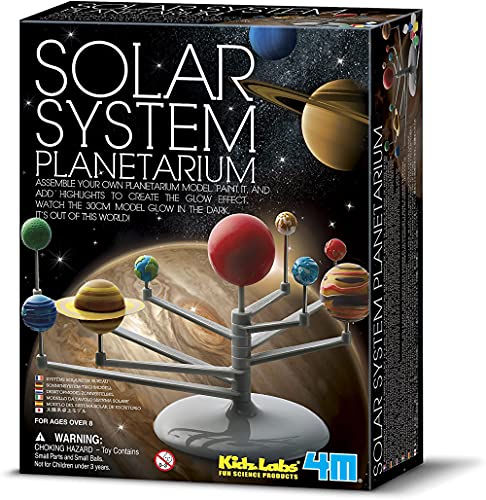
- Assemble and paint the planets
- Includes glow paint and learning materials
- Battery-free kit for ages 8+
Best For: Craft-focused astronomy projects and school activities
Best Sun-Earth-Moon Demonstrator
English Sun Earth Moon Orbital Model

- Shows seasons and eclipse mechanics
- Demonstrates Earth and Moon orbits
- Includes a seasonal information plate
Best For: Science lessons and school projects about Earth and the Moon
Best Glow-in-the-Dark Pick – National Geographic Solar System Model
For shoppers seeking hands-on solar system models, this National Geographic kit combines painting, assembly, and display features in one project. Kids can customize the eight planets and Sun, then arrange them on movable arms for a glowing bedroom display.
Best For: Kids ages 8 and up who enjoy creative astronomy projects and space-themed room decor.
Pros:
- Includes planets, Sun, paints, glow-in-the-dark accent paint, brush, palette, decals, and a fact poster.
- Movable arms make it easy to adjust the planetary arrangement.
- Supports construction, creative, hand-eye coordination, and problem-solving skills.
- Kid-friendly instructions are included.
Cons:
- The manufacturer recommends it for ages 8 and up, so it may not suit younger children.
- The plastic model is a hands-on craft project rather than a detailed orbital simulator.
This is a strong choice when you want solar system models that emphasize creativity and display appeal. Its included supplies make it convenient for a guided project, while the movable arms add flexibility after assembly.
Best Interactive Building Set – LEGO Planet Earth and Moon in Orbit
This LEGO Technic set stands out among solar system models because a hand-operated crank demonstrates the movement of Earth and the Moon around the Sun. Printed month and moon-phase details add an educational layer to the 526-piece building experience.
Best For: Kids ages 10 and up who like LEGO construction, interactive mechanisms, and learning about orbital cycles.
Pros:
- Crank-operated mechanism shows Earth and Moon orbiting the Sun.
- Printed details illustrate months, moon phases, and seasonal effects.
- The LEGO Builder app provides 3D viewing, progress tracking, and build guidance.
- Measures over 9 inches high, 12.5 inches long, and 7 inches wide when built.
Cons:
- The manufacturer recommends the set for ages 10 and up.
- At 526 pieces, assembly requires more time and concentration than a simple display kit.
Choose this model if mechanical interaction matters as much as appearance. It offers a build-focused way to explore orbital movement and seasons, with app support for children who benefit from digital building guidance.
Best Classroom Project Kit – 64-Piece Solar System Model
For an art-centered school or home activity, this 64-piece kit gives children foam components, paints, brushes, sticks, flags, and instructions for creating solar system models. The smooth foam surfaces are designed to be colored and assembled as a guided astronomy project.
Best For: Classroom activities, family projects, and children ages 6 to 12 who learn well through making and painting.
Pros:
- Includes foam discs, balls, stars, bamboo sticks, toothpick flags, 12 paints, two brushes, a palette, and instructions.
- Provides an approachable way to color and build a planetary display.
- Supports hand-eye coordination, focus, artistic skills, and introductory science learning.
- Suitable for solar system themes at home or in the classroom.
Cons:
- The foam construction may be less durable than plastic or interlocking building-block models.
- Although one listing note references ages 3–5, the manufacturer recommendation is 6–12 years; buyers should follow the stated 6–12 recommendation.
- The kit is primarily a craft project, not an interactive orbital model.
This option makes sense when you need a supplied, paint-based activity for a science lesson or family afternoon. Its broad assortment of craft pieces encourages personalization, though adult supervision may be useful during assembly.
Best Rebuildable 3D Puzzle – Ravensburger Solar System 3D Puzzle
This Ravensburger set takes a puzzle-based approach to solar system models, using 540 interlocking plastic and cardboard pieces to create spherical planets and display them on stands. Easy Click Technology eliminates the need for glue and supports repeated assembly.
Best For: Kids ages 7 and up, adults, and families looking for a reusable indoor puzzle with educational space content.
Pros:
- Easy Click Technology lets pieces interlock without glue.
- Sturdy plastic pieces can be assembled and rebuilt multiple times.
- Includes planet stands, Sun, Moon, nylon cord, and a poster with planet facts.
- Designed for concentration, hand-eye coordination, motor skills, and task completion.
Cons:
- The 540-piece format may be demanding for younger or less experienced puzzlers.
- As a manual 3D puzzle, it does not demonstrate planetary motion.
- The set is intended for indoor use and requires space for assembly.
Consider this model when durability and repeat play are priorities. It offers a satisfying puzzle challenge and a finished display, while the included poster adds factual context without requiring batteries or glue.
Hands-On Pick – Foam Ball Solar System Kit
For a traditional, hands-on approach to solar system models, this foam ball kit gives children materials to paint, label, and assemble their own planetary display. The varied ball sizes support visual comparisons between the Sun, planets, and Pluto, while the included supplies make it suitable for school or home projects.
Best For: DIY school science projects and creative astronomy activities for children.
Pros:
- Includes 10 differently sized foam balls for visual scale comparisons.
- Supplies include 12 paint colors, brushes, a palette, bamboo sticks, rings, and flags.
- Assembles without glue and allows planets to be labeled with toothpick flags.
Cons:
- Children must paint and assemble the model themselves.
- Recommended materials and age details may not suit every classroom or project requirement.
This is a practical choice when the learning value comes from making the model. It is less suitable for shoppers wanting a ready-to-use or electronic display, but it offers plenty of creative involvement for a craft-based lesson.
Atmosphere Pick – 13-in-1 Planetarium Projector
This projector offers a room-based alternative to physical solar system models, displaying the Solar System alongside constellations, galaxies, and other space scenes. Its rotating design, adjustable focus, and broad projection range make it useful for creating an immersive astronomy display at home.
Best For: Bedrooms, space-themed room decor, and visual stargazing experiences for children or adults.
Pros:
- Includes 13 HD projection discs featuring the Solar System and other cosmic subjects.
- Projects onto walls, floors, or ceilings and rotates 360 degrees.
- Offers a 1- or 2-hour timer, plus automatic shutoff after four hours.
Cons:
- Requires a dark indoor environment for the recommended viewing experience.
- USB-powered rather than battery-powered.
- Provides projected imagery instead of a tactile, buildable model.
Choose this option if your priority is atmosphere and large-scale visual presentation rather than hands-on construction. The included Solar System disc adds educational interest, while the additional galaxy scenes make it more versatile as room decor.
Interactive Learning Pick – Talking Solar System for Kids
Among solar system models for active learning, this talking model combines a physical planetary display with knowledge cards, quizzes, and a built-in projector. It is designed to reinforce astronomy concepts through bilingual audio options, interactive questions, and projected space images.
Best For: Children ages 6–12 who benefit from interactive STEM activities at home or in classroom lessons.
Pros:
- Teaches 48 space facts through three knowledge cards.
- Includes 53 quiz questions and English and French language options.
- Projects 24 full-color images using three discs and includes a light-up Sun.
- No assembly required.
Cons:
- Requires three AA batteries, which are not included.
- Interactive features may be more than needed for shoppers seeking a simple display model.
- Its learning content is geared toward children rather than advanced astronomy study.
This is the strongest fit for families seeking guided, repeatable learning rather than a one-time craft project. The quizzes, facts, projection discs, and bilingual functionality give children several ways to explore the solar system, though battery costs should be included in the purchase decision.
Best Interactive Build – DOLIVE Solar System Building Kit
For shoppers comparing solar system models, the DOLIVE kit combines a substantial 556-piece building project with a working planetary display. Kids can turn the handle to see the planets rotate and revolve around the illuminated Sun, making it a hands-on option for learning about motion and assembly.
Best For: Children ages 8–14 who enjoy construction-based STEM projects and interactive space displays.
Pros:
- 556-piece kit provides an involved building experience.
- Hand-operated gears demonstrate planetary rotation and revolution.
- Illuminated Sun and molded planetary details add visual interest.
- Includes rounded ABS pieces, an anti-tipping base, and step-by-step instructions.
Cons:
- The 556-piece assembly may require more time and patience than simpler models.
- Recommended for ages 8 and up, so it may not suit younger children.
This is a strong choice when the goal is an engaging build rather than a quick decorative model. Its moving mechanism and lighted Sun give the finished display added play and demonstration value.
Best Glow-in-the-Dark Project – 4M Solar System Planetarium
This 4M planetarium is a practical pick among solar system models for children who like combining crafts with astronomy. The kit lets kids assemble and paint the planets, add glow paint, and use the included chart and quiz questions to reinforce basic space learning.
Best For: Children ages 8 and up who want an arts-and-crafts science project or school activity.
Pros:
- Combines assembly, painting, and astronomy learning.
- Glow paint pen supports a glow-in-the-dark display.
- Includes stencils, rods, string, a fact-filled wall chart, and 10 quiz sets.
- Requires no batteries.
Cons:
- Painting and assembly require hands-on preparation.
- Pluto is not included.
- The educational focus and recommended age of 8+ may limit younger users.
Choose this model if creative customization matters as much as the finished display. It offers more guided learning materials than a basic hanging planet set, though children will need to complete the painting themselves.
Best Sun-Earth-Moon Demonstrator – English Sun Earth Moon Orbital Model
Unlike full-system solar system models, this Sun-Earth-Moon orbital model focuses on explaining relationships between three bodies. Its moving parts can demonstrate Earth’s orbit, Moon phases, seasons, and solar and lunar eclipses, making it especially useful for lessons and guided demonstrations.
Best For: Science teaching, school projects, and children over age 6 learning about seasons, eclipses, and lunar phases.
Pros:
- Demonstrates Earth’s rotation and orbit around the Sun.
- Supports explanations of seasons, solar eclipses, lunar eclipses, and Moon phases.
- Includes a seasonal plate with dates, seasons, and traditional Chinese calendar terms.
- Offers a relatively large display measuring about 15.2 by 7.87 by 11.02 inches.
Cons:
- Represents the Sun, Earth, and Moon rather than all eight planets.
- Assembly involves several screws, gears, alignment steps, and a wrench.
- The instructions require careful setup for accurate demonstrations.
This is the better fit when teaching specific Earth-and-Moon concepts is more important than building a complete solar system. Its instructional scope is focused and useful, but setup and alignment may need adult guidance.
How We Picked These Solar System Models
We selected products across several use cases rather than treating every astronomy toy as interchangeable. The lineup includes build-and-paint kits, mechanical orbital models, 3D puzzles, interactive teaching tools, glow-in-the-dark sets, and a planetarium projector. We considered the intended age range, the amount of hands-on activity, how clearly each product can demonstrate planetary relationships, and whether it works best for independent play, supervised projects, or classroom use.
We also looked for practical differences that matter after purchase: included materials, display value, storage needs, assembly complexity, and whether the model emphasizes accurate motion, visual recognition, or creative customization.
Quick Comparison
- Best for guided STEM building: LEGO Technic Planet Earth and Moon in Orbit.
- Best for a classic glow-in-the-dark project: National Geographic Glow in the Dark Solar System Model.
- Best for open-ended crafting: the 48-piece foam ball kit.
- Best for a large educational project: the 64-piece solar system project kit.
- Best for interactive learning: Science Can Interactive Talking Solar System.
- Best for room ambiance: Galaxy Projector Pro.
- Best for puzzle fans: Ravensburger 540-piece 3D Solar System Puzzle.
- Best for younger STEM learners: DOLIVE Solar System Building Kit or the 4M Solar System Planetarium.
- Best for demonstrating orbital relationships: the English Sun Earth Moon Orbital Model.
Key Buying Factors for Solar System Models
Age and Supervision
Check the recommended age before choosing. Kits containing small balls, sticks, toothpicks, pigments, or numerous construction pieces may require adult supervision, especially for younger children. A puzzle or talking model may be easier for independent use.
Learning Objective
Choose a moving orbital model if the goal is to explain rotation and revolution. For planet identification and visual memorization, an interactive or labeled model may be more useful. Build-and-paint kits add creativity but may provide less mechanical accuracy.
Assembly and Materials
Some Solar System Models are ready to use, while others involve painting, gluing, snapping, or building with rods. Confirm what is included and whether batteries, tools, paint, or extra adhesive are needed. Foam and polystyrene models are lightweight but less resistant to rough handling than engineered building pieces.
Display, Size, and Lighting
Measure the intended shelf, desk, or ceiling area. Glow finishes and LED lighting can improve nighttime appeal, while a projector needs a suitable wall or ceiling and may be more decorative than scientifically precise. Consider whether the finished model can be stored safely between lessons.
Who Should Buy Which Solar System Models?
For a child who enjoys constructing mechanisms, the LEGO Technic set is the strongest fit. Choose National Geographic, 4M, or DOLIVE for a traditional hands-on astronomy craft. The 64-piece and foam ball kits suit families or classrooms that want room for customization and group activity.
For learners who benefit from audio or visual interaction, Science Can is a practical choice. Pick Ravensburger for a patient puzzle enthusiast, the Sun Earth Moon model for focused demonstrations, and Galaxy Projector Pro when the priority is an immersive bedroom experience rather than a detailed tabletop model.