The best illuminated solar system models turn a difficult astronomy lesson into something students can see, touch, and revisit. The options in this roundup range from interactive talking kits and motorized orbital displays to realistic LED-lit decor.
We selected models for different ages, budgets, learning goals, and display spaces. Whether you need a hands-on project, a classroom teaching aid, or an attractive conversation piece, the right model should balance accuracy, durability, visibility, and ease of use.
Best 10 Illuminated Solar System Models Picks for 2026
Best Hands-On Build
National Geographic Glow-in-the-Dark Solar System

- Build-and-paint kit with all eight planets and the Sun
- Glow-in-the-dark accents and movable display arms
- Includes paints, decals, poster, and kid-friendly instructions
Best For: Kids ages 8 and up who enjoy creative STEM projects
Best Orbital Demonstration
Eisco Illuminated Sun, Earth & Moon Model
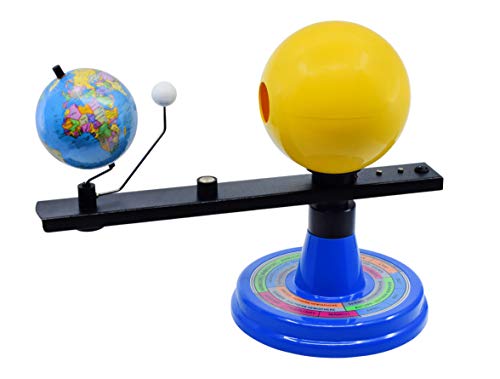
- Gear-driven motion demonstrates orbital relationships
- 12V illuminated Sun supports eclipse and light lessons
- Month-labeled base includes three study activities
Best For: Adult learners and structured astronomy demonstrations
Best Interactive Learning Toy
Science Can Talking Solar System
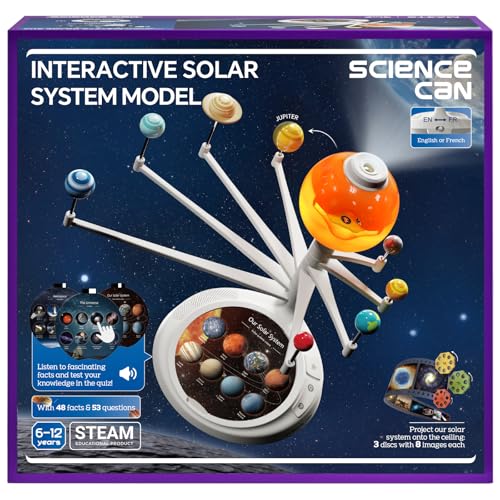
- Provides 48 facts and 53 interactive quiz questions
- Projects 24 colorful space images onto walls and ceilings
- Bilingual English/French play with a light-up Sun
Best For: Children who prefer interactive, multimedia STEM learning
Best Decorative Display
3D Glass True-to-Scale Solar System
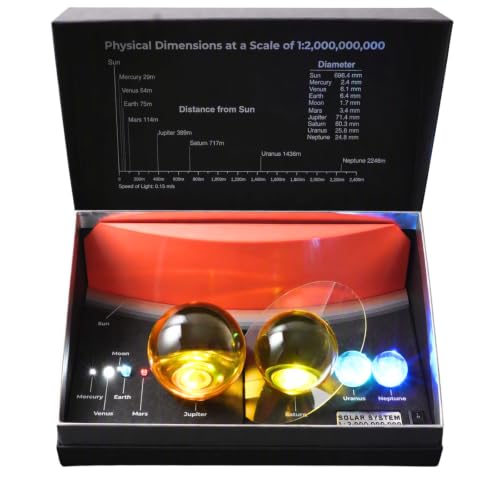
- K9 glass Sun and planets at a 1:2-billion scale
- LED base creates a glowing display and night-light effect
- Includes eight planets, two moons, a manual, and gift packaging
Best For: Space lovers seeking elegant illuminated décor
Best Creative Display Kit

- Starry-sky display box for hanging planets
- Includes paints, brushes, foam pieces, and accessories
- Hands-on project for school or room décor
Best For: Kids’ crafts, science projects, and decorative displays
Best Lighted Demonstration Model

- Lighted sun supports visual demonstrations
- Shows rotation, revolutions, seasons, and lunar orbit
- Useful for introductory astronomy lessons
Best For: Beginners learning Sun, Earth, and Moon relationships
Best Full-Planet Motion Model
EISCO 13-Inch Solar System Model

- Includes the Sun and all eight planets
- Manual rods demonstrate relative planetary motion
- Comes with an experiment guide and labeled month base
Best For: Classroom demonstrations and guided solar system experiments
Best for Young Explorers
Talking Solar System Projector

- Projects eight planets onto walls or ceilings
- Bilingual English and Spanish astronomy facts
- Includes slides and a night-light function
Best For: Young children learning about space through interactive play
Best Mechanical Build

- More than 600 precision metal parts
- Motorized eight-planet movement
- Illuminated LED sun and display-ready size
Best For: Adult builders and collectors who enjoy mechanical models
Best Hanging Decor

- Vivid multicolor planetary design
- Steel ceiling-mounted construction
- Adjustable decor for children or adults
Best For: Space-themed rooms and decorative astronomy displays
Best Hands-On Build – National Geographic Glow-in-the-Dark Solar System
For shoppers seeking illuminated solar system models that combine creativity with astronomy learning, this National Geographic kit offers a hands-on build-and-paint experience. Children assemble all eight planets and the Sun, add glow-in-the-dark details, and arrange the display using movable arms.
Best For: Kids ages 8 and up who enjoy crafts, STEM projects, and space-themed bedroom décor.
Pros:
- Includes planets, Sun, paints, glow-in-the-dark accent paint, brush, palette, decals, and an educational poster.
- Movable arms make it easy to adjust and rearrange the planetary display.
- Supports construction, creative, hand-eye coordination, problem-solving, and imagination skills.
Cons:
- Requires assembly and painting, so it is less suitable for shoppers seeking a ready-to-display model.
- The manufacturer recommends it for ages 8 and up.
This is a strong choice when the activity matters as much as the finished display. Its glow-in-the-dark finish adds visual appeal, while the included materials make it a convenient educational project.
Best Orbital Demonstration – Eisco Illuminated Sun, Earth & Moon Model
This Eisco model is one of the more demonstration-focused illuminated solar system models, using gear-driven motion and a 12V light bulb to show relationships among the Sun, Earth, and Moon. Its month-labeled base and included activities support more structured astronomy study.
Best For: Adult learners, educators, and anyone studying orbital motion, moon phases, or solar eclipses.
Pros:
- Gear-driven mechanism simulates orbital motion for hands-on demonstrations.
- Illuminated Sun helps explain light, alignment, and solar eclipses.
- Month-labeled base and three included activities add structure to lessons.
Cons:
- Designed for adults, with a manufacturer-recommended age of 18 and up.
- Focuses on the Sun-Earth-Moon system rather than displaying all eight planets.
- Its 14-inch scale may require dedicated tabletop space.
Choose this model for functional instruction rather than general décor. The combination of illumination, orbital movement, calendar markings, and guided activities makes it particularly useful for demonstrations.
Best Interactive Learning Toy – Science Can Talking Solar System
For families comparing illuminated solar system models with interactive features, this Science Can model adds talking knowledge cards, quiz play, and a planetarium-style projector. The Sun lights during play, and the unit presents space facts in English and French.
Best For: Children ages 6–12 who learn well through quizzes, spoken facts, and projected space images.
Pros:
- Three knowledge cards provide 48 space facts with English and French options.
- Interactive quiz mode includes 53 questions for reinforcing astronomy concepts.
- Three projection disks provide 24 full-color space images for walls and ceilings.
- No assembly is required.
Cons:
- Requires three AA batteries, which are not included.
- Plastic construction and interactive electronics may appeal less to collectors seeking a display piece.
- The supplied information does not specify rechargeable or included power options.
This is the most feature-rich option for active play and repeated learning sessions. It trades traditional model-building for spoken instruction, quizzes, illumination, and room projection.
Best Decorative Display – 3D Glass True-to-Scale Solar System
This glass option stands out among illuminated solar system models as a display-oriented piece rather than a traditional activity kit. Its eight crystal glass planets and Sun are presented at a 1:2-billion scale and illuminated from an LED base, allowing it to function as both an astronomy display and night light.
Best For: Space enthusiasts, teachers, and gift shoppers seeking an elegant illuminated décor piece for ages 10 and up.
Pros:
- Includes the Sun, eight planets, and two moons in crystal-clear K9 glass.
- LED lighting creates a glowing display and night-light effect.
- 1:2-billion scale provides a realistic basis for comparing planetary sizes.
- Includes a solar system manual and gift-oriented packaging.
Cons:
- Glass construction requires more careful handling than plastic models.
- It is primarily a finished display, with no assembly or interactive orbital mechanism noted.
- The compact base measures approximately 10.24 by 6.3 by 3.54 inches, which may limit visual scale.
Select this model when appearance and ambient illumination are priorities. The glass construction and LED base make it well suited to gifting or décor, while the scale and manual add educational value.
Best Creative Display Kit – Pllieay 3D Solar System Model
For shoppers seeking illuminated solar system models with a strong craft component, this Pllieay kit offers a hands-on alternative. Children paint and assemble foam planets, then hang them inside the included starry-sky display box for a decorative mini universe.
Best For: Kids over 8, school science projects, craft classes, and outer-space room décor.
Pros:
- Display box doubles as a starry-sky presentation backdrop.
- Includes foam balls, paints, brushes, palette, hanging string, labels, and assembly pieces.
- Designed for straightforward assembly without complicated tools.
- Combines astronomy learning with painting and hands-on building.
Cons:
- It is a foam craft kit rather than a mechanically moving or scientifically precise model.
- Painting and assembly require time before the display is complete.
This is a practical pick when the goal is an engaging solar system project that becomes room décor afterward. Its strongest feature is the all-in-one display box, though shoppers wanting illuminated or motion-based demonstrations should consider a different model.
Best Lighted Demonstration Model – Sun Earth Moon Orbital Model
This Sun Earth Moon model is a focused choice among illuminated solar system models, using a lighted sun to support lessons about rotation, revolution, seasons, moon phases, and eclipses. It is intended as an educational demonstration rather than a rigorous research instrument.
Best For: Astronomy beginners, classroom demonstrations, and learners studying Earth, Moon, and Sun relationships.
Pros:
- The sun lights up when its raised button is pressed.
- Demonstrates Earth’s rotation, Earth’s orbit, and the Moon’s orbit in one device.
- Can support explanations of seasons, moon phases, eclipses, and the 24 solar terms.
- Instructions are provided in English.
Cons:
- It covers the Sun, Earth, and Moon rather than all eight planets.
- The supplied notes caution that it is not suitable for rigorous astronomy research.
- Operation requires removing the wire and pressing the sun button.
Choose this model when lighting and orbital relationships matter more than a complete planetary lineup. It offers a clear way to demonstrate foundational astronomy concepts, especially for children beginning to explore the subject.
Best Full-Planet Motion Model – EISCO 13-Inch Solar System Model
For buyers comparing illuminated solar system models with classroom-ready mechanical displays, the EISCO model emphasizes planetary position and motion. Its eight planets sit on manually movable metal rods around a large sun, with a labeled base and experiment guide for structured activities.
Best For: Classroom instruction, demonstrations of planetary movement, and guided solar system experiments.
Pros:
- Includes the Sun and all eight planets.
- Manually movable planets demonstrate relative orbital motion.
- Base is labeled with the months of the year for position-based exploration.
- Experiment guide includes three activities, exploration topics, a grading rubric, and a planet location table.
Cons:
- The supplied notes do not indicate that the model is illuminated.
- Planet movement is a manual demonstration rather than an automated orbit.
- Its 13-inch, 8.5-by-18.25-by-13-inch footprint may require dedicated display space.
This is a strong educational option for shoppers prioritizing a complete planetary lineup and guided motion activities. It is better suited to structured learning than to buyers specifically seeking a lighted display.
Best for Young Explorers – Talking Solar System Projector
For families seeking illuminated solar system models that double as learning tools, this kid-focused projector combines an eight-planet display with bilingual facts, colorful slides, and a night-light function. Its simple snap-together design suits younger children, while the projection feature adds an engaging way to explore space.
Best For: Children ages 3–8 who enjoy interactive STEM toys, bedtime projection, and astronomy activities in English or Spanish.
Pros:
- Projects the eight planets onto a wall or ceiling to create a planetarium-style experience.
- Offers English and Spanish astronomy facts through the planet buttons.
- Includes 24 full-color images across three space-exploration slides.
- Works as both a projector and LED night light or flashlight.
Cons:
- Requires three AA batteries, which are not included.
- The plastic construction and child-oriented design may be less suitable for serious collectors.
This is a practical pick when illumination, simple assembly, and interactive learning matter more than realistic planetary mechanics. The bilingual audio and bedtime-friendly lighting give it broader everyday use than a basic static model.
Best Mechanical Build – Motorized Metal Orrery Kit
Among illuminated solar system models, this TECHING kit is the most substantial choice for hands-on builders and display-focused collectors. It uses more than 600 metal parts to create a motorized orrery, with coordinated planetary movement around an illuminated LED sun.
Best For: Adult model builders, engineering enthusiasts, astronomy hobbyists, and collectors seeking a challenging mechanical centerpiece.
Pros:
- Includes more than 600 precision metal parts made from aluminum alloy, stainless steel, and brass.
- Motorized gearing moves all eight planets around the LED-illuminated sun.
- Combines astronomy concepts with mechanical engineering and problem-solving.
- Creates a substantial display measuring approximately 14.37 × 14.37 × 9.92 inches.
Cons:
- Its 16-and-up recommendation makes it unsuitable for young children.
- The 11-pound metal construction and large footprint require a stable display location.
- The extensive part count makes assembly considerably more involved than a simple model.
This kit stands out for buyers who want the building process to be part of the experience. Once complete, the motorized motion and glowing sun make it both an educational demonstration and a distinctive office or study display.
Best Hanging Decor – Colorful Solar System Mobile
For shoppers who want illuminated solar system models as part of a broader space-themed room, this ceiling-mounted mobile offers a colorful, decorative alternative. Its steel construction and vivid planetary palette make it suitable for nurseries, children’s rooms, studies, or astronomy displays, although the supplied details emphasize visual presentation rather than built-in lighting.
Best For: Buyers looking for adjustable, ceiling-mounted solar system decor for babies, children, adults, or science-themed spaces.
Pros:
- Uses vivid colors to represent the planets and sun in an eye-catching display.
- Steel construction gives the mobile a more substantial decorative feel.
- Designed for ceiling mounting and adjustable presentation.
- Appeals to both children and adults as space-themed decor.
Cons:
- The supplied notes do not identify built-in illumination or lighting features.
- As a hanging mobile, it is primarily decorative rather than an interactive teaching model.
- Ceiling mounting requires suitable overhead space and installation.
This is the better choice for buyers prioritizing color, room decor, and a hanging presentation. If illumination is essential, verify the lighting setup separately, since the listed features focus on the mobile’s visual design and mounting.
How We Picked the Best Illuminated Solar System Models
We evaluated these Illuminated Solar System Models by comparing their educational value, lighting, construction, scale, moving parts, included accessories, and intended audience. A strong model should make planetary order and motion easier to understand rather than serving only as decoration.
We also considered practical ownership details: assembly requirements, display footprint, controls, power needs, and whether the product is better suited to independent play, guided learning, or adult display. Because the selection includes both children’s kits and advanced decor, the best choice depends on how you plan to use it.
Quick Comparison
| Best for | Look for | Most suitable style |
|---|---|---|
| Young learners | Simple controls, durable parts, clear labels | Interactive or guided models |
| School projects | Assembly materials, experiment guides, visible planet layout | Hands-on educational kits |
| Serious demonstrations | Orbital movement, relative positioning, sturdy mechanics | Orrery-style models |
| Home or office display | Bright LED lighting, realistic finish, stable base | Decorative illuminated models |
Key Buying Factors for Illuminated Solar System Models
Age and Learning Objective
Check the recommended age before buying. Younger children usually benefit from large, brightly colored planets and audio or interactive features. Older students may gain more from orbital motion, proportional relationships, experiment instructions, and terminology. Some kits include small components that require adult supervision.
Lighting and Visibility
LED lighting can highlight the Sun, illuminate a base, or make the entire display easier to see. Look for models with a stable light source, accessible controls, and a design that remains legible in normal room lighting. A dramatic glow is useful, but it should not obscure labels or planet details.
Accuracy, Scale, and Movement
Most tabletop models are not to scale in both planet size and distance, so treat scale claims carefully. If teaching orbital relationships matters, choose a model that visibly demonstrates movement or relative positioning. For decor, realistic finishes and balanced proportions may matter more than mechanical accuracy.
Construction and Setup
Consider whether the model arrives assembled, requires painting, or includes a display box. Motorized and metal designs can be more substantial but may need batteries, a power adapter, or careful assembly. Confirm the available table space before choosing a large mobile or orbital model.
Who Should Buy Which Illuminated Solar System Models?
Choose an interactive talking model for children who learn best through audio and guided prompts. A project kit is a better fit for hands-on learners, science-fair preparation, or a supervised classroom activity. For demonstrations of planetary motion, select an orbital orrery with moving components and an informative guide.
Adults furnishing a study, classroom, nursery, or office may prefer a glass, metal, or mobile-style display with integrated lighting and a stable base. If you are buying a gift, prioritize the recipient’s age, available space, and interest level over the highest feature count. The best model is the one that will be used often, seen clearly, and matched to the buyer’s actual learning or display goals.