The best solar system models for classrooms turn abstract astronomy lessons into hands-on demonstrations students can see, move, and discuss. This roundup compares magnetic boards, orbital models, projector-based kits, and DIY planet sets for different ages and teaching styles.
We focused on classroom usefulness, including visual clarity, interactivity, durability, setup requirements, and how well each model supports lessons about planets, moons, orbits, and scale.
Best 10 Solar System Models for Classrooms Picks for 2026
Best Magnetic Demonstration Set

- Large magnets support whiteboard demonstrations
- Includes planets, Sun, Moon, asteroid belt, and Pluto
- Designed for repeated classroom handling
Best For: Interactive whole-class lessons and planetary order activities
Best Build-and-Paint Project

- Includes foam pieces, paints, brushes, and instructions
- Students build and customize the planets
- Combines science learning with creative skills
Best For: Guided elementary classroom projects and craft-based lessons
Best Orbiting Model and Projector
GeoSafari Orbiting Solar System

- Eight planets move on orbiting arms
- Projects 32 space images, including NASA images
- Includes a guide with astronomy facts
Best For: Indoor demonstrations of planetary motion and space imagery
Best Glow-in-the-Dark Build
National Geographic Solar System Model

- Build and paint the Sun and eight planets
- Glow-in-the-dark accents add display appeal
- Movable arms allow position adjustments
Best For: Ages 8+ astronomy projects and creative classroom displays
Best Creative Classroom Kit

- Paint-and-build format supports hands-on learning
- Includes display box and complete craft supplies
- Lightweight foam design needs no complicated tools
Best For: Craft-based science lessons and school projects for children over age 8
Best Visual Group Learning Aid

- Includes 24 magnetic solar system pieces
- Large Sun supports easy group visibility
- Laminated surface is water- and dust-resistant
Best For: Early-childhood sequencing and introductory space activities
Best Interactive STEM Option
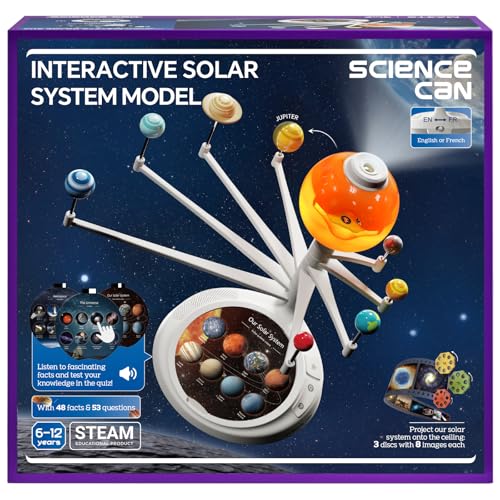
- Offers 48 facts and 53 interactive quiz questions
- Projects 24 full-color space images
- Provides English and French options with no assembly
Best For: Interactive STEM lessons for children ages 6–12
Best Hands-On Build

- Includes eight planets, sun, rotating base, rods, and cards
- Supports naming, ordering, sorting, and presentation activities
- Smooth wooden pieces provide tactile, screen-free learning
Best For: Preschool and elementary classrooms needing an interactive planet model
Best for Earth-Moon-Sun Demonstrations

- Shows Earth rotation and Earth and moon orbits
- Supports lessons on seasons, phases, and eclipses
- Lighted sun adds a visual demonstration feature
Best For: Focused astronomy lessons on Earth, the moon, and the sun
Best for Eclipse and Seasons Lessons

- Demonstrates seasons, eclipses, and moon phases
- Includes a plate with seasons and twenty-four solar terms
- DIY design encourages guided classroom exploration
Best For: School projects focused on Earth-Sun-Moon relationships and seasonal science
Best Magnetic Demonstration Set – Giant Magnetic Solar System
For classrooms seeking solar system models for classrooms that support visual, hands-on instruction, this magnetic set makes planetary order and relative size easier to demonstrate. The large pieces attach to whiteboards, metal doors, and other magnetic surfaces.
Best For: Teachers presenting solar system lessons to younger students through tactile, whole-class activities.
Pros:
- Includes magnetic representations of the planets, Sun, Moon, asteroid belt, and Pluto.
- Large Sun and planet pieces are suitable for whiteboard demonstrations.
- Flexible magnetic material is designed for repeated classroom handling.
- Includes an educational guide with space facts.
Cons:
- Requires a magnetic surface for display.
- The magnetic format is better for demonstration than for a freestanding 3D model.
This is a practical choice when visibility and quick classroom setup matter most. Its magnetic design supports sequencing and comparison activities without requiring assembly.
Best Build-and-Paint Project – 64-Piece Solar System Kit
This project kit is a creative option among solar system models for classrooms, giving students foam pieces, paints, brushes, and accessories to build and personalize a planetary display. It is suited to guided projects at school or home.
Best For: Elementary students completing a hands-on solar system craft that combines science, painting, and construction.
Pros:
- Includes foam balls and discs, paints, brushes, palette, sticks, flags, and instructions.
- Students can color and assemble their own solar system model.
- Instructional material introduces related solar system details.
- Supports hand-eye coordination, focus, artistic skills, and science learning.
Cons:
- Students must assemble and paint the model before it is ready to display.
- Foam construction may be less suitable for rough handling than a magnetic classroom set.
Choose this kit when the learning value comes from making the model. It offers more creative participation than a ready-to-use display, making it a strong fit for project-based instruction.
Best Orbiting Model and Projector – GeoSafari Orbiting Solar System
For classrooms wanting solar system models for classrooms with an added visual presentation feature, this orbiting model combines moving planets with a Sun-shaped projector. Students can observe planetary motion and view NASA-related space images.
Best For: Indoor science demonstrations that pair a physical orbiting model with projected astronomy imagery.
Pros:
- Eight planets move on orbiting arms around the Sun.
- Includes 32 images across four projector discs, including NASA images.
- Guide provides space facts and supports exploration of planets and constellations.
- Offers both hands-on model viewing and ceiling projection.
Cons:
- Requires three AA batteries, which are not included.
- Designed for indoor use and manual operation.
- The moving display may require more careful handling than fixed models.
This model is a good fit for teachers who want more than a static display. Its orbiting arms make planetary movement visible, while the projector adds variety to indoor lessons and demonstrations.
Best Glow-in-the-Dark Build – National Geographic Solar System Model
This build-and-display kit gives students a creative alternative among solar system models for classrooms. They can paint the Sun and all eight planets, add glow-in-the-dark details, and adjust the movable arms for a customized 3D display.
Best For: Older students working on a guided astronomy project that combines construction, painting, and display.
Pros:
- Includes the model components, paints, brush, palette, decals, and fact poster.
- Glow-in-the-dark accents create an engaging finished display.
- Movable arms allow students to adjust planet positions.
- Instructions and facts support hands-on astronomy learning.
Cons:
- Recommended for ages 8 and up, so it may not suit younger classes.
- Students must paint and assemble the model before use.
- The completed model is intended as a display rather than a large whole-class teaching aid.
This kit works well when the project itself is part of the lesson. Its adjustable arms and glow accents can make the finished model memorable, while the included poster adds a reference point for discussion.
Best Creative Classroom Kit – 3D Solar System Project Model
For classrooms seeking solar system models for classrooms that combine astronomy with hands-on creativity, the Pllieay 3D Solar System Model is a practical project kit. Students paint foam planets, assemble the display, and use the included planet information to reinforce basic space concepts.
Best For: Craft-based science lessons, school projects, and parent-child activities for children over age 8.
Pros:
- Includes foam balls, paints, brushes, palette, bamboo sticks, labels, and assembly supplies.
- The starry sky display box provides a ready-made backdrop for displaying the completed model.
- Painting and assembly support hands-on learning and creative engagement.
- Lightweight foam construction and no complicated tools are required.
Cons:
- Students must paint and assemble the model before it can be displayed.
- Foam construction may be less suitable for classrooms needing a highly rugged, reusable model.
This is a strong choice when the learning goal includes making and presenting a model, rather than simply observing a preassembled solar system. The display box also gives the finished project a polished classroom or room-decoration setting.
Best Visual Group Learning Aid – Giant Magnetic Solar System
The Giant Magnetic Solar System is a useful option for classrooms comparing solar system models for classrooms, especially when students need to arrange and identify celestial objects. Its large magnetic pieces can be placed in order, while matching description magnets add context to the visual lesson.
Best For: Toddler and early-childhood activities involving visual matching, sequencing, and introductory solar system concepts.
Pros:
- Includes the Sun, planets, Moon, asteroid belt, Kuiper belt, and corresponding description magnets.
- Students can arrange the pieces in planetary order or pair objects with their descriptions.
- The Sun measures 10 inches across, making the set easy to see in a group activity.
- Laminated, water- and dust-resistant PET film is designed for repeated use.
Cons:
- This is a flat magnetic teaching set rather than a three-dimensional planetary model.
- The large pieces require a suitable magnetic surface or workspace.
Choose this set when visibility and simple interaction matter more than physical scale. The combination of vivid imagery, matching descriptions, and magnetic placement makes it well suited to guided group demonstrations and early science practice.
Best Interactive STEM Option – Talking Solar System Model
For teachers wanting solar system models for classrooms with built-in instruction, the Science Can Talking Solar System Model adds spoken facts, quizzes, and projection activities. It is designed to make lessons more interactive while covering planetary positions, orbits, and related space topics.
Best For: Interactive STEM lessons and independent exploration for children ages 6–12.
Pros:
- Three knowledge cards provide 48 space facts in English and French.
- Quiz mode includes 53 questions to reinforce astronomy concepts.
- Three projector disks provide 24 full-color space images for walls or ceilings.
- The model lights the Sun and requires no assembly.
Cons:
- Three AA batteries are required and are not included.
- Its electronic features may be more than needed for a basic display-only lesson.
- The projector and talking functions require classroom management during group use.
This model is a good fit when participation and repeated practice are priorities. Its bilingual content, quiz mode, and projector broaden its use beyond a static demonstration, although teachers should plan for batteries and supervised operation.
Best Hands-On Build – Wooden Solar System Model Kit
For classrooms seeking solar system models for classrooms that encourage active learning, this wooden kit combines eight planets, a sun, connecting rods, a rotating base, and learning cards. Students can assemble the display, identify planets, compare their order, and use it for presentations or science-fair projects.
Best For: Preschool and elementary classrooms, homeschool activities, planet-naming practice, and hands-on solar system displays.
Pros:
- Includes the sun, eight planets, rotating base, rods, and learning cards.
- Supports planet-order, distance, matching, sorting, and naming activities.
- Wooden construction with smooth edges and a stable base offers a tactile, screen-free experience.
- Can support both beginner play and more detailed student presentations.
Cons:
- Adult supervision is recommended because the set contains small parts.
- The chunky, colorful design is intended more for introductory learning than precise scale modeling.
This is a versatile classroom choice when durability, display appeal, and simple astronomy activities matter more than technical detail. Its rotating parts and cards give teachers several ways to reinforce vocabulary and early STEM concepts.
Best for Earth-Moon-Sun Demonstrations – Orbital Model with Light
This illuminated orbital model is one of the more focused solar system models for classrooms, demonstrating how Earth rotates, Earth revolves around the sun, and the moon orbits Earth. Its lighted sun can help make moon phases, eclipses, and seasonal concepts easier to discuss.
Best For: Astronomy lessons centered on Earth’s rotation, annual revolution, lunar orbits, seasons, moon phases, and eclipses.
Pros:
- Demonstrates Earth’s rotation, its orbit around the sun, and the moon’s orbit.
- Can support explanations of seasons, moon phases, and solar and lunar eclipses.
- The sun lights when its raised button is pressed, adding a visual teaching element.
- English instructions make it usable for classroom science activities.
Cons:
- It focuses on the sun-Earth-moon relationship rather than the full eight-planet system.
- The notes caution that it is not intended for rigorous astronomy research.
- The listed manufacturer age recommendation is 14–17 years, while the product is described as interesting for younger children.
Choose this model when the lesson objective is orbital motion and Earth-Moon-Sun relationships rather than broad planet identification. The light and moving components make it especially useful for teacher-led demonstrations.
Best for Eclipse and Seasons Lessons – Sun Earth Moon Project Kit
For teachers comparing solar system models for classrooms, this DIY sun-Earth-moon kit is designed around seasons, eclipses, moon phases, and orbital relationships. Its seasonal plate includes the four seasons and twenty-four traditional Chinese solar terms, offering an additional calendar connection for geography and Earth-science lessons.
Best For: School projects and guided demonstrations of Earth’s rotation, seasonal change, solar eclipses, lunar eclipses, and moon phases.
Pros:
- Demonstrates Earth orbiting the sun and the moon orbiting Earth.
- Supports hands-on explanations of solar and lunar eclipses, seasons, and moon phases.
- Seasonal plate lists the four seasons and twenty-four traditional Chinese solar terms.
- Includes assembly directions and is described as suitable for children over six.
Cons:
- Assembly requires several steps involving screws, a wrench, gears, and alignment.
- It models the sun-Earth-moon system rather than all eight planets.
- The seasonal calendar content may require additional teacher explanation for students unfamiliar with it.
This kit is a strong project-oriented option for classrooms that want students to manipulate the model while discussing changing light, orbital motion, and eclipses. Plan time for setup and guided alignment before the lesson.
How We Picked the Best Solar System Models for Classrooms
We evaluated these models as teaching tools rather than judging them only as toys. Key considerations included how clearly students can identify the planets, whether the model supports demonstrations or independent activities, and how practical it is to store, assemble, and use with a group.
We also considered age range, included accessories, construction materials, lighting or sound features, and whether the kit works best for whole-class instruction, small groups, or individual projects. Because no tabletop model can accurately represent both planetary scale and distance, we favored products that make their intended learning purpose clear.
Quick Comparison
- Best for visual demonstrations: Magnetic solar system boards and orbiting models make it easy to point out planets and their positions.
- Best for interactive lessons: Talking, light-up, and projector-based products can add engagement and support guided instruction.
- Best for student projects: Build-your-own kits encourage assembly, labeling, painting, and presentation.
- Best for younger learners: Large, durable magnetic pieces are generally easier to handle and identify.
- Best for display: Finished orbital or boxed models can remain on a science shelf between lessons.
Key Buying Factors for Solar System Models for Classrooms
Age and Safety
Check the recommended age and inspect the size of loose components before buying. Small planets, magnets, wires, and assembly parts may not be suitable for preschool classrooms. For younger children, choose large pieces with simple labels and sturdy construction.
Teaching Function
Decide whether you need a model for labeling planets, demonstrating orbital movement, explaining the Earth-Moon-Sun relationship, or supporting a student science project. A static display may be best for reference, while an orbital or illuminated model can make motion and position easier to explain.
Durability and Storage
Classroom materials receive more handling than home-use products. Look for thick planet pieces, secure connectors, stable bases, and a storage solution that keeps parts together. Magnetic models are often convenient because they pack flat, while assembled models may need shelf space.
Power and Setup
Light, sound, and projection features can increase engagement but may require batteries, charging, darkened rooms, or extra setup time. Confirm what is included and whether replacement batteries or assembly tools are needed.
Accuracy and Limitations
Use the model as a visual aid, not a precise scale reference. Explain that planets are enlarged and distances are compressed. For older students, pair the model with diagrams or activities covering scale, rotation, revolution, and planetary characteristics.
Who Should Buy Which Solar System Models for Classrooms?
Choose a magnetic model if you need fast setup, repeated classroom handling, and an easy way to quiz students on planet names and order. Choose an orbiting or lighted model if your lessons focus on movement, the Earth-Moon-Sun system, or visual demonstrations.
Choose a projector or talking model when engagement and guided exploration are priorities, especially in small groups. Choose a buildable kit for science centers, take-home assignments, or projects where students benefit from assembling and presenting their own solar system.
For most classrooms, the best choice is the model that matches your lesson goals, student age, and available storage—not necessarily the one with the most features.