The right light meter for photography can make exposure decisions faster, more consistent, and easier to repeat—especially when working with flash, film, or controlled studio lighting.
We compared 10 popular Sekonic and alternative meters across metering modes, flash control, portability, workflow features, and value to help you choose the best fit for your camera and shooting style.
Best 10 Light Meter for Photography Picks for 2026
Best All-Around Choice

- Incident, reflected, and flash metering
- Photo, Cine, and HD Cine modes
- Pocket-sized design with 0.1-stop accuracy
Best For: Mixed photo, flash, and video workflows
Best for Wireless Flash
Sekonic L-478DR-U PocketWizard

- Built-in PocketWizard transmitter
- Color touchscreen interface
- Ambient, flash, and cine metering
Best For: Professional PocketWizard lighting setups
Simple Legacy Option
- Incident, reflected, and flash metering
- Compact L-308-series design
- Runs on one AA battery
Best For: Shoppers considering an older basic light meter
Best Compact Video Meter

- Dedicated Cine and HD Cine modes
- Ambient, reflected, and flash metering
- Lux and foot-candle readouts
Best For: Portable photo and filmmaking exposure checks
Professional Hybrid Control
Sekonic LiteMaster Pro L-478D-U
- Touchscreen incident, ambient, and flash metering
- Cine frame rate and shutter angle controls
- Illuminance and luminance measurement modes
Best For: Professional photo, studio, and hybrid motion workflows
Advanced Flash Precision
- Incident metering for ambient and flash
- 1° spot metering with viewfinder
- Flash-duration measurement and radio trigger options
Best For: Advanced flash photography and selective exposure readings
Compact Film-Camera Companion

- 35° reflective metering with ±0.1 EV accuracy
- Three tactile dials and multiple exposure modes
- USB-C rechargeable battery with over 20 hours of use
Best For: Film photographers using Leica and similar cameras
Best Pocket Meter

- Incident, reflected, ambient, and flash readings
- Tenth-of-a-stop exposure accuracy
- Pocket-sized 3.4-ounce design
Best For: Portable everyday ambient and flash metering
Best Battery-Free Meter

- Battery-free amorphous photocell
- Incident and reflected ambient metering
- Full analog aperture/shutter dial
Best For: Traditional studio and field ambient metering
Best Advanced Flash Meter

- Flash-duration and HSS analysis
- Built-in 1° spot metering
- Godox/Flashpoint wireless control
Best For: Advanced flash, HSS, and studio lighting workflows
Best All-Around Choice – Sekonic L-308X-U Flashmate
If you want a versatile light meter for photography, the Sekonic L-308X-U combines incident, reflected, and flash metering in a compact body. Its Photo, Cine, and HD Cine modes make it useful for still photography as well as DSLR and mirrorless video.
Best For: Photographers and videographers who want accurate exposure readings in a pocket-sized meter.
Pros:
- Measures ambient and electronic flash exposures to a tenth of a stop in full-stop mode.
- Supports corded and cordless flash measurement.
- Includes dedicated Photo, Cine, and HD Cine modes.
- Offers a broad ambient and flash exposure range.
Cons:
- Requires two AAA batteries.
- Its compact controls may be less suited to users who prefer a larger interface.
The L-308X-U is a strong general-purpose option when you need one small meter for stills, flash, and motion work. Its broad range and straightforward modes make it especially practical for mixed photo and video kits.
Best for Wireless Flash – Sekonic L-478DR-U PocketWizard
The Sekonic L-478DR-U is an advanced light meter for photography built around a touchscreen workflow and integrated PocketWizard control. It measures incident ambient and flash light while adding wireless flash triggering and remote power adjustment.
Best For: Professional photographers and motion creators managing PocketWizard-compatible lighting setups.
Pros:
- Built-in PocketWizard transmitter supports wireless flash triggering and remote power adjustment.
- Large color touchscreen provides intuitive navigation.
- Includes incident ambient and flash metering with flash analysis.
- Supports cine frame-rate and shutter-angle control.
Cons:
- The advanced feature set may be more than casual photographers need.
- Reflected spot metering requires an optional 5° viewfinder attachment.
- Uses a nonstandard battery.
This model is best suited to controlled lighting environments where wireless flash integration can save setup time. The optional spot attachment also makes it more adaptable for selective reflected-light measurements.
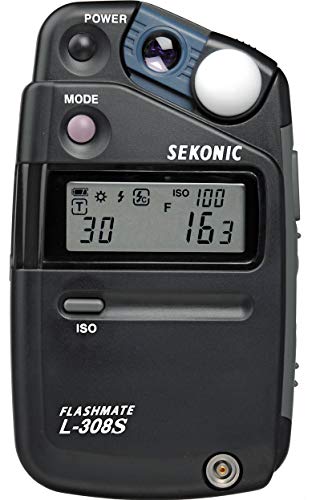
Simple Legacy Option – Sekonic L-308S Flashmate
The Sekonic L-308S is a straightforward digital light meter for photography with incident, reflected, and flash metering. It can suit shoppers seeking the basic functionality of the L-308 line, though the supplied listing notes that a newer version is available.
Best For: Buyers considering a basic L-308-series meter for ambient, reflected, and flash readings.
Pros:
- Supports incident, reflected, and flash light metering.
- Compact dimensions are practical for portable use.
- Uses a single AA battery.
Cons:
- The listing identifies a newer version with an exclusive three-year USA warranty.
- The supplied notes do not provide detailed exposure-range or mode information.
- Listed item weight appears inconsistent with its compact dimensions.
The L-308S may be worth considering if you specifically want this older model, but the availability of a newer version is an important purchasing consideration. Compare the listing carefully before choosing it over the updated alternative.
Best Compact Video Meter – Sekonic L-308X Flashmate
Sekonic FLASHMATE L-308X Photographers and Film Makers Exposure Meter - Black/Blue
Check Price On AmazonThe Sekonic L-308X is a compact light meter for photography that also serves filmmakers with dedicated Cine and HD Cine modes. Its sliding lumisphere supports ambient readings, while a 40° lens reception angle enables reflected-light measurement.
Best For: Photographers and filmmakers who need a small meter for location scouting and quick on-set exposure checks.
Pros:
- Measures ambient and flash lighting in a pocket-sized body.
- Dedicated Cine and HD Cine modes support video work.
- Provides lux and foot-candle readouts.
- Offers a wide ambient and flash metering range.
Cons:
- Requires an AA battery.
- Its compact form may offer fewer handling conveniences than larger touchscreen meters.
With its video-specific modes, broad range, and small footprint, the L-308X is a practical choice for filmmakers who also shoot stills. It is particularly well suited to scouting and fast exposure checks on location.
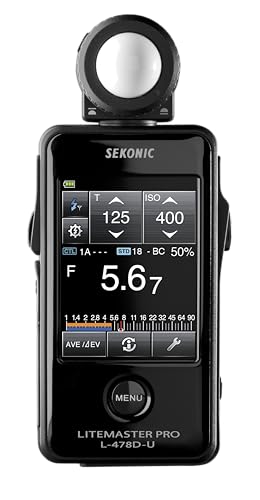
Professional Hybrid Control – Sekonic LiteMaster Pro L-478D-U
For photographers and hybrid creators who need a versatile light meter for photography, the Sekonic LiteMaster Pro L-478D-U combines touchscreen operation with incident, flash, and optional reflected metering. Its cine controls and technical measurement modes make it especially capable for mixed photo and motion workflows.
Best For: Professional photographers, studio users, and filmmakers who need ambient, flash, and cine exposure control in one meter.
Pros:
- Measures incident ambient and flash light.
- Touchscreen color LCD supports quick navigation and clear data visibility.
- Includes cine frame rate and shutter angle controls.
- Offers illuminance and luminance measurement, with optional 5° reflected spot capability.
Cons:
- Its advanced feature set may be more than casual photographers need.
- Reflected spot metering requires an optional attachment.
The L-478D-U is a strong choice when a standard exposure meter is not enough. Its flash analysis, cinema controls, and expanded measurement functions provide room for demanding studio, location, and video work.
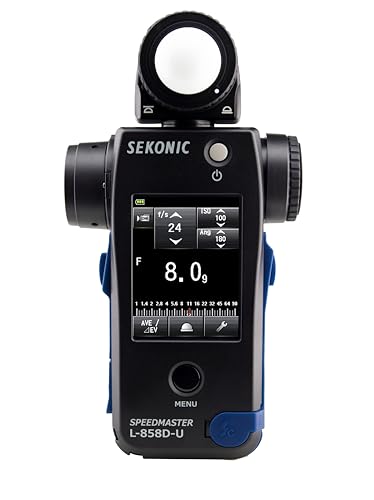
Advanced Flash Precision – Sekonic L-858D-U Speedmaster
The Sekonic L-858D-U is a powerful light meter for photography when flash control and selective readings matter. It combines incident ambient and flash metering with a 1° spot meter, making it suited to photographers who need detailed exposure evaluation.
Best For: Flash photographers and advanced users who need narrow spot readings and flash-duration measurement.
Pros:
- Supports both incident ambient and flash metering.
- Provides precise 1° spot metering through a viewfinder.
- Measures flash duration.
- Radio triggers are available for Phottix, Elinchrom, and PocketWizard systems.
Cons:
- The advanced flash-focused design may be unnecessary for simple ambient-light work.
- The supplied notes do not list a touchscreen or cine-specific control set.
Choose the L-858D-U if your lighting decisions depend on flash performance and highly selective readings. Its 1° spot capability and flash-duration measurement make it particularly useful for controlled lighting setups.
Compact Film-Camera Companion – LightMate AirPro Light Meter
The LightMate AirPro is a compact reflective light meter for photography designed around tactile, retro-style controls. Its 35° metering angle, rechargeable battery, and support for film-camera exposure ranges make it a practical accessory for Leica and other compatible cameras.
Best For: Film photographers who prefer physical dials, compact size, and rechargeable operation.
Pros:
- 35° wide-angle reflective metering with stated ±0.1 EV accuracy.
- Independent tactile dials for aperture, ISO, and shutter speed.
- Supports aperture-priority, shutter-priority, manual, and EV modes.
- USB-C rechargeable battery provides more than 20 hours of battery life.
Cons:
- Its reflective 35° reading is less selective than a 1° spot meter.
- It is designed around film-camera exposure ranges rather than advanced flash analysis.
- The listed details also specify one AAA battery, which may conflict with the rechargeable-battery description.
The AirPro is a good fit for photographers who want a straightforward, physical interface instead of a large professional meter. Its compact metal body and flexible exposure modes make it especially appealing for film-camera use.
Best Pocket Meter – Compact Flashmate L-308S-U
If you want a practical light meter for photography that fits easily in a camera bag, the Sekonic L-308S-U offers incident, reflected, flash, and ambient readings in a compact digital design. It provides exposure accuracy down to a tenth of a stop while supporting half- and third-stop display increments.
Best For: Photographers who need a lightweight, versatile meter for everyday ambient and electronic-flash work.
Pros:
- Pocket-sized design weighs about 3.4 ounces.
- Supports incident, reflected, ambient, and electronic-flash readings.
- Offers a broad ambient range and shutter speeds up to 1/8000 second.
- Displays aperture and shutter-speed values in half- or third-stop increments.
Cons:
- Flash shutter-speed span is limited to 1 second through 1/500 second.
- Its compact feature set may be less suitable for advanced flash analysis.
The L-308S-U is a strong everyday choice when portability matters. It covers the core metering modes without adding the size or complexity of a more advanced professional meter.
Best Battery-Free Meter – Studio Deluxe III L-398A
The Sekonic L-398A is a distinctive light meter for photography for users who prefer an analog workflow and battery-free operation. Its amorphous photocell, full dial readout, swivel head, and included accessories make it adaptable for studio and field ambient-light readings.
Best For: Photographers and cinematographers who value a durable analog interface and do not want routine battery replacement.
Pros:
- Battery-free amorphous photocell operates from ambient light.
- Supports incident and reflected ambient-light measurement.
- Full dial shows aperture and shutter-speed combinations directly.
- Includes a lumisphere, lumidisc, lumigrid, high slide, strap, case, and manual.
Cons:
- Analog operation may feel slower or less familiar than a digital meter.
- At 11.2 ounces, it is notably heavier than the pocket-sized L-308S-U.
- The supplied notes describe ambient metering rather than electronic-flash measurement.
Choose the L-398A if tactile controls, a complete analog dial, and battery-free reliability matter more than a modern digital display. Its accessory set also gives it useful flexibility across different ambient-light setups.
Best Advanced Flash Meter – Speedmaster L-858D-U
For demanding lighting work, the Sekonic L-858D-U is an advanced light meter for photography with incident and built-in 1° spot metering, flash-duration analysis, and wireless Godox/Flashpoint control. It is designed for photographers who need detailed exposure and flash-performance information in one professional tool.
Best For: High-speed, studio, and complex off-camera-flash workflows using compatible Godox or Flashpoint systems.
Pros:
- Measures flash duration, including HSS output, with t.1 and t.5 evaluations.
- Built-in 1° spot viewfinder supports detailed highlight and shadow analysis.
- RT-GX transmitter enables compatible Godox/Flashpoint flash triggering and remote power adjustment.
- Provides incident ambient and flash metering across a -5 to 22.9 EV range at ISO 100.
Cons:
- Its one-pound size and advanced feature set are less convenient for casual users.
- Wireless control depends on compatible Godox or Flashpoint lighting systems.
- More specialized than a simple ambient-light meter.
The L-858D-U is the most capable option here for photographers analyzing flash behavior and controlling compatible lights remotely. It makes the most sense when advanced wireless and high-speed metering features justify the larger, more specialized design.
How We Picked the Best Light Meter for Photography
We focused on the features that affect real-world exposure work: incident and reflected metering, flash compatibility, spot-metering capability, readout clarity, portability, battery requirements, and ease of use. We also considered whether each model suits still photography, film, studio flash, cinematography, or a combination of workflows.
The selection includes compact digital meters, touchscreen models, advanced flash-analysis tools, a battery-free analog option, and meters with radio-triggering or transmitter support. Always confirm the exact regional model and included accessories before buying, since suffixes and bundles can differ.
Quick Comparison
| Best For | Look For | Typical Choice |
|---|---|---|
| Everyday photography | Simple incident and reflected readings | Compact L-308-series meter |
| Studio flash | Flash analysis and wireless triggering | L-478DR-U or L-858D-U |
| Film photography | Incident metering and dependable operation | L-308S or L-398A |
| Cinema and video | Frame-rate and shutter-angle modes | L-478D-U or L-308X-U |
| Spot-metering | Narrow-angle reflected readings | L-858D-U Speedmaster |
Key Buying Factors for a Light Meter for Photography
Metering Type
Incident metering measures the light falling on the subject and is often the easiest way to achieve consistent exposure. Reflected metering evaluates light bouncing from the subject, which is useful for distant subjects and scenes with limited access. A spot meter gives you more precise control over selected areas of the frame.
Flash and Wireless Control
If you use studio strobes or off-camera flash, choose a model that can measure flash duration or flash-to-ambient balance. Radio-enabled versions can also trigger compatible systems or simplify multi-light testing, but they may cost more and require compatible transmitters or receivers.
Photo, Cine, and Exposure Controls
Photographers should check ISO, shutter-speed, aperture, EV, and memory functions. Videographers may benefit from frame-rate, shutter-angle, and HD Cine modes. Choose controls that match your workflow rather than paying for features you will rarely use.
Size, Display, and Power
A compact meter is easier to carry on location, while a larger touchscreen can make complex flash or cinema settings easier to review. Battery-powered models are convenient, whereas the L-398A’s battery-free design may appeal to photographers who prefer a traditional analog tool.
Who Should Buy Which Light Meter for Photography?
Choose a compact L-308-series meter if you want a lightweight, straightforward Light Meter for Photography, film, or occasional flash work. These models are practical for beginners, travel, and photographers who prefer dedicated physical controls.
Choose an L-478-series meter if you need a modern touchscreen interface, more detailed flash control, or radio functionality for studio setups. It is a better match for photographers and filmmakers managing multiple lighting variables.
Choose an L-858D-U if precise spot readings, flash duration analysis, or advanced professional exposure control matters most. Its capabilities are best suited to demanding studio, location, and production workflows.
Choose the L-398A if you value analog operation, a classic shooting experience, and battery-free ambient metering. It is less convenient for complex digital workflows but remains appealing for photographers who want simplicity and tactile control.
Before purchasing, verify your preferred metering method, flash system compatibility, measurement range, and whether the listed model includes the transmitter or accessories you need.