The best robotics sets for science fairs turn abstract STEM concepts into working demonstrations. These kits can help students explore motors, sensors, gears, circuits, hydraulics, coding, and mechanical design through hands-on projects.
Our selection includes approachable building sets for younger learners, programmable robots for developing coders, and electronics-focused kits for students who want a broader range of experiments. Use the guide below to match each option to your student’s age, experience, project goals, and presentation needs.
Best 10 Robotics Sets for Science Fairs Picks for 2026
Solar STEM Builder

- Build 12 models from 190 parts
- Powered by sunlight or strong artificial light
- Progressive, screen-free STEM construction
Best For: Young builders exploring solar energy and mechanical design
Hydraulic Engineering Challenge

- Build two water-powered boxing robots
- Explore gears, cylinders, and pistons
- Includes a scoreboard for robot battles
Best For: Hands-on demonstrations of hydraulic engineering and motion
Mechanical Coding Project
TEACH TECH Mech-5 Coding Robot

- Program actions with a mechanical coding wheel
- Robot can throw, lift, kick, and draw
- Multi-hour build for ages 10 and up
Best For: Older children learning mechanical coding through construction
Bionic Coding Showcase

- Program with physical colored action cards
- Features color and infrared sensors
- Three modes include coding and camouflage play
Best For: Sensor, coding, and biomimicry-themed science-fair projects
Circuit Discovery Pick

- 120+ guided electrical projects
- Includes light, sound, and motion experiments
- No extra tools required
Best For: Kids ages 8+ exploring circuits and electrical engineering
Multi-Build Robotics Pick

- Six different science and robotics builds
- Includes a reptile robot and balance car
- Step-by-step instructions and mini screwdriver
Best For: Ages 8–12 building projects with family guidance
Hands-On Robot Projects Pick
10-in-1 Electronics Robotics Kit

- 10 robotics and electronics projects
- 100+ components included
- Supports line-following and obstacle avoidance
Best For: Ages 8–12 building compact functional robot models
Best App-Controlled Pick
Sillbird 5-in-1 Programmable Robot Kit
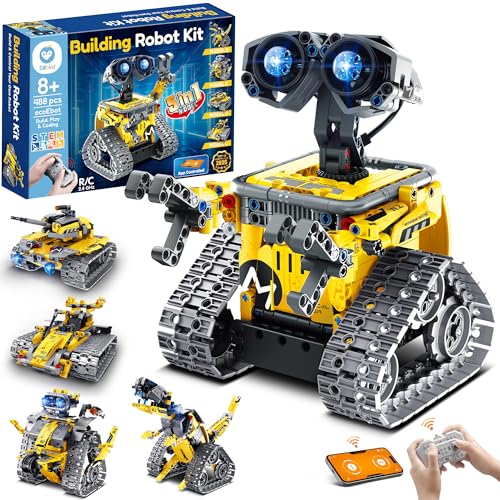
- 488 pieces with five buildable models
- App and remote control options
- Rechargeable battery with up to 40 minutes of play
Best For: Young beginners exploring construction and introductory coding
Best Multi-Project Value

- Six robot and science activity builds
- Includes screwdriver and detailed instructions
- Encourages teamwork and hands-on experimentation
Best For: Classrooms and families planning several beginner projects
Best for Coding Exploration
6-in-1 Space Robot Building Kit

- 780 pieces and six space-themed models
- App includes path coding and STEM programming
- Remote supports movement and 360-degree stunts
Best For: Older beginners building and testing a more advanced project
Solar STEM Builder – 12-in-1 Solar Robot Kit
For robotics sets for science fairs, this 12-in-1 solar robot kit offers a flexible way to explore renewable energy, mechanical building, and problem-solving. Its 190 parts support 12 different models, with clear instructions and progressive challenge levels for developing builders.
Best For: Kids ages 8 and up who want an introductory, screen-free robotics project centered on solar power and hands-on construction.
Pros:
- Builds 12 models, including robots and cars, from 190 parts.
- Uses sunlight or a strong artificial light source such as a flashlight.
- Introduces engineering and renewable-energy concepts through DIY play.
- Step-by-step instructions support independent or family building.
Cons:
- Solar performance depends on adequate sunlight or a strong indoor light source.
- The manufacturer recommends it for ages 10 and up, despite the broader age-focused title.
This is a practical choice when a science-fair project needs multiple build options and an accessible introduction to solar-powered mechanisms. It is less suited to children looking for a fully electronic or app-controlled robot.
Hydraulic Engineering Challenge – Hydraulic Boxing Bots
Among robotics sets for science fairs, the Hydraulic Boxing Bots set stands out for demonstrating water-powered movement without batteries. Builders assemble two robots and investigate how gears, cylinders, and pistons work together before testing them in a boxing-style challenge.
Best For: Students ages 10 and up who want a collaborative project focused on hydraulic mechanisms, motion, and basic engineering physics.
Pros:
- Builds two working boxing robots powered by hydraulics.
- Demonstrates gears, cylinders, pistons, and water-powered mechanisms.
- Independent upper and lower body movement creates varied motion.
- Includes a scoreboard for testing and friendly competition.
Cons:
- The build is centered on one boxing-bot concept rather than multiple robot designs.
- Hydraulic assembly may require careful attention to the included tubing and components.
The set is especially useful for a demonstration about fluid power and mechanical motion. Its interactive robot battle can make engineering principles easier to explain, although it may be less appropriate for a quiet display-only project.
Mechanical Coding Project – TEACH TECH Mech-5 Coding Robot
For robotics sets for science fairs that combine construction with physical programming, the TEACH TECH Mech-5 provides a substantial hands-on project. Builders use coding buttons on a mechanical coding wheel to program actions such as throwing, lifting, kicking, and drawing.
Best For: Future engineers ages 10 and up who are ready for a multi-hour build involving mechanical engineering, coding basics, and problem solving.
Pros:
- Programs several physical actions using a mechanical coding wheel.
- Supports learning in construction, coding, engineering, and problem solving.
- Offers mission-based activities rather than only free-form play.
- Provides an in-depth build for learners who enjoy longer projects.
Cons:
- Assembly can take multiple hours and requires careful adherence to the instructions.
- Requires two AAA batteries.
- It is a single robot project rather than a multi-model kit.
Mech-5 is a strong option for a science-fair demonstration about mechanical sequencing and cause-and-effect programming. It rewards patience, but it may frustrate children seeking a quick build or a largely preassembled experience.
Bionic Coding Showcase – Robotic Pet Coding Chameleon
For robotics sets for science fairs with an emphasis on sensors and biomimicry, My Robotic Pet: Coding Chameleon combines construction, unplugged coding, and interactive behavior. Its color and infrared sensors, RGB LEDs, and physical action cards let children explore how a robot can respond to commands, touch, and its surroundings.
Best For: Kids ages 8 and up who want an engaging tabletop project involving coding logic, sensor-based reactions, color change, and nature-inspired engineering.
Pros:
- Uses physical colored action cards for screen-free coding.
- Includes coding, wild, and pet modes with different interactions.
- Demonstrates color and infrared sensors, RGB LEDs, and articulated movement.
- The 48-page manual connects robotics with bionic and nature-inspired design.
Cons:
- Requires four AAA batteries.
- Independent play is recommended for ages 12 and up; younger builders may need adult help.
- Designed for one player and primarily indoor tabletop use.
This chameleon makes a visually engaging science-fair display because its color changes and programmed reactions are easy to demonstrate. It is a particularly good fit for projects connecting animal adaptations with sensors and robotics, though it requires batteries and some assembly support for younger users.
Circuit Discovery Pick – 120-Project Electronics Kit
For younger students exploring robotics sets for science fairs, this National Geographic electronics kit offers a broad introduction to circuits and electricity. It includes more than 120 projects, from light shows and keyboard sounds to a copter and voice amplifier, with illustrated and video instructions.
Best For: Kids ages 8 and up who are interested in electrical engineering, circuitry concepts, and varied hands-on experiments.
Pros:
- Includes more than 120 electrical projects and activities.
- Offers varied builds, including a light show, keyboard mode, copter, and sound system.
- No additional tools are needed; components connect with included wires.
- Provides illustrated directions plus QR-linked video instructions.
Cons:
- Focuses on circuits and electrical experiments rather than robot construction.
- Projects require alkaline batteries, according to the product details.
This is a strong choice when a science-fair project needs a wide selection of guided circuit experiments. Students looking specifically to build moving robots may prefer one of the dedicated robotics kits.
Multi-Build Robotics Pick – 6-in-1 Robot Science Kit
This 6-in-1 kit is a practical option among robotics sets for science fairs for children ages 8–12. It includes projects such as a reptile robot, balance car, bubble machine, fiber lamp, and buzzer wire game, giving students several models to assemble and demonstrate.
Best For: Kids ages 8–12 who want multiple beginner-friendly robotics and electronics projects to build with an adult or family member.
Pros:
- Provides six projects, including a reptile robot and balance car.
- Includes a mini screwdriver and step-by-step instruction manuals.
- Supports hands-on practice with circuits, motors, problem solving, and motor skills.
- Designed for family participation and science-fair presentations.
Cons:
- AA batteries are not included.
- Bubble solution is required but not included.
- The product details list a manufacturer-recommended age range of 8–14, while the title emphasizes ages 8–12.
Its range of builds makes it useful for comparing different mechanisms in a science-fair display. Plan ahead for batteries and bubble solution, and expect younger builders to benefit from adult guidance.
Hands-On Robot Projects Pick – 10-in-1 Electronics Robotics Kit
For students seeking robotics sets for science fairs, the Butterfly EduFields 10-in-1 kit combines robot building with introductory electronics and mechanics. Its 100-plus components include wires, switches, connectors, and LEDs, while the instructions support projects such as line-following and obstacle-avoidance models.
Best For: Kids ages 8–12 who want a compact, project-focused introduction to robotics, electronics, and mechanical systems.
Pros:
- Offers 10-in-1 STEM robotics projects.
- Includes more than 100 components, including switches, connectors, wires, and LED lights.
- Supports line-following and obstacle-avoidance robot functions.
- Step-by-step instructions are designed for builds that can take about 15 minutes.
Cons:
- The product details do not specify whether batteries are included.
- The compact kit may be better suited to individual models than a large group project.
- Although recommended for ages 8–17 in the details, the product description primarily targets ages 8–12.
This kit is a good fit for a student who wants a demonstrable robot rather than a broad collection of non-robot electronics projects. Its sensor-related functions can also give a science-fair presentation a clear cause-and-effect focus.
Best App-Controlled Pick – Sillbird 5-in-1 Programmable Robot Kit
For robotics sets for science fairs, the Sillbird kit offers a flexible starting point for hands-on building and introductory programming. Its 488 pieces can be assembled into five different models, including a robot, dinosaur, car, and tank, while app and remote controls add interactive testing options.
Best For: Kids ages 8 and up who want a reusable building kit with app control, remote operation, and beginner-friendly programming features.
Pros:
- Five build options provide opportunities to compare different designs.
- Bluetooth app control supports path programming and precise movement.
- Includes colorful, step-by-step instructions and a rechargeable battery.
Cons:
- Only one model can be explored at a time rather than all five simultaneously.
- Listed play time is up to 40 minutes per charge.
This is a practical choice for younger students who need a guided way to develop construction, problem-solving, and basic coding skills before presenting a robotics project.
Best Multi-Project Value – 6-in-1 Robotics STEM Set
Among robotics sets for science fairs, this six-project kit stands out for giving students several simple builds to investigate. The set includes a reptile robot, balance car, bubble machine, fiber lamp, and sliding plane, along with motors, a screwdriver, and step-by-step instructions.
Best For: Families, classrooms, or younger science-fair participants who want multiple hands-on experiments and collaborative building activities.
Pros:
- Six separate projects encourage experimentation with different designs.
- Supports construction, logical thinking, motor skills, and problem solving.
- Includes assembly instructions and a screwdriver for getting started.
Cons:
- The supplied notes do not mention app control or programmable functions.
- The manufacturer age information is broad, so adult guidance may be useful for younger builders.
Its variety makes it a useful project kit when the goal is to try several concepts rather than develop one advanced autonomous robot. It is especially suited to shared building sessions and straightforward demonstrations.
Best for Coding Exploration – 6-in-1 Space Robot Building Kit
For older kids seeking robotics sets for science fairs, this 780-piece space-themed kit combines substantial construction with app-based coding activities. Builders can create six models, including a space robot, battle robot, reconnaissance vehicle, tank, fighter, and tracked vehicle, then test movement through remote or app control.
Best For: Kids ages 8 and up who want a larger build with path coding, STEM programming, and multiple space-inspired vehicle designs.
Pros:
- 780 pieces and six rebuildable models offer considerable construction variety.
- App features include path coding, gravity control, and STEM programming.
- 2.4GHz remote control supports directional movement and 360-degree stunts.
Cons:
- Only one robot model can be built at a time.
- The larger piece count may require more assembly time and organization.
This kit has the strongest coding and engineering focus of the three options. Its rebuildable space models can support a more ambitious demonstration, provided the student has enough time to assemble, test, and document one design.
How We Picked These Robotics Sets for Science Fairs
We selected kits across several skill levels and project types rather than focusing on one robot design. The lineup includes solar-powered builds, coding robots, hydraulic mechanisms, circuit experiments, robotic pets, remote-control models, and multi-project STEM sets. We considered the likely learning value, variety of activities, age suitability, building complexity, and how easily a student could turn the finished model into a clear science-fair demonstration.
Because product contents and instructions can vary, check the current listing for exact parts, software requirements, battery needs, and recommended age before ordering.
Quick Comparison
- Best for solar and mechanical exploration: Sillbird 12-in-1 Solar Robot Building Kit.
- Best for hands-on hydraulics: Thames & Kosmos Hydraulic Boxing Bots.
- Best for introductory coding: TEACH TECH Mech-5.
- Best for coding with personality: Thames & Kosmos My Robotic Pet: Coding Chameleon.
- Best for broad electronics practice: National Geographic Circuit Kit.
- Best for variety on a budget: BeAndge, Butterfly EduFields, and the multi-project STEM kits.
- Best for remote-control building: Sillbird STEM Robot Building Kit and the 780-piece APP/remote-control set.
Key Buying Factors for Robotics Sets for Science Fairs
Age and Building Ability
Match the kit to the student’s fine-motor skills, patience, and previous construction experience—not just the printed age range. Younger beginners generally benefit from fewer complicated steps and more visual instructions, while experienced builders may prefer larger part counts and multiple configurations.
Project Flexibility
A kit with several builds or experiments gives students more opportunities to develop an original question. However, a single programmable robot may be better when the goal is to investigate one variable, such as speed, obstacle detection, movement accuracy, or battery life.
Programming and Electronics
Check whether coding is app-based, remote-controlled, block-based, or built around physical circuit connections. Also confirm device compatibility and whether batteries, chargers, or other accessories are included. Electronics kits are especially useful for projects involving conductivity, switches, series and parallel circuits, and energy transfer.
Demonstration Value
The best science-fair model is not necessarily the most complicated. Choose a kit that can produce a repeatable result and support measurements, comparisons, or controlled tests. A robot that visibly responds to code, light, motion, pressure, or power changes can make the final presentation easier to explain.
Who Should Buy Which Robotics Sets for Science Fairs?
Choose a solar or multi-build mechanical kit for a first-time builder who needs an engaging introduction to robotics. Pick a coding robot or robotic pet for a student interested in programming behavior and interaction. Hydraulic Boxing Bots suit learners who want to demonstrate force and fluid power without relying heavily on software.
For students focused on electrical principles, the National Geographic Circuit Kit offers a wider experiment format than a conventional robot. Older or more experienced builders may prefer the high-piece-count APP and remote-control set, while families seeking a flexible gift can consider the BeAndge, Butterfly EduFields, or other multi-project kits. Whichever option you choose, plan time for testing, troubleshooting, and documenting results before the science-fair deadline.