Finding the best robot arms for outdoor use means balancing payload, control options, weather exposure, portability, and the learning curve. The products in this roundup range from beginner STEM kits to open-source and industrial-style arms.
Use the guide below to match each design to your project, whether you need a teachable robotic arm for experiments, a tracked outdoor toy, or a stronger platform for prototyping.
Best 10 Robot Arms for Outdoor Use Picks for 2026
Best Flexible-Claw Pick

- Six-axis movement with flexible claw
- Metal frame and powered base
- Controller sold separately
Best For: Light-duty robotics projects needing a stable metal arm
Best AI Learning Platform
HIWONDER SO-ARM101 Robotic Arm
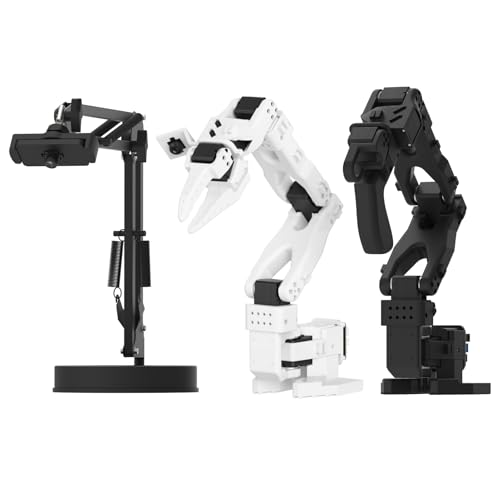
- LeRobot-compatible AI platform
- Dual-camera vision and teleoperation
- Indoor-use specification
Best For: Advanced indoor AI and imitation-learning development
Best Heavy-Lift Option
2.5kg 4-Axis Stepper Robot Arm

- Handles a stated 2.5kg payload
- Supports claw or suction cups
- Metal frame with powered base
Best For: Heavier-duty handling and assembly-line projects
Best STEM Hydraulics Kit

- Water-powered, battery-free operation
- Six axes and 270-degree rotation
- Build-it-yourself STEM project
Best For: Ages 12+ learning hydraulics and robotics
Research-Ready Pick

- 6-DOF arm with gripper and 2.5 kg rated payload
- ±0.1 mm repeatability with approximately 754 mm reach
- Open-source, ROS 2, simulation, and LeRobot workflows
Best For: Robotics research and advanced development
Beginner Learning Pick
Arduino 4-Axis Memorizing Robot Arm

- Step-by-step assembly and programming tutorials
- Records up to 170 joystick-controlled actions
- Compact acrylic kit with four servo-driven axes
Best For: Entry-level robotics education
Outdoor-Themed STEM Pick

- Tracked base with gripper, drill, and bucket attachments
- Remote control plus programmable app play
- 975-piece ABS STEM building set for ages 8–14
Best For: Supervised outdoor-style STEM play
Best All-Terrain Pick
VANLINNY 4-DOF Tracked Robot Arm

- Tank tracks handle grass, gravel, sand, and light snow
- Converts between a gripping arm and shovel loader
- Metal construction with rechargeable robot battery
Best For: Young STEM builders who want remote-controlled outdoor play
Best Programmable Desktop Option
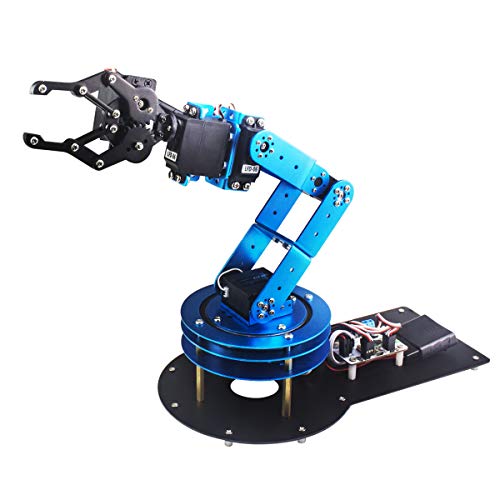
- Six degrees of freedom for complex arm movement
- PC, app, mouse, and wireless-handle controls
- Metal frame with tutorials and Arduino compatibility
Best For: Older learners building indoor robotics and programming projects
Best Open-Source Learning Kit

- Arduino-compatible Atmega328 open-source platform
- Supports Bluetooth, app, knob, and offline controls
- Expansion ports enable optional sensor projects
Best For: Advanced learners developing custom robotics and coding projects
Best Flexible-Claw Pick – 300g 6-DOF Metal Robot Arm
300g Load 6 Dof Robot Arm with Flexible Claw Industrial Manipulator Metal Alloy(Without Controller)
Check Price On AmazonFor shoppers comparing robot arms for outdoor use, this 6-DOF metal model emphasizes structural durability, movement flexibility, and base stability. It is supplied without a controller, so it is best suited to buyers who already have a compatible control solution or are comfortable configuring one.
Best For: Hands-on robotics projects that need a metal frame, powered base, and flexible claw.
Pros:
- Six-axis design supports varied movements and control.
- Metal-alloy construction is intended to provide a robust, long-lasting structure.
- Large dimensions and a powered base support stability and rigidity.
- Flexible claw can suit diverse manipulation tasks.
Cons:
- Controller is not included.
- The supplied notes do not identify outdoor weatherproofing or water resistance.
- Its 300g load rating may limit heavier-object handling.
This arm offers a solid foundation for experimental or light-duty automation, but outdoor buyers should plan for weather protection and separately verify controller compatibility before purchasing.
Best AI Learning Platform – HIWONDER SO-ARM101 Robotic Arm
Among robot arms for outdoor use, the HIWONDER SO-ARM101 stands out as an AI development platform rather than an outdoor-ready machine. Its LeRobot integration, dual-camera vision, and teleoperation features make it particularly capable for training and experimentation, while the supplied specifications list indoor usage.
Best For: Adult developers and advanced learners building imitation-learning or vision-action projects indoors.
Pros:
- Integrates with the LeRobot ecosystem, including community models, datasets, and simulations.
- Supports leader-follower teleoperation and HD trajectory-data capture.
- Dual cameras provide gripper-level and environmental visual information.
- High-torque magnetic-encoder servos are designed for smooth, stable motion.
Cons:
- Listed for indoor use, so it is not a direct outdoor-use recommendation.
- Its advanced AI features may be more than casual users need.
- Recommended for ages 15 and up.
This is the strongest choice here for AI-focused experimentation, but outdoor users should treat it as an indoor development platform unless they provide suitable environmental protection and confirm operating requirements.
Best Heavy-Lift Option – 2.5kg 4-Axis Stepper Robot Arm
For buyers evaluating robot arms for outdoor use with a focus on payload, this 4-axis stepper model offers a stated 2.5kg capacity. Its metal construction, powered base, and compatibility with either suction cups or a claw make it a practical candidate for heavier-duty automation, although the notes do not claim weatherproofing.
Best For: Assembly-line-style projects requiring more payload capacity and interchangeable gripping options.
Pros:
- 2.5kg payload is substantially suited to heavier handling tasks.
- Four-axis design provides multiple movement directions.
- Compatible with suction cups or a claw for different applications.
- Metal frame and powered base support rigidity and stability.
Cons:
- The supplied notes do not specify outdoor weather resistance.
- Four axes provide less movement flexibility than a six-axis arm.
- The notes do not clarify whether the gripping attachments are included.
Choose this model when payload matters more than maximum articulation. For outdoor deployment, add appropriate enclosure and environmental protection after confirming the motor and attachment requirements.
Best STEM Hydraulics Kit – Teach Tech Hydrobot Arm
The Teach Tech Hydrobot is a hands-on alternative for anyone exploring robot arms for outdoor use as an educational activity rather than an automated industrial tool. It uses water-powered hydraulics instead of batteries and offers six axes, rotating motion, and a controllable gripper, but it is a plastic building toy for ages 12 and up.
Best For: Young learners and families studying hydraulics, mechanics, construction, and robotics through assembly.
Pros:
- Water-powered hydraulic operation requires no batteries.
- Six axes and up to 270 degrees of rotation provide engaging movement.
- Gripper can open, close, or be replaced with suction components.
- Detailed assembly process supports problem-solving and STEM learning.
Cons:
- Plastic construction is less suited to industrial outdoor work.
- It must be assembled and is not a ready-to-run automated arm.
- Manual levers provide control rather than programmable automation.
This kit is a good learning project for sheltered outdoor demonstrations or indoor use, but it should not be confused with a weatherproof or industrial robot arm.
Research-Ready Pick – Seeed Studio reBot B601-RS
For serious robotics research, the Seeed Studio reBot B601-RS is one of the more capable robot arms for outdoor use, although its documentation emphasizes controlled development environments rather than weather exposure. This assembled 6-DOF arm combines a manufacturer-rated 2.5 kg payload, approximately 754 mm reach, and open software for experimentation.
Best For: Robotics researchers and developers building ROS 2, simulation, manipulation, or Physical AI workflows.
Pros:
- 6-DOF assembled arm with gripper and 2.5 kg rated payload.
- Manufacturer-specified ±0.1 mm repeatability and approximately 754 mm reach.
- Open-source hardware, Python code, ROS 2, Pinocchio, MuJoCo, and Isaac Sim support.
- Supports demonstration recording and policy evaluation through LeRobot workflows.
Cons:
- Power supply is not included.
- LeRobot demonstrations require a compatible leader arm, cameras, and computing hardware.
- Outdoor operation and weather resistance are not specified in the supplied information.
This is the strongest technical option in the group, but buyers should treat it as a development platform and independently provide environmental protection and validation for any outdoor deployment.
Beginner Learning Pick – Arduino 4-Axis Memorizing Robot Arm
This compact Arduino-oriented kit is a practical entry point for learning robotics, but it is not presented as a weatherproof machine. For shoppers comparing robot arms for outdoor use, its small acrylic construction and educational focus make it better suited to supervised indoor or sheltered experiments.
Best For: Beginners, teens, and adults learning assembly, electronics, programming, and basic robot-arm control.
Pros:
- Includes hardware and tools for step-by-step assembly.
- Four-axis design offers multiple movement ranges, including a 260° clip opening.
- Joystick control can record up to 170 actions and repeat them once.
- Assembly and programming tutorials are included.
Cons:
- Two batteries must be prepared separately.
- Small acrylic design and 0.56 kg weight are intended for learning rather than heavy-duty work.
- Outdoor durability or weather resistance is not specified.
Choose this kit for affordable hands-on education and repeatable motion exercises. It can help explain robotic-arm fundamentals, but it lacks the environmental specifications needed for dependable outdoor use.
Outdoor-Themed STEM Pick – 3-in-1 Tracked Robot Arm
The tracked base makes this 3-in-1 set the most naturally suited to outdoor-themed play among these robot arms for outdoor use. It is a programmable STEM building kit with a gripper, drill, and bucket, but its ABS construction and toy-oriented design should not be confused with outdoor-rated equipment.
Best For: Kids ages 8–14, families, and hobbyists who want a tracked robotics build with remote and app control.
Pros:
- Includes interchangeable gripper, drill, and bucket tool heads.
- Tracked undercarriage is designed for movement, climbing, and obstacle crossing.
- Supports app programming and included remote-control operation.
- Large 975-piece ABS construction set encourages hands-on STEM learning.
Cons:
- It is a plastic building toy rather than a precision industrial arm.
- Outdoor weather resistance is not specified.
- Requires one 9V battery, though the supplied notes indicate it is included.
This is the best choice here for mobile outdoor-style exploration and imaginative play. For real outdoor work, however, buyers should expect to provide supervision and avoid assuming protection from rain, dust, or other exposure.
Best All-Terrain Pick – VANLINNY 4-DOF Tracked Robot Arm
For shoppers comparing robot arms for outdoor use, the VANLINNY stands out because its rubber tank tracks are designed for grass, gravel, sand, and light snow. It also combines a 4-DOF gripping arm with a swappable shovel-loader head, giving younger builders two ways to play.
Best For: Children ages 8 and up who want an outdoor-capable STEM build with remote control and hands-on construction.
Pros:
- Tracked design grips grass, gravel, sand, and light snow.
- Metal chassis, alloy panels, and metal arm gears offer a sturdier build than typical hollow plastic kits.
- Claw and shovel attachments provide two play modes, with lifting capacity of about 3 pounds.
- Includes illustrated English instructions, hex tools, rechargeable robot battery, and remote control.
Cons:
- The remote requires four AA batteries, which are not included.
- The approximately two-hour build and small-payload design may not suit children seeking a ready-to-run or heavy-duty robot.
This is the most practical choice here for outdoor play. Its tracked mobility and dual attachments add versatility, while the metal construction supports repeated supervised use; just keep loads light to protect the gears.
Best Programmable Desktop Option – LeArm 6DOF Robotic Arm
The LeArm is a capable learning platform for programming and mechanical control, but it is primarily a tabletop model rather than one of the robot arms for outdoor use. Its metal structure, six degrees of freedom, and PC, app, mouse, and wireless-handle controls make it better suited to indoor projects.
Best For: Older students, university learners, engineers, and hobbyists developing robotics, programming, and creative automation skills indoors.
Pros:
- Six degrees of freedom support grasping, transport, and custom actions.
- Offers PC, app, mouse, and wireless-handle control options.
- Metal brackets, high-torque servos, and industrial-grade bearings provide a stable base.
- Includes tutorials, graphical programming software, and Arduino compatibility.
Cons:
- Its specified usage is indoor and tabletop, so it is not designed for outdoor conditions.
- Requires an AC power adapter rather than a rechargeable battery.
- The recommended age is for teens and adults, making it less suitable for young children.
Choose the LeArm when coding flexibility and precise desktop experimentation matter more than outdoor mobility. It delivers the richest control setup in this group, but its stationary, AC-powered design limits it to protected workspaces.
Best Open-Source Learning Kit – miniArm Arduino 5DOF Robot
The miniArm is aimed at users who want to program, modify, and expand a robot arm rather than simply operate one. Although it is not specified for outdoor use, its Arduino-based open-source platform and sensor-expansion ports make it a strong educational alternative for protected workspaces.
Best For: Adults and advanced students learning Arduino programming, electronics, sensor integration, and robotics engineering.
Pros:
- Atmega328 platform supports Arduino programming and open-source development.
- Includes app control, six-channel knob control, Bluetooth, and offline action editing.
- Expansion ports support optional cameras, touch, acceleration, and ultrasonic sensors.
- High-precision digital servos provide a capable base for secondary development.
Cons:
- The starter kit does not include the listed optional sensors or ESP32-Cam module.
- No outdoor rating or weather protection is specified.
- Its 17-and-up recommendation and programming focus may be too advanced for younger children.
The miniArm is the best fit for buyers prioritizing open-ended coding and hardware expansion. It is not an outdoor robot arm in the rugged, mobile sense, but it offers a clearer path to custom sensor projects than a simple remote-controlled kit.
How We Picked the Best Robot Arms for Outdoor Use
We compared these robot arms by looking at payload capacity, degrees of freedom, gripper flexibility, control methods, programming support, assembly requirements, and the type of user each kit serves. We also considered practical outdoor concerns such as portability, exposed electronics, battery or power requirements, and how easy the arm is to protect from dust and moisture.
Most of these products are not fully weatherproof industrial systems. They are better suited to sheltered patios, workshops, classrooms, garages, demonstrations, and controlled field experiments than to permanent outdoor installation.
Quick Comparison
| Best For | Look For | Typical Trade-Off |
|---|---|---|
| Outdoor STEM learning | Simple controls, safe construction, clear tutorials | Lower payload and limited environmental protection |
| Programming practice | Arduino, app, PC, or open-source compatibility | More setup and calibration |
| Light automation | Higher payload, rigid frame, repeatable movement | Requires a stable power source and mounting surface |
| Mobile demonstrations | Remote control, compact design, or tracked platform | Shorter runtime and less precise positioning |
Key Buying Factors for Robot Arms for Outdoor Use
Payload and Reach
Check the rated payload before choosing an arm for tools, sensors, or objects. Payload ratings often assume ideal positioning; the practical capacity drops when the arm is fully extended. Confirm reach and base dimensions as well, especially if the arm will operate from a small vehicle or workbench.
Outdoor Protection
Look for enclosed electronics, protected wiring, corrosion-resistant hardware, and an appropriate operating-temperature range. If the listing does not provide an IP rating, assume the arm needs a covered location. Keep controllers, batteries, and servos away from rain, standing water, mud, and direct spray.
Control and Programming
Arduino-compatible boards are useful for custom sensors and routines, while PC software and app control can shorten setup time. Open-source systems offer greater flexibility but may require coding, firmware installation, calibration, and troubleshooting.
Power, Stability, and Maintenance
Verify voltage, connector type, battery compatibility, and expected runtime. A weighted base or secure mounting plate helps prevent tipping. Outdoor dust can affect gears and joints, so choose a design with accessible components and plan for cleaning and periodic fastener checks.
Who Should Buy Which Robot Arms for Outdoor Use?
Choose a hydraulic or remote-controlled educational kit for younger learners and simple demonstrations. Beginners and teens will generally benefit from Arduino-based or app-controlled arms with tutorials and repeatable-motion features. Makers who want customization should prioritize open-source 5- or 6-axis platforms with replaceable grippers and accessible software.
For heavier objects or light automation, select the highest suitable payload and mount the arm securely in a sheltered workspace. If mobility is the priority, a tracked robot-arm combination is more engaging for demonstrations, though it will usually sacrifice some precision compared with a fixed-base arm.